Earth’s Space Environment.
Space and environment are two important and closely related fields that help us to understand both the universe and our planet. Earth’s space environment is the vast region that begins above our planet’s atmosphere and extends into outer space. Although space often appears empty and silent, it is actually a dynamic environment filled with invisible particles, magnetic fields, radiation, and energy emitted by the Sun and other celestial objects. These elements constantly interact with Earth, influencing everything from satellite communications and GPS navigation to weather forecasting and even the beautiful auroras seen near the polar regions. Environment is the surrounding physical, chemical, and biological conditions in which living and non-living systems exist and interact. You may think that Earth’s atmosphere marks the end of our planet’s influence, but that is only the beginning. Beyond the atmosphere lies a complex space environment where the Earth’s magnetic field, known as the magnetosphere, acts as a protective shield. This magnetic shield deflects many of the harmful charged particles carried by the solar wind, helping to preserve life on Earth. Without this natural defense, intense solar radiation could damage living organisms, disrupt technology, and gradually strip away our atmosphere over millions of years.
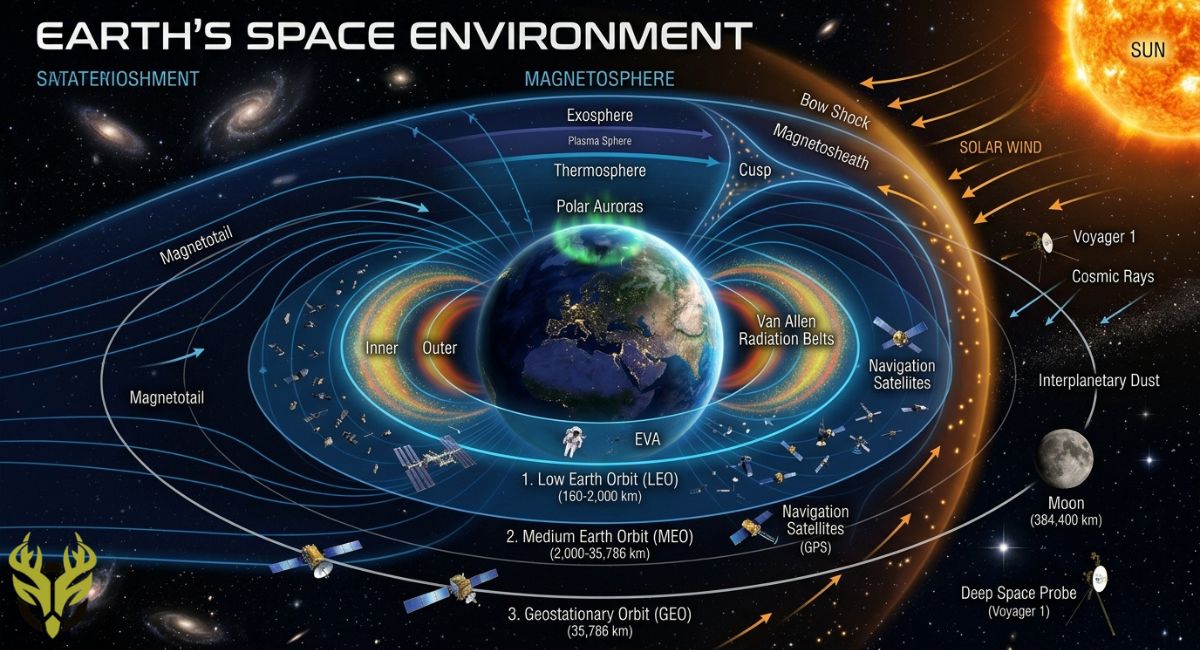
The Sun plays the most significant role in shaping Earth’s space environment. Every second, it releases a continuous stream of charged particles called the solar wind. Under normal conditions, Earth’s magnetic field redirects much of this solar wind around the planet. However, during powerful solar events such as solar flares and coronal mass ejections (CMEs), enormous amounts of energy and particles reach Earth’s magnetic field, creating disturbances known as space weather. These events can interfere with satellites, radio communication, power grids, and navigation systems while also producing spectacular auroras in high-latitude regions. Erath’s space environment is not limited to solar activity alone. It also includes cosmic rays arriving from distant stars and galaxies, Earth’s radiation belts, plasma, dust particles, and the gravitational influence of the Moon and nearby planets. Together, these components form an ever-changing environment that scientists continuously monitor to better understand how space affects both our planet and modern technology.
Studying Earth’s space environment has become increasingly important as humanity depends more on space-based systems. Communication satellites, weather satellites, GPS networks, and space missions all operate within this environment and must withstand its changing conditions. Engineers design spacecraft to survive radiation, extreme temperatures, and high-speed particles, while scientists use advanced satellites and observatories to monitor solar activity and predict space weather before it impacts Earth. Under standing Earth’s space environment also helps us prepare for future exploration beyond our planet. As astronauts travel farther into the Solar System and new missions target the Moon and Mars, knowledge of radiation, magnetic fields, and solar activity becomes essential for ensuring both human safety and mission success.
In simple terms, Earth’s space environment is the invisible region surrounding our planet where the Sun, Earth’s magnetic field, radiation, plasma, and other space phenomena continuously interact. It connects our planet to the rest of the Solar System and plays a vital role in protecting life, supporting modern technology, and expanding our understanding of the universe. Appreciating this remarkable environment allows us to recognize that Earth is not isolated in space but is part of a constantly changing cosmic system.
Outer Space,
Outer space is the huge stretch of area that starts once you leave Earth’s atmosphere, home to planets, stars, galaxies, moons, comets, and asteroids. Most people picture it as empty and silent, but that’s not really true. Space is actually busy in its own quiet way, full of radiation, magnetic fields, dust, gas, and fast-moving particles. There just isn’t much of any of it packed into each cubic mile, which is why it still feels like a void even though real activity is happening constantly. You actually feel the effects of outer space every single day, even without noticing. Sunlight warming your skin, the Moon pulling ocean tides back and forth, GPS guiding you to a restaurant, all of it depends on outer space working exactly the way it does. Space isn’t some distant, irrelevant place anymore. It’s quietly woven into a huge chunk of modern daily life.Space is nothing like Earth in one obvious way: there’s no air to breathe and almost no air pressure at all. Because there’s no atmosphere up there to scatter light around, astronauts see a pitch-black sky even in broad daylight, sunlight or not. Sound can’t travel either, since sound needs particles bumping into each other to move, and space simply doesn’t have enough of them. That’s exactly why space gets called silent. Temperature swings wildly too, depending entirely on whether something’s sitting in direct sunlight or hiding in shadow.

Space officially begins about 100 kilometers, or 62 miles, above Earth’s surface, a line scientists call the Kármán Line. Past that point, you’re looking at Earth’s orbit, then the rest of the Solar System, then the Milky Way, and eventually billions upon billions of other galaxies. Scientists actually break space down into zones, near-Earth space, interplanetary space, interstellar space, and intergalactic space, since each region behaves pretty differently from the next.The word “vacuum” gets used a lot to describe space, and it’s mostly accurate, gas particles really are spread incredibly thin out there. But empty isn’t quite right either. Space carries sunlight and starlight, streams of charged particles called solar wind, cosmic rays zipping along at nearly light speed, tiny dust particles, and drifting clouds of gas that eventually clump together into brand-new stars and planets.Space is also where all the truly massive stuff lives. Our Solar System alone holds the Sun, eight planets, a handful of dwarf planets, moons, asteroids, and comets. Zoom out further and you hit the Milky Way, home to hundreds of billions of stars. Zoom out even further, and there are billions of other galaxies out there too, each one packed with its own stars and planets. It’s genuinely hard to wrap your head around distances that large.
Humanity’s exploration of space has completely reshaped how we understand the universe. Ever since the first satellite launched back in 1957, thousands more have followed it into orbit. Spacecraft have landed on the Moon, rolled across Mars, and even flown past the edge of our own Solar System entirely. Telescopes parked in space have let scientists spot distant galaxies, discover entirely new planets circling other stars, and dig into how the universe itself actually began.None of this comes easy, though. Astronauts and their equipment have to survive brutal temperature swings, heavy radiation, fast-flying space debris, and the strange effects of near-zero gravity. Engineers spend enormous effort building technology specifically to protect both people and hardware from all of it, just to keep space missions safe and successful.
When Did Space Exploration Start?
Although humans have observed the night sky for thousands of years, modern space exploration officially began on October 4, 1957. On this day, the former Soviet Union launched Sputnik 1, the world’s first artificial satellite, into Earth’s orbit. This historic event marked the beginning of the Space Age. Sputnik 1 was a small metal sphere that orbited Earth and transmitted simple radio signals. Even though it was simple by today’s standards, it proved that humans could successfully send objects into space. This achievement inspired many countries to invest in space science and technology.

Soon after Sputnik’s success, the United States and the Soviet Union began competing to achieve new milestones in what became known as the Space Race.
The Early Years of Space Exploration
Following the launch of Sputnik 1, space exploration advanced rapidly.
In 1958, the United States launched its first satellite, Explorer 1, which discovered the Van Allen radiation belts surrounding Earth. Scientists realized that space was far more complex than previously imagined. In 1961, Soviet cosmonaut Yuri Gagarin became the first human to travel into space aboard Vostok 1. His mission lasted about 108 minutes and proved that humans could survive spaceflight. Only a few years later, in 1969, astronauts Neil Armstrong and Buzz Aldrin landed on the Moon during Apollo 11, while Michael Collins remained in lunar orbit. Armstrong became the first person to walk on the Moon, demonstrating that humans could travel to another celestial body and return safely.
These achievements transformed space exploration from a dream into reality.
What Happened After the Moon Landing?
The Moon landing was not the end of space exploration—it was only the beginning.
Scientists shifted their focus toward long-term exploration and scientific research. New spacecraft were designed to visit every planet in our Solar System. Robotic missions explored Mars, Venus, Jupiter, Saturn, Uranus, and Neptune, sending back thousands of photographs and valuable scientific data. In 1977, NASA launched the Voyager 1 and Voyager 2 spacecraft. These probes visited the outer planets before continuing toward interstellar space. Today, Voyager 1 is the most distant human-made object from Earth. The development of reusable spacecraft also changed space exploration. The Space Shuttle program, which operated from 1981 to 2011, enabled astronauts to deploy satellites, conduct scientific experiments, and help build the International Space Station (ISS).
The ISS became a permanent laboratory in orbit where astronauts from many countries work together, studying medicine, biology, physics, and the effects of living in microgravity.
What Is Happening in Space Exploration Today?
Today, space exploration is entering an exciting new era. Governments and private companies are working together to explore deeper into space than ever before.
Modern missions include:
- Sending advanced robotic rovers to Mars.
- Returning astronauts to the Moon through the Artemis program.
- Searching for water and signs of ancient life on Mars.
- Studying distant galaxies with powerful space telescopes.
- Launching reusable rockets that reduce the cost of space travel.
- Developing spacecraft for future missions to Mars.
Private companies have also become major contributors by building rockets, satellites, and spacecraft that support scientific research and commercial spaceflight.
What Will Happen in the Future?
The future of space exploration promises discoveries that once seemed impossible.
Scientists hope to establish permanent human bases on the Moon, where astronauts can live and work for extended periods. These lunar bases could serve as stepping stones for missions to Mars. Within the coming decades, humans may set foot on Mars for the first time. Such missions will require advanced spacecraft, new life-support systems, and protection against space radiation. Researchers are also developing technologies for asteroid mining, which could provide valuable metals and resources for future space industries. Powerful telescopes will continue searching for Earth-like planets around distant stars. If scientists discover signs of life beyond Earth, it would become one of the greatest discoveries in human history. Artificial intelligence, robotics, and autonomous spacecraft will make future missions safer, faster, and more efficient. Space tourism is also expected to become more common as technology advances and costs decrease.
Timeline of Major Space Exploration Milestones
| Year | Event | Importance |
| 1957 | Sputnik 1 launched | Beginning of the Space Age |
| 1958 | Explorer 1 launched | Discovery of the Van Allen radiation belts |
| 1961 | Yuri Gagarin becomes the first human in space | Proved humans can survive spaceflight |
| 1969 | Apollo 11 Moon landing | First humans walked on the Moon |
| 1977 | Voyager missions launched | Explored the outer planets |
| 1981 | First Space Shuttle flight | Reusable spacecraft era begins |
| 1998 | International Space Station construction begins | Continuous human presence in space |
| 2020s | New Moon and Mars missions | Preparing for deep-space exploration |
Why Space Exploration Matters
Space exploration has improved life on Earth in many ways. Satellites help us communicate, navigate with GPS, predict weather, monitor climate change, and respond to natural disasters. Research conducted in space has also led to advances in medicine, engineering, computer technology, and materials science.More importantly, space exploration satisfies humanity’s natural curiosity. It helps us understand our place in the universe and inspires future generations to pursue science, technology, engineering, and mathematics.
What Happened After the Moon Landing?
The Moon landing was not the end of space exploration—it was only the beginning.
Scientists shifted their focus toward long-term exploration and scientific research. New spacecraft were designed to visit every planet in our Solar System. Robotic missions explored Mars, Venus, Jupiter, Saturn, Uranus, and Neptune, sending back thousands of photographs and valuable scientific data.In 1977, NASA launched the Voyager 1 and Voyager 2 spacecraft. These probes visited the outer planets before continuing toward interstellar space. Today, Voyager 1 is the most distant human-made object from Earth.
Luminosity of a Star.
The night sky is filled with stars that appear brighter or dimmer than one another. At first glance, it is easy to assume that the brightest star must also be the most powerful. However, this is not always true. Some stars only look bright because they are much closer to Earth, while others are incredibly powerful but appear faint because they are millions of light-years away. To truly understand how much energy a star produces, astronomers use a quantity called luminosity.
In simple words, luminosity is the total amount of energy a star emits every second in all directions. It is an intrinsic property of a star, meaning it does not depend on how far the star is from Earth. Whether you observe a star from nearby or from another galaxy, its luminosity remains the same because it measures the star’s actual energy output.
Imagine two light bulbs. One is a 40-watt bulb and the other is a 100-watt bulb. If you stand very close to the 40-watt bulb, it may appear brighter than the 100-watt bulb that is far away. However, the 100-watt bulb is actually producing more light. Stars behave in the same way. Their brightness depends on distance, but their luminosity tells us how much energy they truly generate.
Definition of Luminosity
Luminosity is the total amount of electromagnetic energy emitted by a star per unit time.
It is usually represented by the symbol:
- {L}
The SI unit of luminosity is the watt (W).
Since stars produce enormous amounts of energy, astronomers often compare their luminosity with that of the Sun.
The luminosity of the Sun is
L⊙=3.828×10^26 W
where
- L = Solar luminosity
- L=3.828× 10^26 watts is the total energy emitted by the Sun every second.
Formula for Luminosity
One of the most important equations in astronomy is based on the Stefan–Boltzmann Law.
- L=4πR2σT4
- The total output power of a star is directly proportional to the product of its surface area and the fourth power of its temperature.
Where
|
Meaning | SI Unit |
|
Luminosity of the star | Watt (W) |
|
Radius of the star | meter (m) |
|
Stefan–Boltzmann Constant | 5.67×10^−8 Wm^−2K^−4 |
|
Surface temperature of the star | Kelvin (K) |
Understanding the Formula.
This equation tells us that a star’s luminosity depends mainly on two factors:
- The size (radius) of the star
- The surface temperature of the star
A larger star has more surface area to emit energy. A hotter star radiates much more energy from every square meter of its surface.
Notice that temperature is raised to the fourth power ((T^4)). This means that even a small increase in temperature causes a very large increase in luminosity.
For example:
- Double the radius → Luminosity becomes 4 times larger.
- Double the temperature → Luminosity becomes 16 times larger.
This is why some hot blue stars shine thousands or even millions of times more brightly than the Sun.
Relationship Between Luminosity and Brightness.
- People often confuse luminosity with brightness, but they are different.
- Luminosity is the star’s actual energy output.
- Brightness is how bright the star appears from Earth.
- Brightness changes with distance, while luminosity remains constant.
Inverse Square Law
Astronomers calculate the brightness received on Earth using
F=L4πd2
| Symbol | Meaning |
| (F) | Apparent brightness (energy received per unit area) |
| (L) | Luminosity |
| (d) | Distance from Earth |
| (π) | 3.1416 |
This equation shows that as the distance increases, brightness decreases according to the inverse square law.
For example, if the distance from a star becomes twice as large, the observed brightness becomes
Only one-quarter as bright.
Factors Affecting Luminosity
-
Surface Temperature
Temperature has the greatest effect on luminosity.
Blue stars are much hotter than red stars, so they emit far more energy.
Typical temperatures are:
| Star Color | Temperature |
| Red | 2,500–3,500 K |
| Orange | 3,500–5,000 K |
| Yellow (Sun) | 5,778 K |
| White | 7,500–10,000 K |
| Blue | Above 10,000 K |
Hotter stars generally have much higher luminosities.
-
Radius
A giant star has a much larger surface area than a dwarf star.
Even if two stars have the same temperature, the larger star emits more total energy.
-
Stellar Composition
The amount of hydrogen, helium, and heavier elements inside a star influences nuclear fusion and therefore affects its luminosity over time.
-
Stage of Stellar Evolution
A star’s luminosity changes as it ages.
During its lifetime, a star passes through different stages:
- Protostars
- Main Sequence
- Red Giant
- White Dwarf (or other final stages depending on its mass)
Each stage has a different luminosity.
Example Calculation
Suppose a star has
- Radius (R = 7108m)
- Temperature (T = 6000;K)
Using
L=4πR2σT4
R2=(7108)2=4.9×10¹⁷
T4=60004=1.296×10¹⁵
Substituting these values into the equation gives the star’s total energy output in watts. Astronomers often use computers for these calculations because the numbers are extremely large.
Radiant Intensity
Radiant intensity is the amount of radiant flux (power) emitted by a source per unit solid angle in a particular direction.
It is represented by the symbol
le
here:
- le = Radiant intensity
The SI unit of radiant intensity is.
- Watt per steradian (W/sr)
Formula for Radiant Intensity.
Radiant intensity is calculated using the formula
le=e
| Symbol | Meaning | SI Unit |
| le | Radiant intensity | W/sr |
| Φe | Radiant flux (total radiant power) | W |
| Ω | Solid angle | Steradian (sr) |
What Is Radiant Flux?
Radiant flux is the total amount of electromagnetic energy emitted every second by a source.
It is represented by
Φe
Its SI unit is the watt (W).
For example, if a lamp emits 100 watts of radiant power, then
Φe=100 W
What Is a Solid Angle?
A solid angle is the three-dimensional version of an ordinary angle.
Instead of measuring an opening in a flat plane (degrees or radians), a solid angle measures how much of space is covered by a beam of light.
The SI unit is
Steradian (sr)
A complete sphere contains
4π sr
which is approximately
4π≈12.57 sr
Radiant Intensity of a Star.
Stars emit electromagnetic radiation in all directions. If a star radiates equally in every direction (an isotropic emitter), the total solid angle is
4π sr
The radiant intensity of such a star is
le=L4π
where
- L = Luminosity of the star (W)
This equation shows that the star’s total energy is distributed uniformly over the entire sphere surrounding it.
Difference Between Luminosity and Radiant Intensity
Although these terms are related, they describe different physical quantities.
| Property | Luminosity | Radiant Intensity |
| Meaning | Total energy emitted every second | Energy emitted in a particular direction |
| Symbol | L | le |
| SI Unit | Watt (W) | Watt per steradian (W/sr) |
| Depends on Direction | No | Yes |
| Used For | Total power of stars | Directional distribution of radiation |
Applications of Radiant Intensity
Radiant intensity is widely used in many scientific and engineering fields:
- Designing LED lamps and laser systems.
- Measuring the directional output of flashlights and spotlights.
- Studying the radiation emitted by stars and galaxies.
- Designing optical communication systems.
- Evaluating satellite sensors and telescopes.
- Developing medical imaging and laser treatment equipment
STANDARD CANDLES.
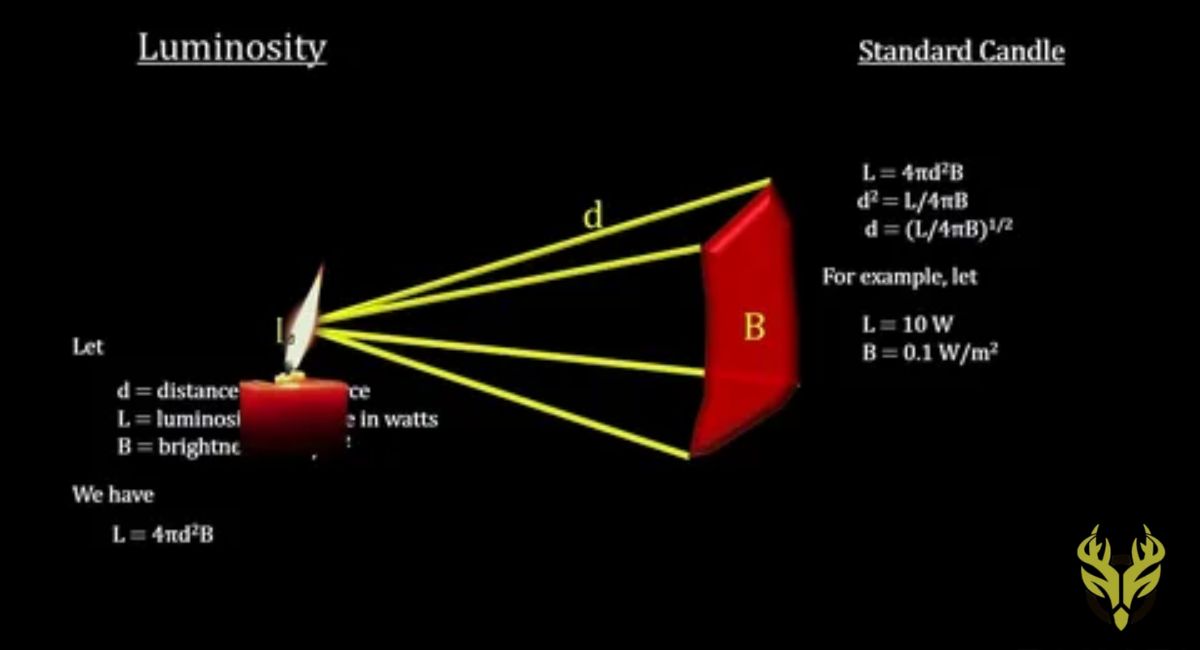
The standard candles are astronomical objects with known intrinsic brightness that serve as vital tools for measuring cosmic distances.
How Do Standard Candles Work?
The process is based on comparing two quantities:
- Absolute Luminosity (L): The actual energy emitted by the object.
- Apparent Brightness (F): The energy received on Earth.
As light travels through space, it spreads over a larger area. Therefore, distant objects always appear dimmer than nearby objects, even if they emit the same amount of energy.
The relationship is given by
F=L4d2
Where
| Symbol | Meaning | SI Unit |
| F | Apparent brightness (flux) | W/m² |
| L | Luminosity | W |
| d | Distance to the object | m |
| π | Mathematical constant (≈3.1416) | — |
Distance Formula.
Rearranging the equation gives the distance:
F=L/4pid2
This formula allows astronomers to determine the distance of a standard candle when its luminosity and apparent brightness are known.
Types of Standard Candles
-
Cepheid Variable Stars
Cepheid variables are pulsating stars whose brightness changes regularly over time. Astronomers discovered that the longer the pulsation period, the greater the star’s luminosity. This relationship allows scientists to determine the star’s true luminosity and calculate its distance. Cepheid variables are excellent standard candles for measuring distances within the Milky Way and to nearby galaxies.
-
Type Ia Supernovae
A Type Ia supernova occurs when a white dwarf star accumulates enough matter from a companion star to trigger a powerful thermonuclear explosion. These explosions reach nearly the same peak luminosity, making them among the best standard candles for measuring very large distances. Because they are extremely bright, Type Ia supernovae can be observed in galaxies billions of light-years away. They have played a crucial role in discovering that the universe is expanding at an accelerating rate.
-
RR Lyre Stars
RR Lyre stars are older pulsating stars with nearly constant luminosities. Although they are less luminous than Cepheid variables, they are valuable for measuring distances within the Milky Way and nearby star clusters.
Advantages of Standard Candles.
Standard candles provide one of the most reliable methods for measuring distances in the universe. They help astronomers determine the size of galaxies, map the structure of the cosmos, study stellar evolution, and measure the expansion of the universe. They also improve our understanding of dark energy and the large-scale structure of the universe.
Applications of Standard Candles
Standard candles are used in many areas of astronomy and cosmology:
- Measuring distances to stars and galaxies.
- Determining the size of the Milky Way.
- Mapping the large-scale structure of the universe.
- Studying galaxy formation and evolution.
- Measuring the expansion rate of the universe.
- Investigating dark energy and cosmology.
Blackbody Radiation.
When an object is heated, it starts to glow and releases energy in the form of radiation. This radiation depends only on the temperature of the object, not on its material or shape. As the temperature increases, the colour of the object changes from dull red to bright yellow and then to white, indicating that the radiation is shifting from longer wavelengths (infrared) to shorter ones (ultraviolet). However, real objects do not absorb or emit all the radiation completely, which makes it difficult to study their behaviour accurately. To understand this better, scientists consider an ideal object, called a blackbody
What Is Blackbody Radiation?
Blackbody radiation is the electromagnetic radiation emitted by an ideal object called a blackbody, which absorbs all incoming radiation and re-emits energy depending only on its temperature.
A blackbody is an ideal object that:
- Absorbs 100% of the radiation falling on it.
- Reflects no light.
- Transmits no radiation.
- Emits the maximum possible radiation at any given temperature.
Electromagnetic Spectrum of Blackbody Radiation
A blackbody emits radiation across the entire electromagnetic spectrum, including:
- Radio waves
- Microwaves
- Infrared radiation
- Visible light
- Ultraviolet radiation
- X-rays (at extremely high temperatures)
Experiment.
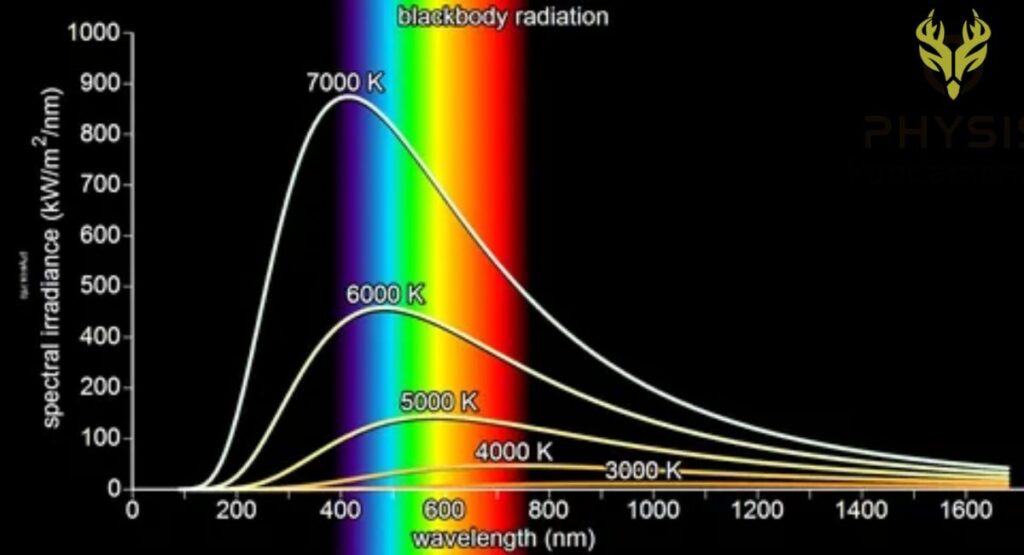
In real life, a good example of a blackbody is a hollow cavity with a small hole and blackened inner walls . The inner walls of the cavity are coated with black carbon soot to help them absorb radiation effectively and reflect it internally. When radiation enters through the small hole, it bounces around inside and gets trapped. If the cavity is heated to a high enough temperature, it starts to emit radiation of all wavelengths. This is known as blackbody radiation. The pattern of this radiation depends only on the temperature of the blackbody. As the temperature increases, the energy it gives off also increases. When we plot the intensity of this radiation against its wavelength , we find that the peak of the curve shifts to shorter wavelengths with rising temperature. This means hotter blackbodies emit more energy at shorter wavelengths.
Effect of Temperature
As temperature increases: The amount of emitted radiation increases. The wavelength of maximum intensity becomes shorter. The color of a heated object changes.
Example (Heated Platinum Wire)
- 500°C: Dull red
- 900°C: Cherry red
- 1100°C: Orange
- 1300°C: Yellow
- 1600°C: White
Energy Distribution Curves
Lummer and Pringsheim studied how the intensity of radiation changes with wavelength at different temperatures.
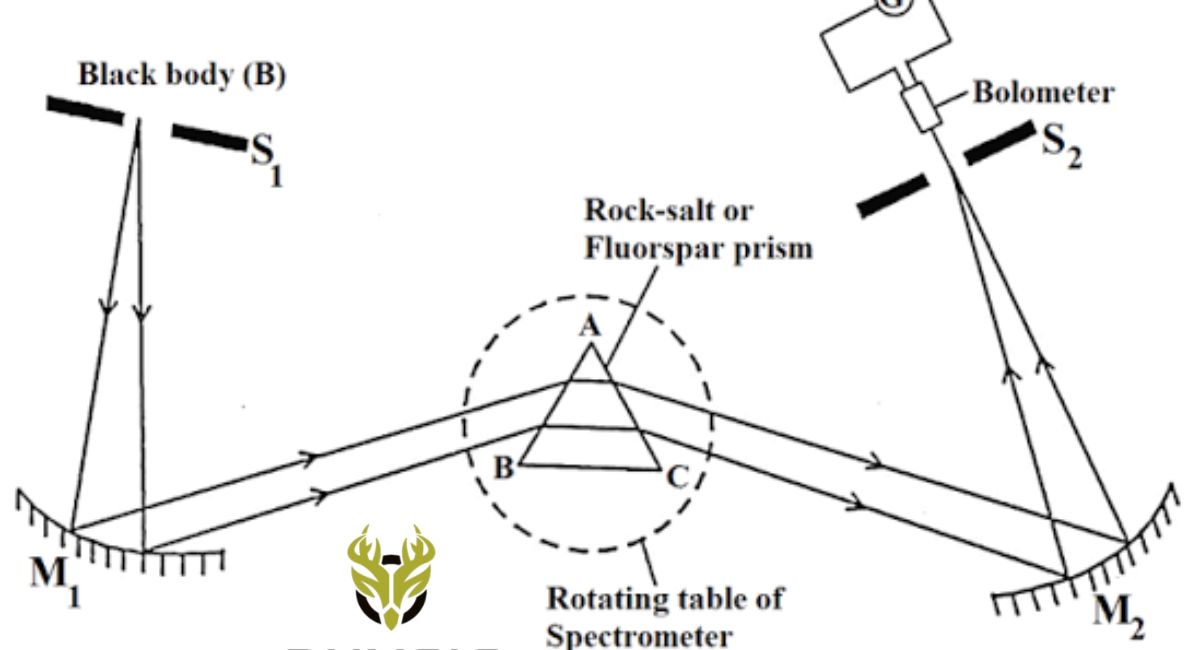
Results
- Energy is Not Uniformly Distributed
At a fixed temperature, energy is not equally distributed over all wavelengths. Some wavelengths carry more energy than others.
-
Radiation Intensity Changes with Wavelength
The energy distribution curves also show that the intensity of radiation changes continuously with wavelength.
At any fixed temperature:
- The radiation intensity is very small at short wavelengths.
- It gradually increases as the wavelength increases.
- It reaches its maximum value at the peak wavelength
- Beyond this point, the intensity decreases as the wavelength continues to increase.
This creates the characteristic bell-shaped curve of blackbody radiation.
As the temperature increases, two important changes occur:
- The peak of the curve becomes higher, meaning more energy is emitted.
- The peak shifts toward shorter wavelengths.
These changes explain why hotter objects appear brighter and emit bluer light.
Stefan–Boltzmann Law.
The total energy emitted by a blackbody per unit surface area is given by the Stefan–Boltzmann Law.
- E=AT^4
Where
| Symbol | Meaning | SI Unit |
| P | Total radiant power emitted | Watt (W) |
| σ | Stefan–Boltzmann constant | 5.67×10⁴Wm-2T-4 |
| A | Surface area | m² |
| T | Absolute temperature | Kelvin (K) |
If the power emitted per unit area is required, the equation becomes
E=σT^4
where E is the radiant energy emitted per unit area
Wien’s Displacement Law.
The color of a hot object changes because the wavelength of maximum emission depends on temperature.
Wien’s Displacement Law.
λmaxT=constant
| Symbol | Meaning |
| λmax | Peak wavelength (m) |
| T | Temperature (K) |
| constant | Wien’s constant = 2.898×10⁻³ m |
As temperature increases,
- Peak wavelength becomes shorter.
- The object’s color changes from red to orange, yellow, white, and eventually blue.
This explains why blue stars are hotter than red stars.
Area Under the Energy Distribution Curve.
The area under each energy distribution curve represents the total energy emitted per second per unit surface area by the blackbody at that temperature.
A larger area under the curve means the object is emitting more total energy.
As the temperature increases, the area under the curve also increases rapidly. Therefore, hotter objects radiate much more energy than cooler ones.
Planck’s Radiation Law.
The complete description of blackbody radiation is given by Planck’s Radiation Law.
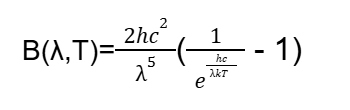
| Symbol | Meaning |
|
Spectral radiance |
|
Planck’s constant |
|
Speed of light |
|
Wavelength |
|
Boltzmann constant |
|
Temperare |
Planck introduced this equation in 1900, marking the birth of quantum physics.
Stars as Blackbody Radiators.
Stars such as the Sun behave like a blackbody radiator. They generate and emit their own energy due to nuclear fusion and this energy spreads into space in the form of electromagnetic radiation. The radiation emitted by a star covers a wide range of wavelengths and forms a continuous spectrum without any gaps. This spectrum is similar to a blackbody spectrum. By studying the spectrum, scientists can estimate the surface temperature of the star accurately. As each star has its own spectrum, its surface temperature is also different.
E = mC2
This energy slowly travels from the core to the star’s surface before escaping into space as electromagnetic radiation. The emitted radiation includes radio waves, infrared radiation, visible light, ultraviolet rays, X-rays, and, in some cases, gamma rays. Because stars emit energy across a broad range of wavelengths, they produce a continuous spectrum, which is one of the defining characteristics of blackbody radiation.Unlike emission spectra that contain only a few bright lines or absorption spectra with dark gaps, a star’s blackbody spectrum is smooth and continuous. Every wavelength carries information about the star’s physical properties. By carefully studying this spectrum with powerful telescopes and spectrometers, astronomers can learn a remarkable amount about a star without ever visiting it.
For example, the Sun has a surface temperature of approximately 5,778 K, causing it to emit most of its energy in the visible part of the electromagnetic spectrum. In contrast, a cool red dwarf with a temperature of around 3,000 K emits more infrared radiation and appears reddish, while a massive blue giant with a surface temperature above 20,000 K radiates intensely in the ultraviolet region and appears blue.
Planck’s Assumptions.
At the end of the 19th century, scientists faced a serious problem. Classical physics could not explain how a blackbody emits radiation at different wavelengths. According to classical theories, the energy emitted at shorter wavelengths should increase without limit, leading to a prediction known as the ultraviolet catastrophe. However, experiments showed that the emitted energy reaches a maximum value and then decreases. This contradiction indicated that the existing theories were incomplete.
In 1900, the German physicist Max Planck proposed a revolutionary idea that successfully explained blackbody radiation. His theory marked the beginning of quantum physics and completely changed our understanding of how matter and radiation interact.
statement.
Planck’s assumption states that energy is not emitted or absorbed continuously. Instead, atoms emit or absorb energy in small, discrete packets called quanta (singular: quantum)
- Matter can emit or absorb energy only in fixed amounts called quanta, not in a continuous flow.
Planck’s Quantum Theory.
-
Energy Is Quantized
The atoms or molecules of a blackbody cannot emit or absorb energy continuously. They exchange energy only in the form of small packets called quanta.
-
Each Quantum Has a Fixed Amount of Energy
The energy of each quantum depends on the frequency of the radiation.
The relationship is given by
E=hf
-
Higher Frequency Means Higher Energy
Since
E=hf
radiation with a higher frequency carries more energy than radiation with a lower frequency.
For example:
- Radio waves have low frequency and therefore low-energy photons.
- Visible light has moderate frequency and moderate-energy photons.
- Gamma rays have extremely high frequency and therefore extremely energetic photons.
-
Emission and Absorption Occur in Whole Quanta
Atoms cannot emit or absorb half or a fraction of a quantum. They exchange energy only in whole-number multiples of hf.
Therefore,
E=nhf
where
- n=1,2,3,…
This means an atom can emit one quantum, two quanta, three quanta, and so on, but never a fraction of a quantum.
Planck’s Constant.
The proportionality constant introduced by Planck is known as Planck’s constant.
Its value is
h=6.626×10⁻³⁴ J\c
It is one of the most important constants in physics because it connects the energy of radiation with its frequency.
What Is the Radius of a Star?
The radius of a star is the distance from the center of the star to its surface.
It is represented by the symbol:
R
The SI unit of radius is the meter (m),
but because stars are extremely large, astronomers usually express their radii in terms of the Sun’s radius.
The radius of the Sun is
R⊙=6.96×10⁸m or approximately 696,000 km
Astronomers often compare other stars with the Sun by writing, for example:
- R⊙ = Same size as the Sun.
- 10R⊙ = Ten times the Sun’s radius.
- 1000 R⊙ = One thousand times the Sun’s radius.
How Is the Radius of a Star Determined?
Since stars are extremely far from Earth, it is impossible to measure their radius directly with a ruler. Instead, astronomers calculate the radius using observations of the star’s luminosity and surface temperature.
The relationship is given by the Stefan–Boltzmann Law.
- L=4πR2σT^4
Formula for the Radius of a Star.
Rearranging the Stefan–Boltzmann equation gives the radius:
R=L4T4
This formula shows that:
- A star with greater luminosity generally has a larger radius.
- A hotter star can produce the same luminosity even if it is smaller.
- Both temperature and luminosity determine the size of a star.
Factors That Affect the Radius of a Star.
Several factors influence the size of a star throughout its lifetime.
-
Stellar Mass
More massive stars generally have larger radii than less massive stars during the main-sequence stage.
-
Surface Temperature
Temperature affects how much energy is emitted from each square meter of the star’s surface. Hotter stars radiate more energy, which influences the relationship between luminosity and radius.
-
Stage of Stellar Evolution
A star’s radius changes dramatically as it ages.
- Protostar: Radius decreases as the star contracts.
- Main Sequence: Radius remains relatively stable.
- Red Giant: Radius expands hundreds of times.
- White Dwarf: Radius shrinks to about the size of Earth.
-
Internal Pressure
The balance between gravity pulling inward and gas pressure pushing outward determines the star’s size. If gravity becomes stronger, the star contracts. If internal pressure dominates, the star expands.
EMISSION AND ABSORPTION SPECTRA FROM DIFFERENT STARS
Stars emit a continuous spectrum of light because of their extremely hot, dense surfaces that behave like near-perfect blackbodies. As this light passes through the cooler outer atmosphere of a star, atoms in the gaseous layers absorb specific wavelengths corresponding to electronic transitions between energy levels. This creates dark lines in the continuous spectrum where specific colours of light have been absorbed. It is known as the absorption spectrum. Although the absorbed energy is re-emitted at the same wavelengths, the emitted photons are scattered in various directions making them unlikely to reach observers on the Earth. Therefore, we detect a characteristic absorption spectrum with distinct missing wavelengths. In emission and absorption spectra from distant stars and galaxies, the lines in the spectra show an increase in wavelength from their known laboratory values . This phenomenon is called redshift which occurs due to stretching of photons when they travel through the universe.
What Is a Spectrum?
A spectrum is the distribution of light according to its wavelength or frequency.
When white light passes through a prism or diffraction grating, it splits into its component colors, ranging from violet to red. This spread of colors is called a spectrum.
There are three main types of spectra:
- Continuous spectrum
- Emission spectrum
- Absorption spectrum
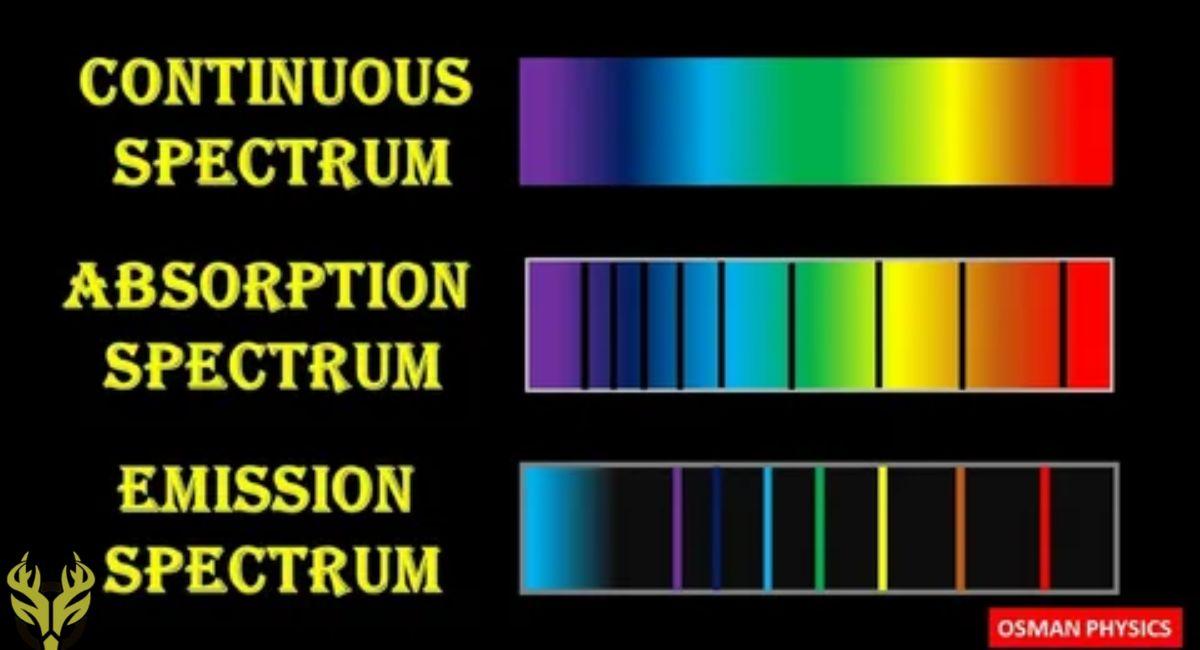
Stars mainly show continuous spectra with absorption lines, while certain stars and nebulae also produce emission spectra.
Continuous Spectrum
A continuous spectrum is produced by hot, dense objects such as the surface of the Sun or other stars.
It contains all visible wavelengths without any gaps.
The continuous spectrum follows the laws of blackbody radiation, and its shape depends mainly on the star’s surface temperature.
Absorption Spectrum.
An absorption spectrum is formed when continuous light from a hot source passes through a cooler gas. The atoms in the cooler gas absorb light at specific wavelengths, producing dark lines in the spectrum.
How Is an Absorption Spectrum Formed?
The interior of a star is extremely hot and emits a continuous spectrum. As this light travels through the cooler outer atmosphere, atoms absorb photons whose energies exactly match the differences between their electron energy levels. Electrons absorb this energy and jump to higher energy levels.As a result, those particular wavelengths disappear from the spectrum, leaving dark absorption lines.
The energy absorbed by an atom is given by
E=hf
Characteristics of Absorption Spectra
- Dark lines appear on a continuous background.
- Each element absorbs light at unique wavelengths.
- The pattern of lines acts as the element’s fingerprint.
- Most ordinary stars, including the Sun, show absorption spectra.
Example: The Sun.
The Sun produces a continuous spectrum from its hot photosphere. However, gases such as hydrogen, helium, sodium, calcium, and iron in the cooler outer layers absorb specific wavelengths. These dark lines are called Fraunhofer lines.
By studying these lines, astronomers discovered the chemical composition of the Sun.
Emission Spectrum.
An emission spectrum is produced when hot, low-density gases emit light at specific wavelengths.
Instead of dark lines, bright colored lines appear against a dark background.
Characteristics of Emission Spectra.
- Bright lines appear on a dark background.
- Each chemical element has its own unique emission pattern.
- Produced by hot, low-density gases.
- Common in nebulae and certain types of stars.
Emission and Absorption Spectra in Different Stars.
Different stars have different temperatures and chemical compositions. As a result, their spectra are not identical.
O-Type Stars (Blue Stars).
These are the hottest stars, with surface temperatures above 30,000 K.
Their spectra contain strong lines of ionized helium and weak hydrogen lines because the high temperature ionizes many hydrogen atoms.
B-Type Stars.
These stars have temperatures between 10,000 K and 30,000 K.
They show strong neutral helium lines and stronger hydrogen absorption lines than O-type stars.
A-Type Stars.
A-type stars have temperatures around 7,500–10,000 K.
They exhibit the strongest hydrogen absorption lines of all stars.
The bright star Sirius is a well-known A-type star.
F-Type Stars
These stars have temperatures between 6,000 K and 7,500 K.
Their spectra contain weaker hydrogen lines but stronger calcium and iron absorption lines.
G-Type Stars.
The Sun is a G-type star with a surface temperature of about 5,778 K.
Its spectrum contains many absorption lines produced by hydrogen, calcium, sodium, magnesium, and iron.
K-Type Stars.,
K-type stars are cooler, with temperatures between 3,700 K and 5,200 K.
Their spectra contain strong metal absorption lines and molecular bands.
M-Type Stars (Red Stars)
These are among the coolest stars, with temperatures below 3,700 K.
Their spectra contain molecular absorption bands, especially titanium oxide (TiO).
COSMIC REDSHIFT: EVIDENCE FOR AN EXPANDING UNIVERSE.
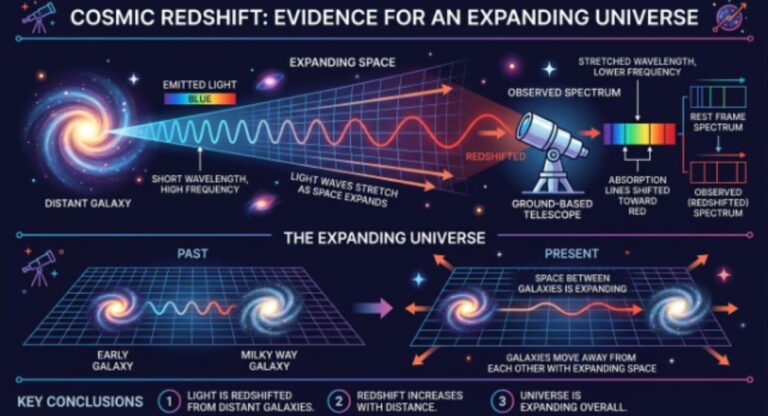
Cosmic redshift refers to the effect in which light coming from distant galaxies across the universe is stretched toward the red end of the spectrum. This happens because the universe is expanding, causing galaxies to move away from us. As a result, the wavelength of light emitted by the galaxies increases. The greater the distance of a galaxy, the larger its redshift, i.e.; it is moving away faster. By studying cosmic redshift, scientists can measure how fast the universe is expanding. When you hear an ambulance approaching, its siren sounds louder and higher in pitch. As the ambulance passes by and moves away, the siren suddenly becomes lower in pitch. This familiar effect happens because the sound waves are compressed as the ambulance approaches and stretched as it moves away. This phenomenon is known as the Doppler Effect.
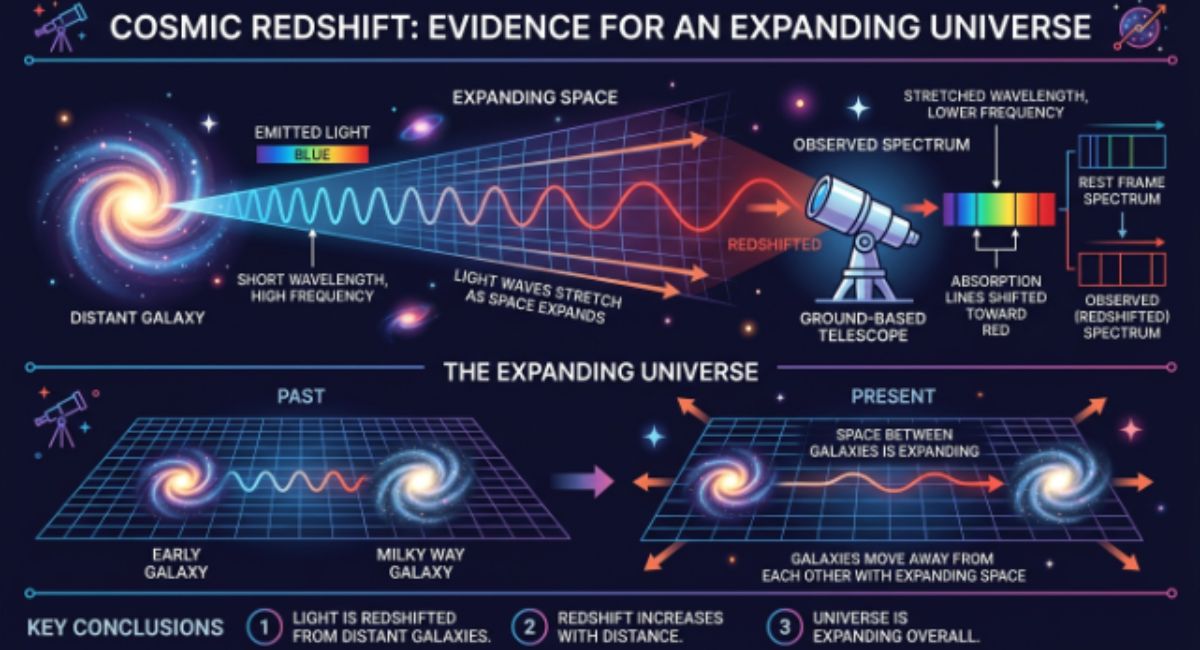
Light behaves in a very similar way. When a star or galaxy moves away from Earth, the light waves it emits become stretched, causing them to shift toward the red end of the visible spectrum. This phenomenon is called cosmic redshift. It is one of the strongest pieces of evidence that the universe is expanding.
What Is Cosmic Redshift?
Cosmic redshift is the increase in the wavelength of light emitted by distant galaxies as they move away from the observer due to the expansion of the universe.
In 1929, the American astronomer Edwin Hubble carefully measured the distances and redshifts of many galaxies.
How Does Redshift Occur?
Every chemical element produces spectral lines at specific wavelengths. When a galaxy moves away from Earth, the wavelengths of these spectral lines become stretched. Instead of appearing at their normal positions, the lines shift toward longer wavelengths, which lie in the red region of the electromagnetic spectrum. This shift allows astronomers to determine whether a galaxy is moving toward or away from Earth.
The Doppler Effect for Light.
The Doppler Effect explains how motion changes the observed wavelength of light.
If the source moves toward the observer:
- Wavelength becomes shorter.
- Frequency increases.
- Light shifts toward the blue end of the spectrum.
- This is called blueshift.
If the source moves away from the observer:
- Wavelength becomes longer.
- Frequency decreases.
- Light shifts toward the red end of the spectrum.
- This is called redshift.
Redshift Formula
The redshift of light is represented by the symbol
z
and is calculated using
z=OBSERVED – EMITTEDEMITTED
Interpretation
- z>0 → Redshift (moving away)
- z=0→ No motion relative to the observer
- z<0→ Blueshift (moving toward the observer)
Hubble’s Law
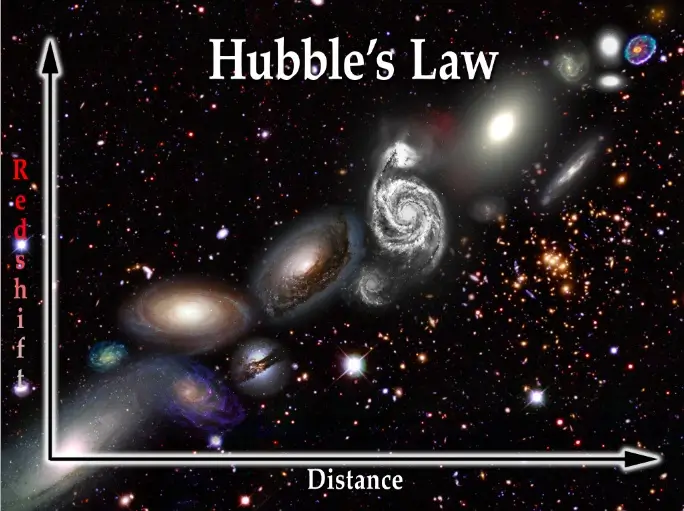
Edwin Hubble found that the recession speed of galaxies is directly proportional to their distance.
The mathematical expression is
This equation shows that galaxies located farther away move away faster than nearby galaxies.
Why Does the Universe Expand?
The expansion of the universe does not mean that galaxies are flying through empty space away from a central point. Instead, space itself is expanding.
As space expands, the distance between galaxies increases, and the light traveling through space becomes stretched. This stretching increases the wavelength of light, producing cosmic redshift.
An everyday analogy is drawing dots on the surface of a balloon. As the balloon inflates, every dot moves farther away from every other dot. None of the dots is the center of the expansion—the surface itself is expanding. Similarly, galaxies move farther apart because the fabric of space is expanding.
Evidence for an Expanding Universe.
Cosmic redshift provides several important pieces of evidence for the expansion of the universe.
-
Redshift of Distant Galaxies
Nearly every distant galaxy observed shows a redshift.
This indicates that most galaxies are moving away from Earth.
-
Hubble’s Law
The linear relationship between distance and recession speed confirms that the universe is expanding uniformly on large scales.
-
Cosmic Microwave Background Radiation (CMB)
The discovery of the Cosmic Microwave Background supports the idea that the universe began in a hot, dense state and has been expanding and cooling ever since.
-
Distribution of Galaxies
Large-scale observations show that galaxies are becoming more widely separated over time, consistent with an expanding universe
HUBBLE’S LAW
In 1929, the American astronomer Edwin Hubble studied the light coming from distant galaxies. By measuring their redshift, he found that almost every galaxy was moving away from the Milky Way.
More importantly, he discovered that:
- Nearby galaxies move away slowly.
- Distant galaxies move away much faster.
This relationship became known as Hubble’s Law and changed our understanding of the universe forever.
Mathematical Expression of Hubble’s Law
The mathematical form of Hubble’s Law is
v=Hod
Here, v is how fast a galaxy is moving away from us (called its recession velocity), d is how far away it is, and H₀, called the Hubble constant, ties the two together. Its value works out to roughly 2.3 × 10⁻¹⁸ per second (often written more practically as about 70 km/s per megaparsec).
Universe expand.
If you plot every galaxy’s distance on one axis and its recession velocity on the other, you get a clean straight line, not a scattered mess. That straight line is exactly what Hubble’s Law predicts. The slope of that line is the Hubble constant itself. As distance goes up, velocity goes up right along with it, and that consistent pattern is strong evidence that the universe isn’t sitting still. It’s expanding.
Before Hubble’s discovery, most scientists genuinely believed the universe was static, fixed in size, never changing. This single graph flipped that assumption completely, and it’s what eventually led scientists toward the Big Bang Theory.
The Balloon Analogy.
The diagram above shows the classic way scientists explain this idea. Picture galaxies as dots painted on the surface of a balloon. As someone blows air into the balloon, every dot moves farther away from every other dot, not because any single dot is special or moving on its own, but because the entire surface underneath all of them is stretching.
That’s exactly what’s happening with real space. It isn’t that galaxies are flying through some fixed background. Space itself is stretching, carrying the galaxies along with it. This explains something that trips a lot of students up: an observer standing in any other galaxy would see the exact same thing we do, every other galaxy rushing away from them. There’s no special center to the universe, and Earth definitely isn’t sitting at one.
Running the Clock Backward.
Here’s the genuinely powerful part. If the universe is expanding right now, you can mentally rewind that process. Go back far enough, and galaxies must have been closer together. Keep rewinding, and eventually all matter in the universe would have been squeezed into an incredibly small, dense, unimaginably hot point.
That’s the core idea behind the Big Bang Theory: the universe began from that single dense state roughly 13.8 billion years ago and has been expanding ever since. Hubble’s Law isn’t just a neat pattern in a graph. It’s one of the strongest pieces of real observational evidence supporting the entire Big Bang model.
A Quick Timeline of the Universe
| Stage | What Happened |
|
The universe begins expanding from an extremely hot, dense state |
|
Recombination Era: atoms form, light can finally travel freely |
|
First stars and first large structures begin forming |
|
Galaxies and galaxy clusters take shape |
|
The universe continues expanding, and that expansion is speeding up |
Applications of Hubble’s Law.
Hubble’s Law is widely used in modern astronomy and cosmology to:
- Measure distances to distant galaxies.
- Calculate the expansion rate of the universe.
- Estimate the age of the universe.
- Study galaxy evolution.
- Investigate dark energy and cosmic expansion.
- Understand the large-scale structure of the cosmos.
EARTH’S CLIMATE SYSTEM.
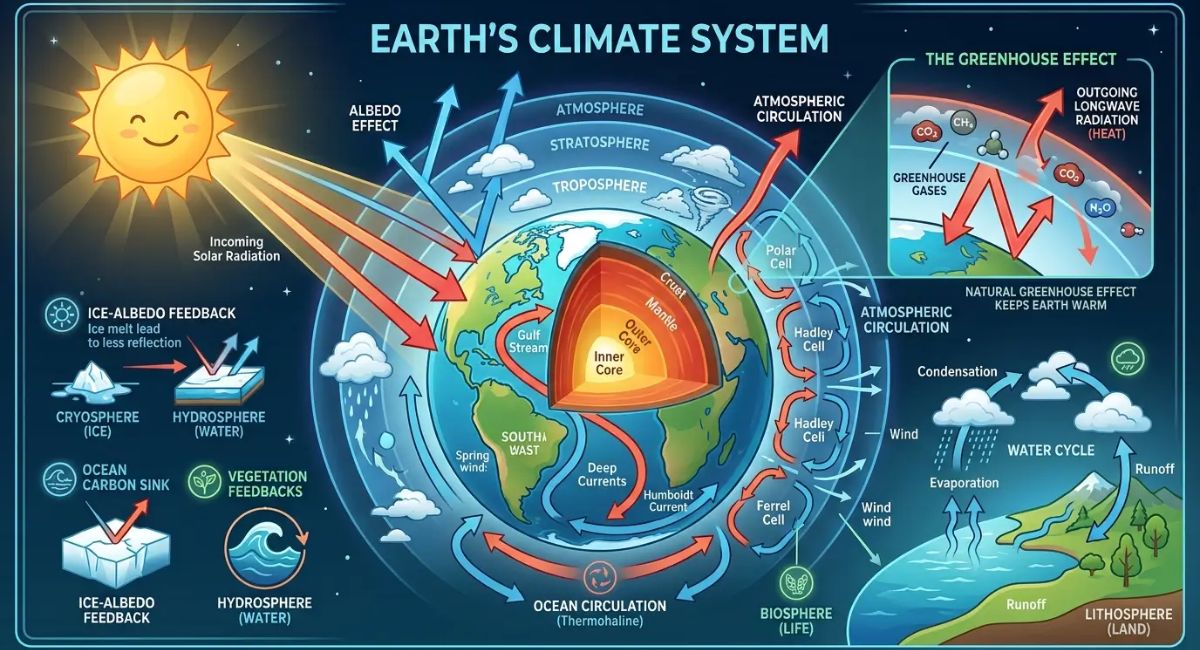
Earth’s climate system is a long-term pattern of temperature, rainfall, wind, and other weather conditions in a region. It affects all living things and natural systems on our planet. The climate is shaped by natural factors, like the Sun and ocean currents, and human activities, such as burning fossil fuels and cutting down forests. Understanding the climate of Earth helps us to prepare for and to reduce the impacts of climate change. The climate system of Earth is made up of five components which include atmosphere (air), the hydrosphere (water), the cryosphere (ice and permafrost), the lithosphere (Earth’s upper rocky layer) and the biosphere (living things) These components work . together and affect each other. Changes in one part can cause changes in the others.Earth’s climate system is a complex network of interactions between the atmosphere, oceans, land, ice, and living organisms. These components constantly exchange energy, water, and gases, creating the climate we experience. The Sun is the primary source of energy that powers this entire system. Without solar energy, Earth would be a frozen and lifeless planet.
What Is Earth’s Climate System?
Earth’s climate system is the collection of interacting components that regulate Earth’s climate by controlling the flow of energy, water, and matter between the atmosphere, oceans, land, ice, and living organisms.
The Main Source of Energy.
The entire climate system is powered by the Sun. Solar radiation reaches Earth in the form of electromagnetic waves. Part of this energy is reflected back into space, while the remaining energy is absorbed by the atmosphere, oceans, and land. This absorbed energy heats the Earth’s surface and drives atmospheric circulation, ocean currents, and the water cycle.
The balance between incoming solar energy and outgoing heat energy determines Earth’s average temperature.
Components of Earth’s Climate System
Earth’s climate system consists of five major components that constantly interact with one another.
- Atmosphere
The atmosphere is the layer of gases surrounding Earth.
It is mainly composed of:
| Gas | Percentage |
| Nitrogen (N₂) | 78% |
| Oxygen (O₂) | 21% |
| Argon (Ar) | 0.93% |
| Carbon dioxide (CO₂) | About 0.04% |
| Water vapor | Variable |
The atmosphere performs several important functions:
- Absorbs and redistributes heat.
- Protects Earth from harmful ultraviolet radiation.
- Produces weather phenomena such as clouds, rain, and storms.
- Maintains the greenhouse effect that keeps Earth warm enough for life.
-
Hydrosphere
The hydrosphere includes all of Earth’s water.
It consists of:
- Oceans
- Seas
- Rivers
- Lakes
- Groundwater
- Water vapor
- Glaciers
Oceans store enormous amounts of heat and transport it around the globe through ocean currents such as the Gulf Stream. This helps regulate regional and global climates.
-
Cryosphere
The cryosphere includes all frozen water on Earth.
Examples include:
- Polar ice caps
- Ice sheets
- Glaciers
- Sea ice
- Snow cover
- Permafrost
Ice reflects much of the incoming sunlight back into space because it has a high albedo. This helps keep the planet cool. As global temperatures rise, melting ice reduces Earth’s reflectivity, causing more heat to be absorbed and accelerating warming.
-
Lithosphere (Geosphere)
The lithosphere is Earth’s solid outer layer, including:
- Continents
- Mountains
- Rocks
- Soil
- Volcanoes
Land surfaces absorb and release heat at different rates than oceans. Mountains influence rainfall patterns, while volcanic eruptions can inject ash and gases into the atmosphere, temporarily affecting global temperatures.
-
Biosphere
The biosphere includes all living organisms, such as:
- Plants
- Animals
- Humans
- Microorganisms
Living organisms play a crucial role in regulating atmospheric gases. Plants absorb carbon dioxide during photosynthesis and release oxygen, helping maintain the balance of greenhouse gases in the atmosphere.
How the Climate System Works
Earth’s climate system operates through the continuous exchange of energy, water, and gases among its different components.
- The basic process works as follows:
- The Sun supplies energy to Earth.
- Land and oceans absorb solar radiation.
- The heated surface warms the atmosphere.
- Water evaporates into the atmosphere.
- Clouds form and produce precipitation.
- Ocean currents redistribute heat around the planet.
- Greenhouse gases trap some of the outgoing heat, keeping Earth warm.
- Plants absorb carbon dioxide, helping regulate atmospheric composition.
- These interactions occur continuously, maintaining Earth’s climate over long periods.
Energy Balance of Earth
Earth’s climate depends on maintaining an energy balance.
The basic relationship is.
Incoming Solar Energy=Outgoing Heat Energy
When incoming energy equals outgoing energy, Earth’s average temperature remains relatively stable.
- If Earth absorbs more energy than it loses, the planet warms.
- If Earth loses more energy than it receives, the planet cools.
The Greenhouse Effect.
One of the most important processes in Earth’s climate system is the greenhouse effect.
Certain gases in the atmosphere trap some of the infrared radiation emitted by Earth’s surface.
Major greenhouse gases include:
- Water vapor (H₂O)
- Carbon dioxide (CO₂)
- Methane (CH₄)
- Nitrous oxide (N₂O)
- Ozone (O₃)
Without the natural greenhouse effect, Earth’s average surface temperature would be about −18°C instead of approximately 15°C, making life as we know it impossible.
The Water Cycle and Climate.
The water cycle continuously moves water through Earth’s climate system.
The cycle includes:
- Evaporation
- Condensation
- Cloud formation
- Precipitation
- Runoff
- Infiltration
This cycle transfers heat around the globe and strongly influences humidity, rainfall, storms, and weather patterns.
-
Factors That Influence Earth’s Climate
Several natural and human-related factors affect Earth’s climate.
Natural Factors
- Variations in solar radiation.
- Volcanic eruptions.
- Ocean circulation.
- Earth’s orbital changes (Milankovitch cycles).
- Natural climate oscillations such as El Niño and La Niña.
Human Activities
- Burning fossil fuels.
- Deforestation.
- Industrial emissions.
- Agriculture.
- Urbanization.
These activities increase greenhouse gas concentrations, contributing to global warming and climate change.
Ocean Currents and Wind Patterns.
Imagine standing on a beach and feeling a cool sea breeze blowing toward the land. Thousands of kilometers away, powerful ocean currents are moving warm and cold water across the globe, while high above the Earth’s surface, winds are constantly circulating through the atmosphere. Although these processes seem unrelated, they work together as part of Earth’s climate system. Ocean currents and wind patterns continuously exchange heat, moisture, and energy, helping regulate the planet’s climate and weather.
Without ocean currents and global winds, some regions of Earth would become extremely hot while others would remain permanently frozen. These natural systems redistribute solar energy from the equator toward the poles, creating a more balanced climate that supports life on Earth.
How Ocean Water Actually Moves
Ocean water moves in two very different ways. Near the surface, wind is basically doing the pushing, dragging the top layer of water along as it blows across the ocean. But there’s a second, much slower kind of movement happening deep below, called thermohaline circulation. This deeper movement isn’t driven by wind at all. It’s driven by temperature and saltiness, since colder, saltier water is denser and sinks, while warmer water rises, creating a slow, ongoing churn throughout the ocean’s depths. Earth’s own rotation shapes all of this even further, twisting surface currents into massive, spinning loops called gyres. In the northern hemisphere, these gyres spin clockwise. In the southern hemisphere, they spin the opposite way, counterclockwise. This isn’t random. It’s a direct result of the Earth spinning on its axis, an effect scientists call the Coriolis effect.
What Are Ocean Currents?
Ocean currents are continuous, directed movements of seawater that flow through the world’s oceans due to the combined effects of wind, Earth’s rotation, temperature differences, salinity differences, and gravitational forces.
What Are Wind Patterns?
Wind patterns are the large-scale movements of air caused by differences in air pressure, uneven heating of Earth’s surface by the Sun, and Earth’s rotation.
How Ocean Currents Are Formed.
Ocean currents are produced by several natural forces working together.
-
Solar Heating
The Sun heats Earth’s surface unevenly. Regions near the equator receive more solar energy than the poles. Warm water becomes less dense and moves away from the equator, while colder, denser water moves toward lower latitudes.
This difference in temperature creates large-scale ocean circulation.
-
Winds
Surface winds push the upper layer of ocean water.
For example, the trade winds and westerlies drive many of the major surface currents found in the Atlantic, Pacific, and Indian Oceans.
-
Earth’s Rotation (Coriolis Effect)
As Earth rotates, moving water is deflected:
- To the right in the Northern Hemisphere.
- To the left in the Southern Hemisphere.
This effect causes ocean currents to curve rather than travel in straight lines.
-
Differences in Salinity and Density
Cold, salty water is denser than warm, less salty water.
Dense water sinks while lighter water rises, creating deep ocean circulation known as thermohaline circulation, often called the global ocean conveyor belt.
-
Coastlines and Ocean Basins
Continents block and redirect ocean currents, shaping their paths around the globe.
Types of Ocean Currents.
Ocean currents are generally divided into two main categories.
-
Surface Currents
Surface currents occur in the upper few hundred meters of the ocean and are mainly driven by winds.
-
- Gulf Stream
- Kuroshio Current
- California Current
- Canary Current
-
Deep Ocean Currents
Deep ocean currents are driven by differences in water density caused by temperature and salinity. These slow-moving currents connect all the world’s oceans and transport enormous amounts of heat over long periods.
How Wind Patterns Are Formed.
The atmosphere is heated unevenly because the equator receives more sunlight than the poles.
- Warm air rises near the equator, creating areas of low pressure.
- Cooler air from higher latitudes moves toward these low-pressure regions.
As Earth rotates, the moving air is deflected by the Coriolis Effect, creating the major global wind belts.
Major Global Wind Patterns
-
Trade Winds
Trade winds blow from the subtropical high-pressure regions toward the equator.
- Northern Hemisphere: Northeast Trade Winds
- Southern Hemisphere: Southeast Trade Winds
These winds were historically important for sailing ships and continue to drive tropical ocean currents.
-
Westerlies
Westerlies blow from west to east in the middle latitudes.
They strongly influence the weather of North America, Europe, and many other regions.
-
Polar Easterlies
These cold winds blow from the polar regions toward lower latitudes.
They help transport cold air away from the poles.
-
The Coriolis Effect
The Coriolis Effect is the apparent deflection of moving air and water caused by Earth’s rotation.
It explains why:
- Hurricanes rotate.
- Ocean currents curve.
- Global wind belts follow curved paths.
Without the Coriolis Effect, winds and ocean currents would move almost directly north and south instead of following their familiar circular patterns.
Interaction Between Ocean Currents and Wind Patterns
Surface winds push ocean water, creating surface currents. In turn, ocean currents transfer heat to the atmosphere, affecting air temperature, humidity, and rainfall.
For example:
- Warm ocean currents heat the air above them, leading to increased evaporation and rainfall.
- Cold currents cool the overlying air, often creating dry, foggy coastal climates.
This interaction plays a vital role in shaping regional weather and global climate.
Effects on Earth’s Climate
Ocean currents and wind patterns influence climate in many ways.
-
Temperature Regulation
Warm currents carry heat from the equator toward higher latitudes, while cold currents transport cooler water toward the tropics.
This redistribution of heat helps moderate Earth’s climate.
-
Rainfall Distribution
Winds transport moisture from oceans to land.
Regions influenced by warm currents generally receive more rainfall, whereas cold currents often produce dry conditions.
-
Storm Formation
Warm ocean waters provide energy for tropical storms and hurricanes.
Wind patterns determine the movement and strength of these storms.
-
Marine Ecosystems
Cold ocean currents often bring nutrient-rich water to the surface through upwelling, supporting abundant marine life and productive fisheries.
- El Niño and La Niña
One of the best examples of ocean-atmosphere interaction is the El Niño–Southern Oscillation (ENSO).
El Niño
During El Niño:
- Pacific Ocean surface waters become warmer than normal.
- Trade winds weaken.
- Rainfall patterns shift across the globe.
- Some regions experience floods, while others suffer droughts.
La Niña
During La Niña:
- Pacific Ocean surface waters become cooler than normal.
- Trade winds strengthen.
- Weather patterns often become opposite to those during El Niño.
Global Climate and Energy Transfer from the Sun
Energy received from the Sun plays an important role in producing changes in the global climate. Here, we will briefly describe how energy received from the Sun is distributed on Earth and how uneven heating of Earth between equator and poles can produce atmospheric changes. The Sun is the ultimate source of energy for Earth. Almost every natural process on our planet depends directly or indirectly on solar energy. The Sun warms the Earth’s surface, drives the water cycle, creates winds, powers ocean currents, supports photosynthesis, and regulates the global climate. Without the continuous supply of solar energy, Earth would become a frozen, lifeless planet with no atmosphere capable of sustaining life.
What Is Global Climate?
Global climate is the long-term average pattern of temperature, rainfall, humidity, wind, and atmospheric conditions across the Earth over many years.
The Sun: Earth’s Primary Energy Source.
The Sun is a medium-sized star located about
1.496×10¹¹ m
(approximately 150 million kilometers) from Earth.
Inside the Sun’s core, hydrogen atoms combine to form helium through nuclear fusion. This process releases enormous amounts of energy according to Einstein’s equation
E=mc2
where
- E = Energy produced
- m= Mass converted into energy
- c = Speed of light
This energy travels through space as electromagnetic radiation and reaches Earth in approximately 8 minutes and 20 seconds.
The Solar Constant.
The amount of solar energy received per unit area at the top of Earth’s atmosphere is called the solar constant.
S≈1361 W/m2
where
- S = Solar constant
- Unit = Watts per square meter
This value represents the average solar energy reaching Earth’s atmosphere when the Sun’s rays strike a surface directly.
Earth’s Energy Budget.
The Earth’s energy budget refers to the balance between the solar energy absorbed by the Earth and the energy it radiates back into space. It is a measure of how much solar energy is received at the Earth and how much of that energy is lost to space through reflection. When the Earth is colder, more ice and snow cover the surface. Ice and snow are bright and reflect a large amount of sunlight back into space, which makes the Earth even cooler. But when the Earth gets warmer, ice and snow start to melt. This exposes darker surfaces like land and oceans, which absorb more sunlight and reflect less. As a result, the Earth becomes warmer. This balance of incoming and outgoing energy is known as the Earth’s energy budget, which plays an important role in keeping Earth’s temperature steady. depicts how sunlight reaches the Earth’s surface and atmosphere. The energy coming in from the Sun is balanced by the energy going out from the Earth in the form of infrared (heat) radiation When this balance is maintained, the temperature of Earth remains constant over time. However, greenhouse gases trap infrared radiation, preventing it from escaping into space. As a result, the Earth is warming up, a problem known as global warming .
Incoming Solar Energy=Outgoing Infrared Energy
- If Earth absorbs more energy than it releases, global temperatures rise.
- If Earth loses more energy than it gains, global temperatures decrease.
Energy Imbalance between the Poles and Equator.
The Earth’s climate system is fundamentally shaped by the uneven distribution of solar energy across its surface. The equator receives direct, intense sunlight, causing warm air to rise and form low pressure zones, while the poles get slanted, weaker sunlight, leading to cold, sinking air and high pressure zones. This energy imbalance drives global atmospheric circulation, creating wind patterns like the trade winds near the equator, westerlies in mid-latitudes, and polar easterlies near the poles. These winds, along with ocean currents, work together to redistribute heat worldwide. However, human-induced greenhouse gas emissions are disrupting this natural balance, intensifying global warming and changing weather patterns. The equator receives direct sunlight, while the poles receive oblique sunlight at an angle, resulting in uneven heating.
Energy Transfer Within Earth.
Once Earth’s surface absorbs sunlight, the energy is transferred throughout the planet by three important processes.
- Radiation
Radiation transfers heat through electromagnetic waves.
Example:
The Sun heats Earth through radiation across empty space.
-
Conduction
Conduction transfers heat through direct contact.
Example:
The ground becomes warm during the day and transfers heat to the air touching it.
-
Convection
Convection transfers heat by the movement of fluids such as air and water.
Warm air rises while cooler air sinks.
This continuous circulation produces winds, clouds, storms, and ocean currents.
Unequal Heating of Earth
Earth does not receive equal amounts of solar energy everywhere.
The equator receives nearly vertical sunlight, so solar energy is concentrated over a smaller area.
Near the poles, sunlight strikes at a low angle and spreads over a much larger area, reducing its intensity.
As a result:
- Equatorial regions are warmer.
- Polar regions remain much colder.
These temperature differences drive the movement of air and water around the globe.
Global Atmospheric Circulation
The uneven heating of Earth creates pressure differences in the atmosphere.
Warm air rises near the equator, creating low-pressure regions.
Cool air sinks near the poles, creating high-pressure regions.
This circulation produces three major global wind belts:
- Trade Winds
- Westerlies
- Polar Easterlies
These winds transport heat and moisture across the Earth.
Ocean Currents and Energy Transfer
The oceans store enormous amounts of heat.
Ocean currents move this heat around the globe.
Warm currents carry heat from tropical regions toward the poles, while cold currents transport cooler water toward the equator.
Examples include:
- Gulf Stream (warm current)
- Kuroshio Current (warm current)
- California Current (cold current)
- Labrador Current (cold current)
These currents moderate coastal climates and influence rainfall.
The Water Cycle and Energy Transfer
The Sun powers the water cycle, which transfers both water and heat throughout the climate system.
The cycle includes:
- Evaporation
- Condensation
- Cloud formation
- Precipitation
- Runoff
- Infiltration
When water evaporates, it absorbs heat from Earth’s surface. When it condenses into clouds, that heat is released into the atmosphere, helping to drive weather systems.
The Greenhouse Effect.
After Earth’s surface absorbs solar energy, it emits infrared radiation back toward space. Some of this heat escapes, but greenhouse gases trap part of it, warming the lower atmosphere. sunlight infrared returned infrared atmosphere Earth
At level 55, 40% of the modeled outgoing infrared returns toward Earth
Greenhouse gas level
The natural greenhouse effect keeps Earth’s average temperature around
15degree C
Without greenhouse gases, Earth’s average temperature would be approximately
18degree C
making life as we know it impossible.
Major greenhouse gases include:
- Water vapor (H₂O)
- Carbon dioxide (CO₂)
- Methane (CH₄)
- Nitrous oxide (N₂O)
- Ozone (O₃
ATMOSPHERIC CIRCULATION AND ATMOSPHERIC CELLS.
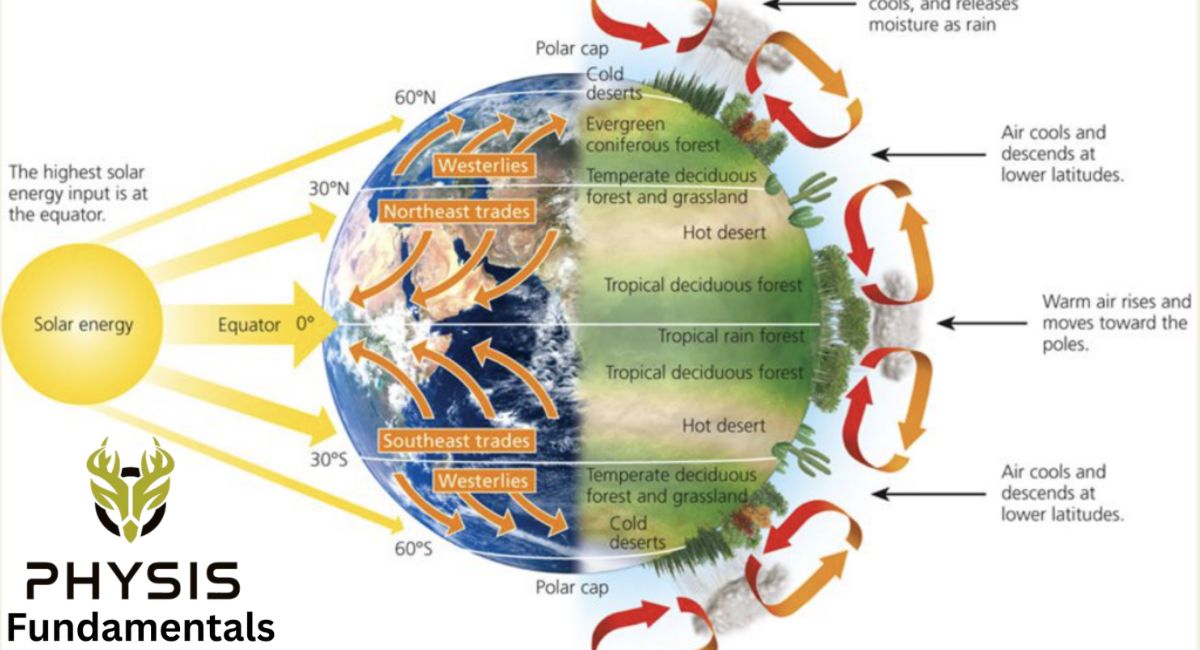
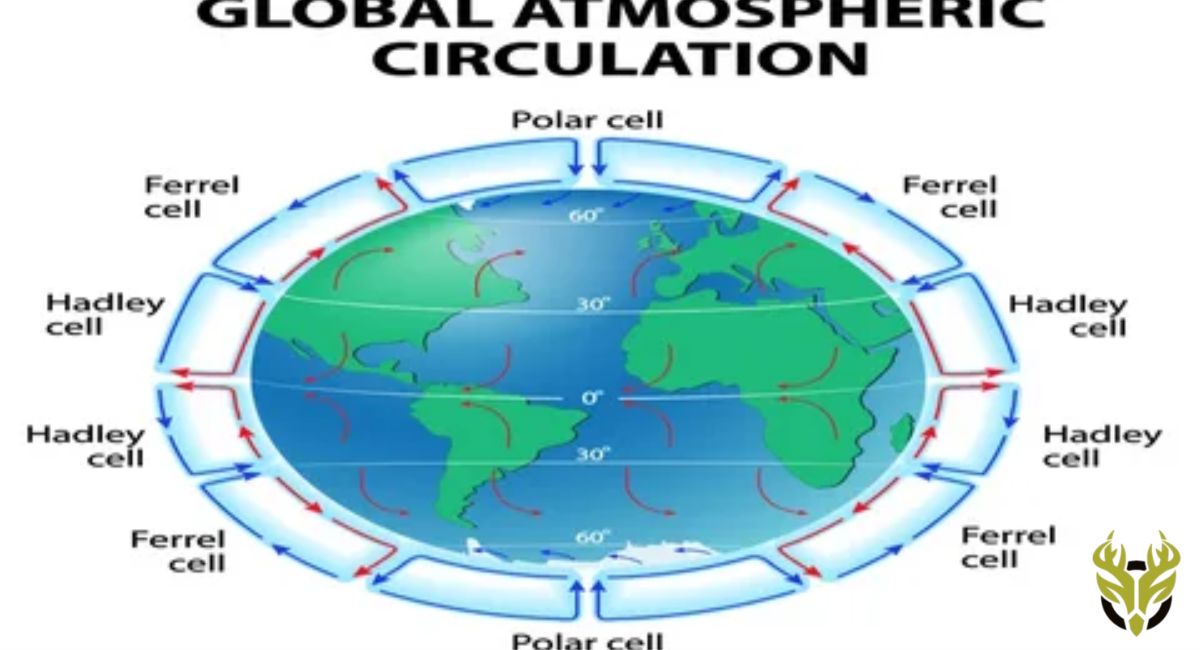
The Earth’s atmosphere is constantly moving. Warm air rises, cool air sinks, and these continuous movements create global wind patterns that distribute heat and moisture around the planet. This large-scale movement of air is called atmospheric circulation. It helps balance the unequal heating of Earth by transferring warm air from the equator toward the poles and bringing cooler air back toward the equator.
What Is Atmospheric Circulation?
Atmospheric circulation is the large-scale movement of air around the Earth that redistributes heat and moisture from warmer regions to cooler regions.
Ocean water contains a variety of dissolved substances, with salt being the most abundant. The amount of salt in ocean water is called salinity. When ocean water has more salt, it becomes heavier or denser. This happens because the dissolved salt increases the mass of the water without significantly increasing its volume. As a result, higher salinity leads to higher water density. In the ocean, density differences between water masses are one of the key forces driving ocean circulation, especially in deep waters. These density differences arise mainly due to variations in temperature and salinity. Cold water is denser than warm water, and salty water is denser than less salty water. When surface waters become colder and saltier often due to evaporation or the formation of sea ice, they become denser and sink to deeper layers. As denser water sinks, it pushes other water out of the way, creating slow-moving but large-scale currents that circulate throughout the global oceans. This deep circulation helps transport heat, and gases (such as oxygen and carbon dioxide) around the globe. It connects surface and deep water systems and plays an important role in regulating the Earth’s climate.
Why Does Atmospheric Circulation Occur?
Atmospheric circulation occurs because the Sun heats different parts of Earth unevenly.
The equator receives nearly direct sunlight throughout the year, making it much warmer than the polar regions, where sunlight arrives at a low angle.
This uneven heating creates differences in temperature and air pressure.
- Warm air expands, becomes less dense, and rises.
- Cool air becomes denser and sinks.
- Air naturally moves from high-pressure areas to low-pressure areas.
Earth’s rotation further influences these air movements through the Coriolis Effect, causing winds to curve rather than travel in straight lines.
The Coriolis Effect.
The Coriolis Effect is the apparent deflection of moving air caused by Earth’s rotation.
- In the Northern Hemisphere, moving air is deflected to the right.
- In the Southern Hemisphere, moving air is deflected to the left.
The Coriolis Effect is responsible for the curved paths of global winds and the formation of atmospheric circulation cells.
Atmospheric Cells
Scientists divide Earth’s atmospheric circulation into three major cells in each hemisphere.
These cells work together to transfer heat from the equator toward the poles.
They are:
- Hadley Cell
- Ferrel Cell
- Polar Cell
-
Hadley Cell
The Hadley Cell extends approximately from the equator to 30° latitude in both hemispheres.
How the Hadley Cell Works
Near the equator, intense solar heating causes warm, moist air to rise.
As the air rises:
- It cools.
- Water vapor condenses into clouds.
- Heavy rainfall occurs.
After reaching the upper atmosphere, the air moves toward 30° latitude.
There, it cools further and sinks, creating high-pressure zones.
The sinking air is dry, which is why many of the world’s largest deserts are located around 30° north and south latitude, including:
- Sahara Desert
- Arabian Desert
- Australian Desert
The surface air then flows back toward the equator, forming the Trade Winds.
-
Ferrel Cell
The Ferrel Cell lies between 30° and 60° latitude.
Unlike the Hadley and Polar Cells, the Ferrel Cell is influenced by the movement of air in the neighboring cells.
-
How the Ferrel Cell Works
Air near 30° latitude moves toward higher latitudes.
Due to the Coriolis Effect, these winds become the Westerlies, which blow from west to east.
Near 60° latitude, this relatively warm air meets cold polar air.
The warm air rises, creating clouds, rainfall, and frequent storms.
The upper-level air then returns toward 30° latitude, completing the circulation.
-
Polar Cell
The Polar Cell extends from 60° latitude to the poles (90°).
How the Polar Cell Works
At the poles, extremely cold, dense air sinks, creating high-pressure areas.
This cold air flows toward lower latitudes.
Earth’s rotation deflects these winds, producing the Polar Easterlies.
Near 60° latitude, the cold polar air meets warmer air from the Ferrel Cell.
The warm air rises, and the circulation cycle continues.
Major Global Wind Systems
Atmospheric cells produce three major wind belts.
Trade Winds
- Blow from 30° toward the equator.
- Deflected westward by the Coriolis Effect.
- Important for tropical weather.
Westerlies
- Blow between 30° and 60° latitude.
- Move from west to east.
- Influence the weather of Europe, North America, and other temperate regions.
Polar Easterlies
- Blow from the poles toward 60° latitude.
- Carry very cold air.
- Influence polar climates.
Why Wind Actually Curves.
Earth spins faster at the equator than it does near the poles, simply because points near the equator have to cover more ground to complete one full rotation. So when air drifts from the equator toward higher latitudes, it’s still carrying the faster spin speed it started with, and it ends up moving quicker than the ground beneath it. The reverse happens too: air drifting from the poles toward the equator lags behind the surface below it.This mismatch causes moving air to visibly curve instead of traveling in a straight line, an effect known as the Coriolis effect. In the northern hemisphere, this deflection bends air to the right. In the southern hemisphere, it bends left instead. Importantly, this effect doesn’t slow air down or speed it up. It only bends its path.
ROLE OF SALT AND DENSITY IN OCEAN CIRCULATION
- The oceans cover about 71% of Earth’s surface, making them one of the most important components of the Earth’s climate system. While winds drive surface currents, the movement of water deep within the oceans is controlled mainly by differences in salinity (salt content) and density. These differences create a slow but powerful global circulation system that transports heat, oxygen, and nutrients around the world.
- This deep circulation is known as thermohaline circulation, where “thermo” refers to temperature and “haline” refers to salinity (salt content). Together, temperature and salinity determine the density of seawater. Dense water sinks, while less dense water rises, creating a continuous movement of ocean water that helps regulate Earth’s climate.
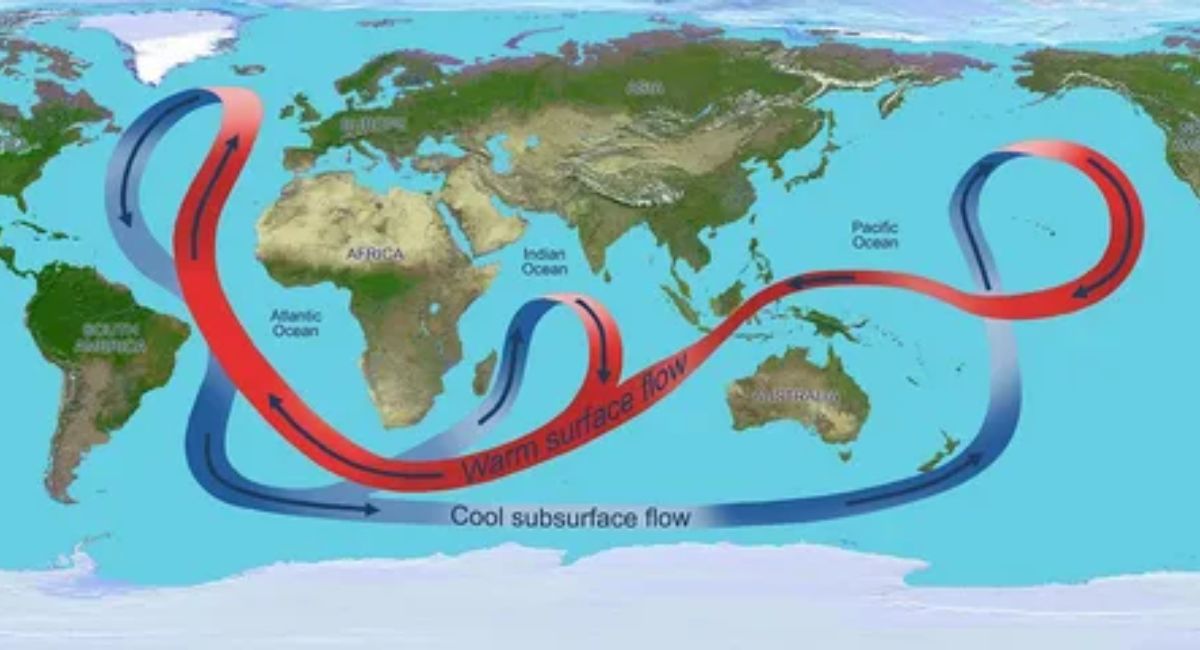
What Is Salinity?
Salinity is the amount of dissolved salts present in seawater.
average salinity of seawater is about
- 35 ppt
where ppt means parts per thousand.
This means that every 1000 grams of seawater contains approximately 35 grams of dissolved salts.
The major dissolved salts include:
| Salt | Chemical Formula |
|
NaCl |
|
MgCl₂ |
|
MgSO₄ |
|
CaSO₄ |
|
KCl |
Sodium chloride (common salt) makes up the largest portion of the dissolved salts.
What Is Density?
Density is the amount of mass contained in a given volume.
The density of seawater depends mainly on:
- Temperature
- Salinity
- Pressure (especially in deep oceans)
- =mV
Relationship Between Salinity and Density
Salinity and density are closely related.
When the amount of dissolved salt increases:
- Water becomes heavier.
- Density increases.
- The water is more likely to sink.
When salinity decreases:
- Water becomes lighter.
- Density decreases.
- The water remains near the surface.
Therefore,
Higher salinity produces higher density.
Relationship Between Temperature and Density
Temperature also affects seawater density.
- Cold water is denser than warm water.
- Warm water expands, becomes less dense, and stays near the surface.
As a result:
- Cold, salty water sinks.
- Warm, less salty water rises.
This continuous movement drives deep ocean circulation.
What Is Thermohaline Circulation?
Thermohaline circulation is the large-scale movement of ocean water caused by differences in temperature (thermo) and salinity (haline).
In simple words,
Thermohaline circulation is the slow movement of deep ocean water caused by changes in temperature and salt content.
It is often called the Global Ocean Conveyor Belt because it connects all of Earth’s oceans into one continuous circulation system.
How Salt and Density Drive Ocean Circulation
The process begins in the cold polar regions.
Step 1: Cooling of Surface Water
Near the poles, ocean water loses heat to the atmosphere.
As the temperature decreases:
- Water becomes colder.
- Density increases.
Step 2: Formation of Sea Ice
When seawater freezes:
- Most of the salt is left behind in the surrounding water.
- The remaining seawater becomes saltier.
This increase in salinity makes the surrounding water even denser.
Step 3: Dense Water Sinks
Cold, salty water becomes very dense and sinks toward the ocean floor.
This sinking motion creates deep ocean currents.
Step 4: Deep Water Flows Around the Globe
The dense water slowly moves through the deep ocean basins.
This deep circulation connects the Atlantic, Pacific, Indian, and Southern Oceans
Step 5: Upwelling
Eventually, deep water rises back to the surface in certain regions through a process called upwelling.
Upwelling brings:
- Cold water
- Oxygen
- Nutrient-rich water
to the surface, supporting marine life.
Factors That Affect Salinity.
Several natural processes change the salinity of seawater.
Increase Salinity
- High evaporation
- Sea ice formation
- Low rainfall
Decrease Salinity
- Heavy rainfall
- River discharge
- Melting glaciers
- Melting sea ice
These changes influence seawater density and ocean circulation.
Importance of Salt and Density in Ocean Circulation
Salt and density play several important roles in Earth’s climate system.
-
Heat Distribution
Ocean circulation transfers warm water from tropical regions toward the poles and returns cold water toward the equator.
This redistribution helps regulate Earth’s climate.
-
Climate Regulation
The thermohaline circulation prevents extreme temperature differences between equatorial and polar regions.
Without this circulation, many parts of the world would experience much harsher climates.
-
Oxygen Distribution
Deep ocean currents carry oxygen-rich surface water into deeper layers, allowing marine organisms to survive at great depths.
-
Nutrient Transport
Upwelling brings nutrients such as nitrates and phosphates from the deep ocean to the surface.
These nutrients support:
-
- Phytoplankton
- Fish
- Marine ecosystems
-
Carbon Storage
The deep ocean absorbs and stores large amounts of carbon dioxide (CO₂), helping regulate Earth’s climate.
Global Ocean Conveyor Belt
The Global Ocean Conveyor Belt is the worldwide system of interconnected surface and deep ocean currents driven by differences in temperature and salinity.
Its major functions include:
- Transporting heat around the planet.
- Redistributing salt.
- Carrying oxygen to deep oceans.
- Recycling nutrients.
- Influencing global climate.
A complete cycle of the conveyor belt takes approximately 1,000 years.
Effects of Climate Change
Climate change is affecting thermohaline circulation.
As glaciers and polar ice melt:
- Large amounts of freshwater enter the oceans.
- Salinity decreases.
- Water becomes less dense.
- Less dense water sinks more slowly.
If this process continues, deep ocean circulation could weaken, affecting global climate, rainfall patterns, and marine ecosystems.
THERMOHALINE CIRCULATION.
One of the most important movements of ocean water is thermohaline circulation, often called the Global Ocean Conveyor Belt. Unlike surface currents, which are mainly driven by winds, thermohaline circulation is driven by differences in temperature and salinity (salt content). These differences change the density of seawater, causing cold, salty water to sink and warmer, less salty water to rise.
This continuous circulation transports heat, oxygen, nutrients, and dissolved gases around the globe, helping regulate Earth’s climate and supporting marine life.
What Is Thermohaline Circulation?
Thermohaline circulation is the large-scale movement of ocean water driven by differences in temperature (thermo) and salinity (haline), which together determine the density of seawater.
Meaning of the Word “Thermohaline”
The term thermohaline comes from two Greek words:
- Thermo = Temperature (heat)
- Haline = Salt (salinity)
Together, they describe a circulation system controlled by temperature and salinity.
Why Does Thermohaline Circulation Occur?
The oceans are not uniform. Different regions have different temperatures and salt concentrations.
These differences affect the density of seawater.
- Cold water is denser than warm water.
- Saltier water is denser than fresher water.
As a result:
- Dense water sinks.
- Less dense water rises.
This continuous sinking and rising of water creates deep ocean circulation.
How Thermohaline Circulation Works
Thermohaline circulation operates through a continuous sequence of processes.
Step 1: Warm Surface Water Moves Poleward
Warm ocean currents, such as the Gulf Stream, carry warm surface water from tropical regions toward the North Atlantic.
Step 2: Cooling of Surface Water
As the warm water reaches higher latitudes, it loses heat to the cold atmosphere.
The water temperature decreases, making it denser.
Step 3: Increase in Salinity
In polar regions, seawater begins to freeze.
During ice formation:
- Pure water forms ice.
- Most dissolved salt remains in the surrounding seawater.
This process, called brine rejection, increases the salinity of the remaining water.
As salinity increases, the water becomes even denser.
Step 4: Deep Water Formation
The cold, salty, dense water sinks to the ocean floor.
This forms deep water masses such as:
- North Atlantic Deep Water (NADW)
- Antarctic Bottom Water (AABW)
These are among the densest water masses on Earth.
Step 5: Deep Ocean Flow
The deep water slowly flows through the Atlantic, Indian, Pacific, and Southern Oceans.
Unlike surface currents, which move relatively quickly, deep currents travel very slowly.
Step 6: Upwelling
In certain regions, deep water gradually rises back to the surface through a process known as upwelling.
Upwelling returns:
- Cold water
- Oxygen
- Nutrients
to surface waters, supporting marine ecosystems.
The cycle then begins again.
The Global Ocean Conveyor Belt.
Thermohaline circulation is often called the Global Ocean Conveyor Belt because it links all of Earth’s oceans into one continuous system.
The conveyor belt:
- Moves warm surface water toward the poles.
- Returns cold deep water toward the equator.
- Connects the Atlantic, Pacific, Indian, Arctic, and Southern Oceans.
A complete cycle takes approximately
1000–1500 years
How the Cycle Actually Works
Near the equator, warm water is lighter and less dense, so it stays near the surface and drifts toward the poles, carrying all that heat energy along with it. Once it arrives at the poles, things change fast. The water cools down, and as sea ice forms, it leaves extra salt behind in the surrounding water, making it noticeably denser. That denser water can’t stay at the surface anymore. It sinks, dropping down into the deep ocean, then slowly flows back toward the equator along the ocean floor, completing the loop. It’s basically a slow-motion water elevator, warm water rising and traveling on top, cold salty water sinking and traveling underneath.
SATELLITE REMOTE SENSING.
Remote sensing is the process of obtaining information about an object or area from a distance by detecting reflected or emitted electromagnetic radiation.
- Source and Illumination:
The first and foremost element of SRS is source or illumination, which illuminates the target. It is in the form of electromagnetic radiation.
- Atmosphere:
After radiation is emitted from the source, they interact with the atmosphere. This interaction may be in the form of scattering, reflection, etc.
- Interaction with Target:
After atmospheric interaction comes interaction with the target of interest that this interaction depends on the properties of the target and the radiation.
- Recording with Sensor:
The emitted or reflected radiations from target are recorded by sensors which are remote (not in contact with target).
- Transmission and Reception:
The recorded radiation from the sensor is then transmitted to the reception station to convert the data into understandable form of images, etc.
- . Interpretation and Analysis:
The processed image is then interpreted (to get information) electronically or digitally.
How Does Satellite Remote Sensing Work?
Satellite remote sensing follows a series of steps that begin with the Sun and end with the analysis of satellite images.
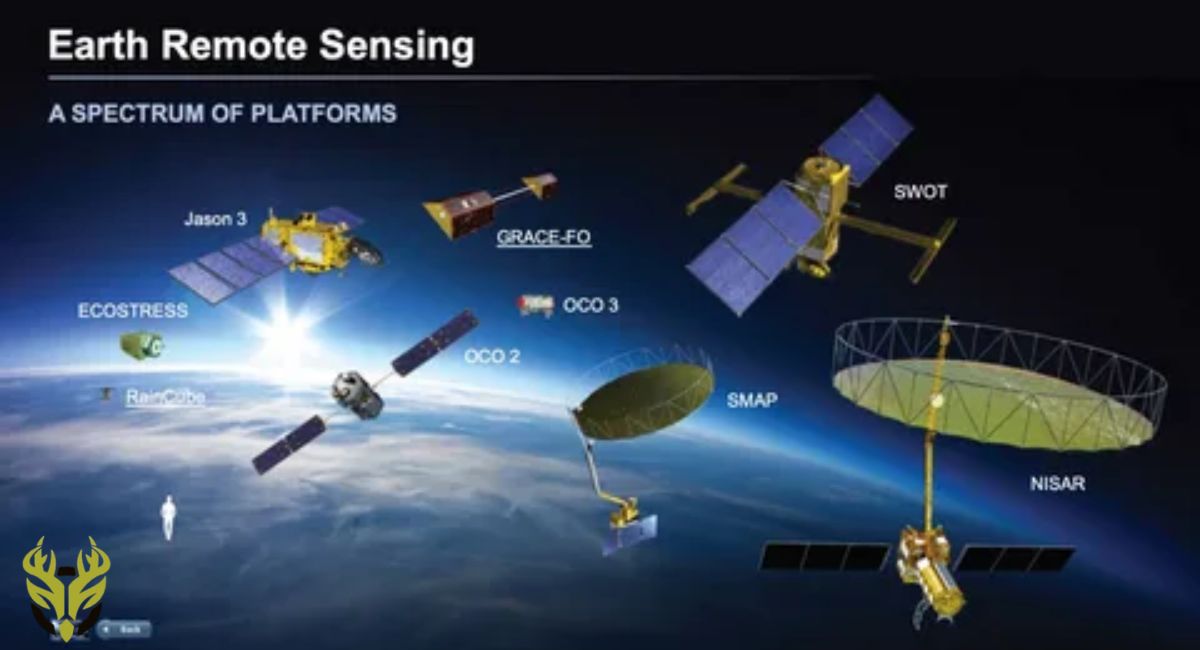
Step 1: The Sun Emits Energy
The Sun emits electromagnetic radiation, including:
- Visible light
- Infrared radiation
- Ultraviolet radiation
This energy travels through space and reaches Earth.
Step 2: Energy Interacts with Earth’s Surface
When sunlight reaches Earth:
- Some energy is absorbed.
- Some are reflected.
- Some are scattered by the atmosphere.
Different materials reflect different amounts of energy.
For example:
- Healthy vegetation reflects large amounts of near-infrared radiation.
- Water absorbs much of the incoming radiation.
- Snow and ice reflect most visible light.
Step 3: Satellite Sensors Detect Radiation
Sensors mounted on satellites measure the reflected or emitted energy.
These sensors convert the detected radiation into digital signals.
Step 4: Data Is Transmitted to Earth
The satellite sends the collected information to ground stations using radio waves.
Step 5: Data Processing and Analysis
Scientists process the received data to create:
- Satellite images
- Weather maps
- Vegetation maps
- Ocean temperature maps
- Land-use maps
- Climate models
Types of Satellite Remote Sensing
Satellite remote sensing is divided into two main types.
-
Passive Remote Sensing
Passive sensors detect natural radiation.
Usually, they measure sunlight reflected from Earth’s surface or thermal radiation emitted by objects.
Examples include:
- Optical cameras
- Multispectral sensors
- Thermal infrared sensors
Passive remote sensing depends on sunlight and is less effective at night for visible-light observations.
-
Active Remote Sensing
Active sensors generate their own energy and measure the reflected signal.
Examples include:
- Radar (Radio Detection and Ranging)
- LiDAR (Light Detection and Ranging)
Because they provide their own illumination, active sensors can operate both day and night and often through clouds (especially radar).
Advantages of Satellite Remote Sensing
Satellite remote sensing offers many benefits:
- Covers very large areas quickly.
- Monitors remote and inaccessible regions.
- Provides continuous observations over time.
- Collects data without disturbing the environment.
- Helps detect natural disasters early.
- Supports environmental conservation.
- Produces accurate digital maps.
FAQs
1. What is global climate?
Global climate refers to the long-term average pattern of temperature, rainfall, humidity, wind, and other atmospheric conditions across the Earth over many years.
2. Why is the Sun important for Earth’s climate?
The Sun is the primary source of energy for Earth. It powers the water cycle, atmospheric circulation, ocean currents, weather systems, and supports life through photosynthesis.
3. What is energy transfer from the Sun?
Energy transfer from the Sun is the movement of solar radiation to Earth through electromagnetic waves. This energy heats the atmosphere, land, and oceans, driving Earth’s climate system.
4. What is atmospheric circulation?
Atmospheric circulation is the large-scale movement of air around Earth that redistributes heat and moisture from the equator toward the poles, helping regulate global climate.
5. What are atmospheric cells?
Atmospheric cells are large convection systems in Earth’s atmosphere. The three main cells are the Hadley Cell, Ferrel Cell, and Polar Cell, each playing a role in global wind patterns and climate.
6. What are ocean currents?
Ocean currents are continuous movements of seawater driven by wind, Earth’s rotation, temperature differences, and salinity. They transport heat around the globe and influence weather and climate.
7. What is thermohaline circulation?
Thermohaline circulation is the deep-ocean circulation driven by differences in temperature and salinity. It is often called the Global Ocean Conveyor Belt because it connects all of Earth’s oceans.
8. How does the greenhouse effect affect Earth’s climate?
The greenhouse effect traps some of the infrared radiation emitted by Earth, keeping the planet warm enough to support life. Without it, Earth’s average temperature would be about −18°C.
9. What is satellite remote sensing?
Satellite remote sensing is the process of collecting information about Earth’s atmosphere, land, and oceans from satellites without making physical contact with the observed objects.
10. Why is studying global climate important?
Studying global climate helps scientists understand weather patterns, predict natural disasters, monitor climate change, protect ecosystems, and support sustainable development.
Conclusion
Earth’s climate is powered by the continuous flow of energy from the Sun. Solar radiation warms the atmosphere, land, and oceans, creating temperature differences that drive atmospheric circulation, ocean currents, and the water cycle. Processes such as the greenhouse effect, thermohaline circulation, and global wind systems help redistribute heat across the planet, maintaining a climate suitable for life. Modern technologies like satellite remote sensing allow scientists to monitor these interconnected systems and better understand environmental changes. By learning how solar energy moves through Earth’s climate system, we gain valuable insights into weather, climate change, and the delicate balance that sustains life on our planet.