
Thermal Physics Explained: Heat, Temperature & Energy Transfer Guide
Introduction to Thermal Physics.
Imagine holding a cup of hot coffee on a cold winter morning. Within a few minutes, the coffee begins to cool, while your hands feel warmer. On a sunny afternoon, the black roof of a parked car becomes much hotter than the white walls of a nearby building. When you place an ice cube in a glass of water, the ice slowly melts until both reach the same temperature. These everyday experiences may seem ordinary, but they are all governed by one fascinating branch of physics known as Thermal Physics. Thermal physics deals with collections of large numbers of particles Thermal Physics is the study of heat, temperature, thermal energy, and the movement of energy between objects. It explains why materials become hot or cold, why metals expand when heated, how refrigerators keep food fresh, why engines produce power, and even how stars like the Sun generate enormous amounts of energy. From cooking food in your kitchen to designing spacecraft that can survive the extreme temperatures of outer space, thermal physics plays a vital role in science, engineering, medicine, and everyday life. At the microscopic level, every substance is made of tiny atoms and molecules that are constantly moving. Even an object that appears perfectly still contains particles vibrating and colliding with one another. The faster these particles move, the greater their kinetic energy, and the hotter the object becomes. When particles slow down, the object loses thermal energy and its temperature decreases. Understanding this invisible motion helps explain many natural phenomena, including melting, freezing, evaporation, condensation, and the transfer of heat from one object to another.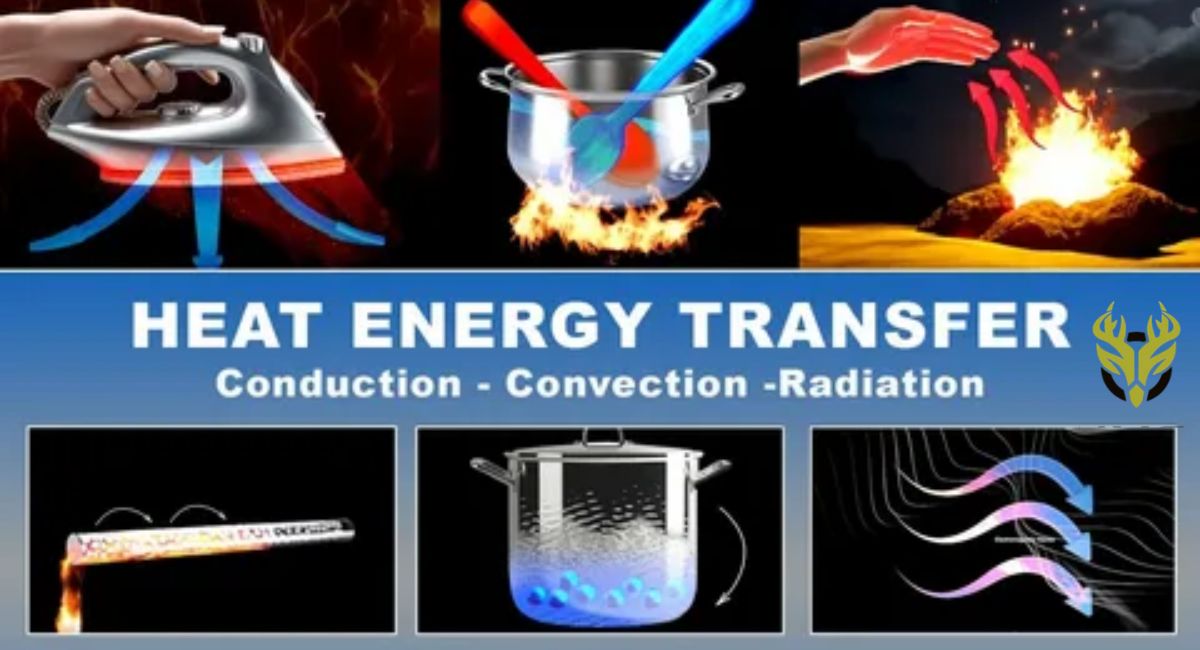
thermal physics is an important area of study which deals with the relationship between heat, work, temperature, and other forms of energy. The laws of thermodynamics describe the mechanism of energy change within a system, allowing it to perform useful work on its surroundings. A large system containing many atoms or molecules is called a macroscopic system, and a system consisting of a single atom or molecule is called a microscopic system. Macroscopic systems have properties such as temperature and pressure, these are thermal properties of the whole system. They can be observed and studied without reference to the molecular nature of matter. Microscopic systems have properties such as kinetic energy and momentum. In thermal physics, we deal with a large number of particles of the order of Avogadro’s number. These particles may be atoms or molecules in gases, liquids and solids. We can extend it to the electron motion in metals and neutrons in neutron stars. There are a number of applications of the kinetic theory of gases in daily life such as in automobile engines, turbines, pumps, air conditioners, preparation of food, and environment etc. These diverse applications make thermal physics an important area. Thermal physics is an area which includes the knowledge of statistical mechanics and kinetic theory of gases.
Unlike mechanics, which focuses on the motion of large objects, thermal physics explores the behavior of billions of microscopic particles and how their collective motion produces measurable properties such as temperature, pressure, volume, and internal energy. It connects the microscopic world of atoms with the macroscopic world we observe every day.
Thermal Physics is also closely linked to the laws of thermodynamics, which describe how energy is transferred and transformed. These laws govern everything from the operation of car engines and power plants to biological processes in the human body and climate systems on Earth. Because energy can never be completely converted into useful work without some loss as heat, thermal physics is essential for improving the efficiency of modern technologies and reducing energy waste. Today, thermal physics is one of the most important branches of modern science. Engineers use it to design efficient heating and cooling systems, scientists apply it to understand weather and climate, doctors rely on it in medical technologies such as thermal imaging, and manufacturers use it to produce stronger materials and more efficient electronic devices. Whether you are studying physics for the first time or preparing for advanced engineering courses, understanding thermal physics provides the foundation for explaining countless physical processes in the natural world.
In this comprehensive guide, you will learn the fundamental concepts of Thermal Physics in a simple and intuitive way. We will explore the meaning of heat and temperature, methods of heat transfer, thermal expansion, gas laws, the laws of thermodynamics, entropy, heat engines, refrigeration systems, and many real-life applications. By the end of this article, you will understand not only the formulas and principles but also how thermal physics shapes the world around us every single day.
Thermal Physics.
Thermal Physics is the branch of physics that deals with the relationships among heat, temperature, energy, work, and the physical properties of matter, describing how energy is transferred and transformed according to the laws of thermodynamics.
History and Development of Thermal Physics.
The development of thermal physics took place over several centuries as scientists sought to understand the nature of heat and energy. Early civilizations knew that fire produced heat, but they did not understand why objects became hot or how heat moved. During the seventeenth century, scientists began making careful observations and measurements. Galileo Galilei developed one of the earliest thermoscopes, which eventually led to the invention of the thermometer. This made it possible to measure temperature instead of simply feeling whether an object was hot or cold. Later, Robert Boyle discovered that the pressure of a gas changes with its volume, laying the foundation for gas laws. Jacques Charles showed that gases expand when heated, while Joseph Louis Gay-Lussac explained how gas pressure varies with temperature. In the nineteenth century, James Prescott Joule demonstrated that heat is a form of energy rather than a mysterious substance. His experiments established the mechanical equivalent of heat, showing that mechanical work can be converted into thermal energy.
At nearly the same time, Rudolf Clausius and William Thomson, 1st Baron Kelvin developed the laws of thermodynamics, providing a mathematical framework for understanding energy transfer and heat flow. Later, Ludwig Boltzmann connected thermodynamics with the microscopic behavior of atoms and molecules through statistical mechanics, giving thermal physics its modern scientific foundation. Today thermal physics combines thermodynamics, kinetic theory, and statistical mechanics to explain phenomena ranging from household appliances to stars and galaxies.
Difference Between Heat and Temperature.
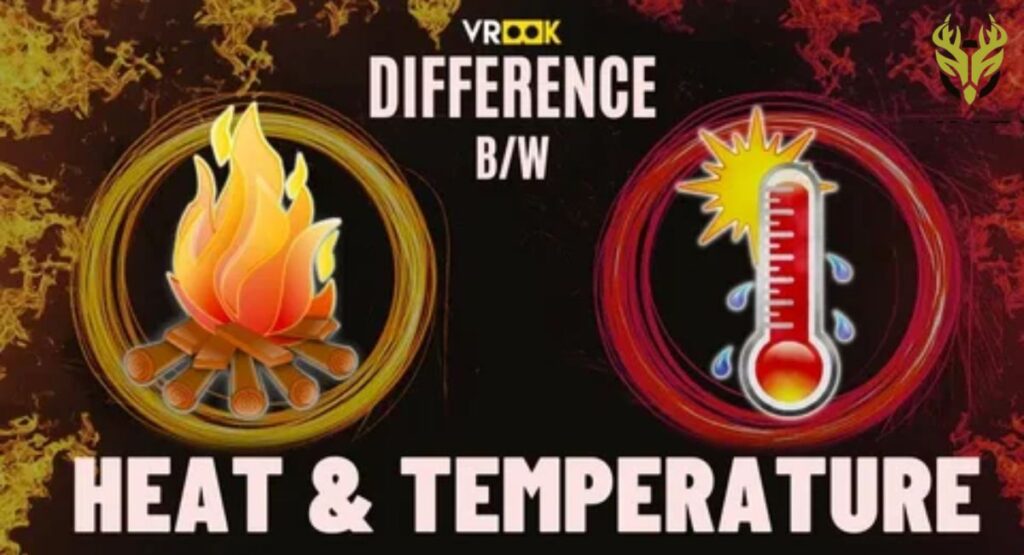
- Heat is energy in transit. It flows from a hotter object to a colder object because of a temperature difference.
Heat is measured in joules (J) in the SI system.
SI Unit.
The SI unit of heat is:
Joule (J)
Another commonly used unit is:
Calorie (Cal)
Conversion
1 Cal=4.186 J
Formula for Heat
The amount of heat transferred without a phase change is given by:
Q=mcΔT
where:
- Q = Heat absorbed or released (J)
- m = Mass (kg)
- c = Specific heat capacity (J/kg· K)
- ΔT = Change in temperature (°C or K)
This equation shows that the heat required depends on the material, its mass, and the temperature change.
Internal Energy.
Definition
Internal energy is the total energy contained within a substance due to the random motion and interactions of its atoms and molecules.
It includes:
- Kinetic energy of moving particles.
- Potential energy due to the forces between particles.
Unlike heat, internal energy is stored within the system.
- Temperature, on the other hand, is a measure of how hot or cold an object is. It indicates the average kinetic energy of the particles within a substance.
Temperature is measured in Kelvin (K), degrees Celsius (°C), or degrees Fahrenheit (°F).
For example, imagine placing a cold metal spoon into a cup of hot coffee. The coffee has a higher temperature than the spoon. Because of this temperature difference, heat flows from the coffee to the spoon until both reach the same temperature. The heat is the energy being transferred, while the temperature indicates the thermal state of each object.
Why Do We Need Different Temperature Scales?
Different countries and scientific fields developed different methods for measuring temperature. Today, the three most common temperature scales are:
- Celsius (°C)
- Kelvin (K)
- Fahrenheit (°F)
Each scale has a different reference point, but all measure the same physical quantity.
Celsius Scale (°C).
The Celsius scale is the most widely used temperature scale in everyday life and science.
Reference Points
- Freezing point of water = 0°C
- Boiling point of water = 100°C
These values are measured at standard atmospheric pressure.
he Celsius scale is convenient because it is directly related to the freezing and boiling points of water.
Kelvin Scale (K).
The Kelvin scale is the SI unit of temperature and is mainly used in physics, chemistry, and engineering. Unlike Celsius, Kelvin begins at absolute zero, the lowest possible temperature.
Absolute Zero(k)
Absolute zero is:
0 K = -273.15°C
At this temperature, the thermal motion of particles reaches its minimum possible value.
Scientists prefer Kelvin because many thermodynamic equations require absolute temperature rather than relative temperature.
Temperature Conversion Formulas.
Celsius to Kelvin
K=°C+273.15
Kelvin to Celsius
°C=K−273.15
Celsius to Fahrenheit
°F=95(°C)+32
Fahrenheit to Celsius
°C=59(°F−32)
Worked Example 1
Convert 25°C into Kelvin.
Solution
K=25+273.15
Answer: 298.15 K
Worked Example 2
Convert 68°F into Celsius.
Solution
To convert 68°F to Celsius, subtract 32 from 68, which gives 36. Then multiply 36 by 5/9. The result is 20°C.
Therefore, 68°F = 20°C.
Fahrenheit Scale (°F).
The Fahrenheit scale is commonly used in the United States for weather forecasts, cooking, and everyday temperature measurements.
Reference Points
- Water freezes at 32°F
- Water boils at 212°F
-
Zeroth Law of Thermodynamics.
If Object A and Object B have the same temperature as Object C, then Object A and Object B must also have the same temperature.
Thermal Equilibrium.
The Zeroth Law is based on the concept of thermal equilibrium.
Thermal equilibrium is the state in which two or more objects in thermal contact have the same temperature, so no net heat flows between them.
When two objects have different temperatures, heat naturally flows from the hotter object to the colder one. This continues until both objects reach the same temperature.
Once their temperatures become equal, heat transfer stops, and the objects are said to be in thermal equilibrium.
Real-Life Examples
Example 1: Measuring Body Temperature
When a digital thermometer is placed under your tongue, heat flows between your body and the thermometer. After a few seconds, both reach the same temperature. The thermometer then displays your body temperature.
This is an application of the Zeroth Law of Thermodynamics.
Introduction to Heat Transfer.
Have you ever wondered why the handle of a metal spoon becomes hot when left in a cup of tea, why water circulates while boiling, or how you feel the warmth of the Sun even though space is almost a vacuum? These everyday experiences are all examples of heat transfer.
Heat transfer is the process by which thermal energy moves from a hotter object or region to a colder one because of a temperature difference. According to the Second Law of Thermodynamics, heat naturally flows from a higher temperature to a lower temperature until thermal equilibrium is reached.
There are three main methods of heat transfer:
- Conduction – Heat transfer through direct contact.
- Convection – Heat transfer through the movement of fluids (liquids or gases).
- Radiation – Heat transfer through electromagnetic waves without requiring a material medium.
What Is Conduction?
Conduction is the transfer of thermal energy through a substance by direct particle-to-particle interaction, without any overall movement of the substance.
Particle Explanation.
In Solids
Conduction is most effective in solids, especially metals, because their particles are tightly packed. In metals, free electrons also carry energy rapidly, making metals excellent conductors of heat.
In Liquids and Gases.
Liquids and gases can conduct heat, but much less efficiently because their particles are farther apart and collide less frequently.
Examples of Conduction.
- A metal spoon becomes hot when placed in hot tea.
- An iron pan heats up on a stove.
- Walking barefoot on hot sand warms your feet.
- An ice cube melts faster when held in your hand.
Formula for Conduction (Fourier’s Law).
The rate of heat transfer by conduction is given by:
-
Heat Capacity.
Heat capacity is the amount of heat required to raise the temperature of an entire object by 1°C or 1 K.
Unlike specific heat capacity, heat capacity depends on the mass of the object.
C=ΔQ/T
Formula.
C = Heat capacity (J/K)
Q = Heat supplied (J)
ΔT = Temperature change (K or °C)
SI Unit. J/K
Latent Heat.
Latent heat is the heat absorbed or released during a change of state without any change in temperature. The word latent means hidden, because the energy is used to break or form intermolecular bonds instead of increasing the temperature.
Types of Latent Heat
-
Latent Heat of Fusion
The heat required to change solid into liquid without changing the temperature.
Example:
-
- Ice melting into water at 0°C.
-
Latent Heat of Vaporization
The heat required to change liquid into gas without changing the temperature.
Example:
- Water boils into steam at 100°C.
Formula
Q=mL
Where:
- Q = Heat absorbed or released (J)
- m = Mass (kg)
- L = Specific latent heat (J/kg)
Everyday Examples
- Ice melting in a drink.
- Water boiling in a kettle.
- Steam condensing on a bathroom mirror.
- Wax melting in a candle.
Calorimetry.
Calorimetry is the process of determining the amount of heat transferred by measuring changes in temperature.
The instrument used is called a calorimeter.
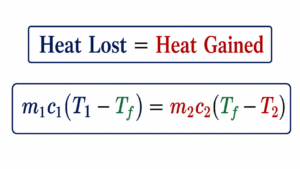
m1 = Mass of the hotter substance
c1= Specific heat capacity of the hotter substance
T1 = Initial temperature of the hotter substance
m2 = Mass of the colder substance
c2 = Specific heat capacity of the colder substance
T2 = Initial temperature of the colder substance
Tf = Final equilibrium temperature
Worked Example
A 0.5 kg block of hot iron at 80°C is placed in 1 kg of water at 20°C. Assuming no heat loss to the surroundings, the heat lost by the iron equals the heat gained by the water.
Using the calorimetry principle:
Heat Lost=Heat Gained
Substituting the appropriate values for mass, specific heat capacity, and temperature changes allows you to solve for the final equilibrium temperature. This method is widely used in laboratory experiments to determine unknown temperatures or the specific heat capacity of materials.
Applications of Calorimetry
- Measuring the specific heat capacity of substances.
- Determining the energy content of foods.
- Studying chemical reactions.
- Designing efficient heating and cooling systems.
- Fuel testing in industries.
- Medical and pharmaceutical research.
What Is an Ideal Gas?
An ideal gas is a hypothetical gas that perfectly follows all gas laws under every condition of temperature and pressure. Although no real gas behaves perfectly, gases such as oxygen, nitrogen, hydrogen, and helium behave very similarly to an ideal gas under ordinary conditions.
An ideal gas assumes that:
- Gas particles occupy negligible volume.
- There are no attractive or repulsive forces between particles.
- Particles move continuously and randomly.
- Collisions between particles are perfectly elastic.
- The average kinetic energy depends only on the absolute temperature.
BROWNIAN MOTION.
Brownian motion is the random and irregular motion of molecules in a gas. In 1827, Robert Brown, a botanist, observed under a microscope that tiny plant pollen grains suspended in water moved randomly. These particles were identified as dust particles. Later, it was proved to be one of the effects of molecular motion. A molecule in a gas changes its path after collision with another molecule. When it keeps on colliding with other molecules, the interacting molecule follows a random or zig-zag motion. In fact, collision transfers or exchanges the momentum and energy between the molecules .Brownian motion describes randomness and chaos, therefore, it represents one of the simple models of randomness. There are various reasons and causes of this motion which are given as under:.
- For a given impulse, lighter (smaller-mass) particles gain a large change in velocity, so they show more vigorous Brownian motion. Avoid trying it to particle size.
- The speed of the particles is inversely proportional to the viscosity of the fluid. Low viscosity of the fluid results in faster Brownian movement.
- Viscosity describes the magnitude of the internal friction in a fluid. It represents the resistance to flow of the fluid. For your information Albert Einstein explained the pollen movement in a liquid assisted by the molecules in 1905. In 1908, a French physicist J Perrin experimentally verified Einstein’s explanation which earned him the 1926 Nobel Prize in physics.
- Brownian motion causes the particles of a fluid to be in constant motion.
Why Does Brownian Motion Occur?
According to the kinetic theory of matter, molecules in a fluid are always moving. Their motion becomes more vigorous as the temperature increases.
A microscopic particle suspended in the fluid is struck by enormous numbers of molecules. At any particular instant, the impacts from different directions are not perfectly balanced. One side may experience slightly more collisions than another, causing the particle to move in a particular direction. A moment later, the balance of collisions changes, so the particle changes direction again. This process continues continuously, producing the characteristic random motion known as Brownian motion.
Example of Brownian Motion
A classic example is pollen grains in water. When pollen grains are placed in water and viewed under a microscope, they appear to move randomly in different directions.
Another example is the motion of tiny dust or smoke particles in air. The surrounding air molecules continuously collide with these particles, causing them to move irregularly.
Brownian Motion and Temperature
Temperature has an important effect on Brownian motion. When the temperature of a fluid increases, its molecules generally have greater average kinetic energy and move more rapidly. As a result, collisions with suspended particles become more energetic, and the observed Brownian motion generally becomes more vigorous.
Thus:
Higher temperature→ more vigorous Brownian motionAt lower temperatures, molecular motion decreases, so Brownian motion becomes less vigorous.
Factors Affecting Brownian Motion.
The intensity of Brownian motion depends mainly on the temperature of the fluid, size of the suspended particle, and viscosity of the surrounding medium.
Smaller particles generally show more noticeable Brownian motion because their motion is more strongly affected by individual molecular collisions. Increasing temperature usually increases the motion, while increasing the viscosity of the fluid tends to reduce the particle’s movement.
Brownian Motion and Molecular Theory.
Brownian motion provides important evidence that matter is made of tiny particles that are in constant motion. Before atoms and molecules could be observed directly, Brownian motion was an important experimental clue supporting the atomic theory of matter.
In 1905, Albert Einstein provided a mathematical explanation of Brownian motion using molecular theory. His work showed how the observable random motion of microscopic particles could arise from collisions with invisible molecules.
Later, experimental work by Jean Perrin helped provide strong evidence for the molecular nature of matter.
Brownian Motion in Gases and Liquids.
Brownian motion can occur when small particles are suspended in both liquids and gases. In a liquid, molecules of the liquid collide with suspended particles. In a gas, gas molecules produce collisions.
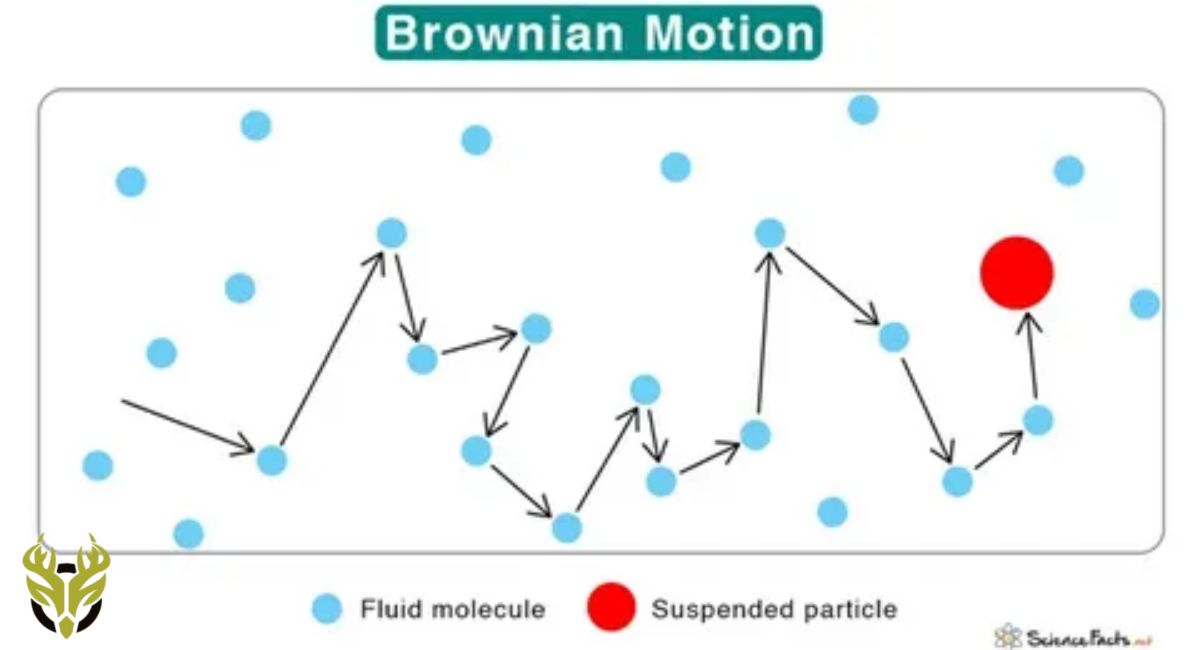
For example, smoke particles suspended in air can exhibit Brownian motion, while pollen particles suspended in water provide the classic classroom demonstration.
Importance of Brownian Motion.
Brownian motion is important because it connects what we can observe at the microscopic level with the behavior of atoms and molecules. It supports the kinetic theory of matter and helps explain why particles suspended in fluids do not remain completely still.
It is also related to modern scientific fields such as diffusion, statistical mechanics, colloidal science, and nanotechnology.
Brownian Motion vs Random Motion.
Brownian motion should not simply be described as ordinary random movement. The randomness has a physical cause: many microscopic collisions from surrounding molecules.
The suspended particle follows an unpredictable path because the individual molecular collisions are extremely numerous and occur in constantly changing directions.
Conclusion
Brownian motion is the random motion of microscopic particles suspended in a fluid, caused by continuous collisions with the rapidly moving molecules of the fluid. It provides strong experimental support for the idea that matter consists of constantly moving atoms and molecules.
FAQs.
1. What is the difference between heat and temperature?
Heat is energy in transit that flows between objects due to a temperature difference, measured in joules. Temperature measures the average kinetic energy of particles in a substance, measured in Kelvin, Celsius, or Fahrenheit.2. What are the three methods of heat transfer?
Conduction (through direct contact), convection (through fluid movement), and radiation (through electromagnetic waves, requiring no medium).3. What is the Zeroth Law of Thermodynamics?
It states that if two objects are each in thermal equilibrium with a third object, they must also be in thermal equilibrium with each other — this is the basis for how thermometers work.4. Why does water have a high specific heat capacity?
Water requires a large amount of energy to change temperature, which is why oceans warm and cool slowly, helping regulate Earth’s climate.5. What is latent heat?
Latent heat is the energy absorbed or released during a change of state (like melting or boiling) without any change in temperature, since the energy breaks or forms intermolecular bonds instead.6. What is Brownian motion and why is it important?
Brownian motion is the random, zig-zag movement of particles suspended in a fluid caused by collisions with fast-moving molecules. It provided key experimental evidence for the atomic theory of matter, explained mathematically by Einstein in 1905.7. What is absolute zero?
Absolute zero is 0 K (−273.15°C), the theoretical lowest possible temperature, where particle thermal motion reaches its minimum.
-