
Kinetic Theory & Stellar Evolution: From Gas Physics to Black Holes
What Is Kinetic Theory?
Kinetic theory is a model that explains the physical properties of matter in terms of the motion and interactions of its microscopic particles.
For gases, the kinetic theory of gases is especially useful because gas molecules are relatively far apart compared with their sizes and move freely through the available space. The basic idea is simple: matter consists of particles that are continuously moving. The temperature of a substance is closely related to the average kinetic energy of its particles.
KE = ½mv²
Assumptions of the Kinetic Theory of Gases
- The ideal-gas kinetic model makes several simplifying assumptions. Gas molecules are considered to be extremely small compared with the volume occupied by the gas, so their individual volumes can usually be neglected.
- The molecules are assumed to move continuously and randomly in all directions.
Collisions between molecules and with the walls of the container are treated as elastic collisions, meaning that total kinetic energy is conserved during an ideal collision. Between collisions, molecules are assumed to move approximately in straight lines.
- The molecules are also assumed not to exert significant attractive or repulsive forces on one another except during collisions.
- These assumptions describe an ideal gas. Real gases can deviate from this behavior, particularly at very high pressures and very low temperatures.
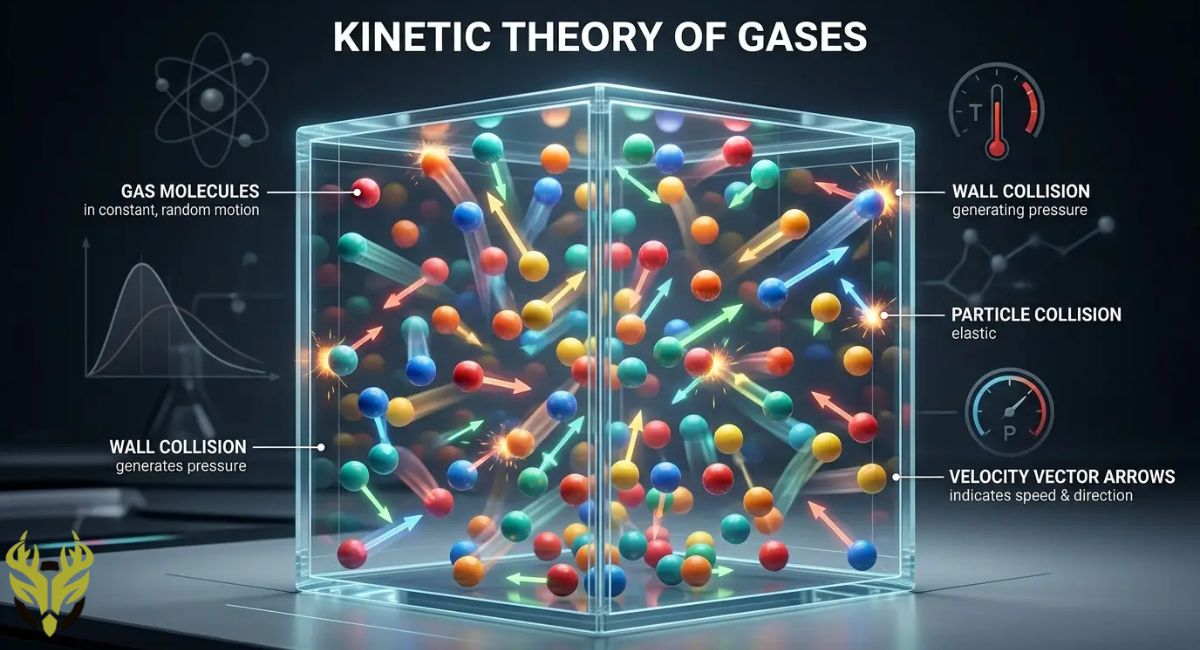
Pressure According to Kinetic Theory.
Gas pressure results from collisions between gas molecules and the walls of their container. Every collision transfers momentum to the wall. Although an individual collision is extremely small, an enormous number of collisions occur every second, producing a measurable pressure.
Kinetic theory gives the relationship.
P = 1⁄3ρv̄2
where P is pressure, ρ is gas density, and v2 is the mean square speed of the molecules.
Since
ρ=Nm\V
the equation can also be written as.
PV = 1⁄3Nm‾v2
where N is the number of molecules and m is the mass of one molecule. This equation connects the macroscopic pressure and volume of a gas with the microscopic motion of its molecules.
Kinetic Theory and the Ideal Gas Equation.
The ideal gas equation is.
PV = NkBT
where N is the number of molecules. Using the molar form, it becomes
PV=nRT
where n is the number of moles and R is the universal gas constant.
Kinetic theory explains why this equation works. The pressure comes from molecular collisions, while temperature represents the average kinetic energy of the molecules. Therefore, the ideal gas equation is not simply an experimental formula; kinetic theory provides a microscopic explanation for it.
Root-Mean-Square Speed.
Gas molecules do not all move at the same speed. Some move slowly, while others move much faster. Therefore, we often use the root-mean-square speed to describe their typical speed.
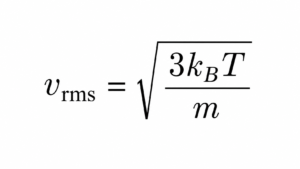
For a gas with molar mass M: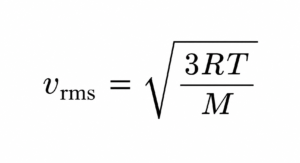
This shows that molecular speed increases with temperature and decreases as molecular mass increases. For example, at the same temperature, lighter gas molecules generally move faster than heavier gas molecules.
What Is Statistical Physics?
Statistical physics is the branch of physics that uses probability and statistics to explain the collective behavior of systems containing very large numbers of particles.
- A single molecule may behave unpredictably, but a system containing billions or trillions of molecules can show highly predictable properties.
Imagine throwing a single coin. The result is uncertain. But if you throw millions of coins, the fraction of heads becomes very close to a predictable value. Statistical physics works with a similar idea: individual microscopic events may be unpredictable, but the average behavior of enormous numbers of particles becomes remarkably reliable.
So far we know that kinetic theory of gases is used to determine the pressure of the ideal gas using the gas laws assuming the random motion of molecules. For a large number of molecules, we use statistical physics. It is the branch of physics that uses probability theory. Accordingly, atoms and molecules of a system may exist in different energy states , , , ……,et c due E, E1 ,E2 For your information In 1860 James Clark Maxwell (1831–1879) derived an expression that describes the distribution of molecular speeds within the system at thermal equilibrium. About 60 years later, experiments were performed to confirm Maxwell’s predictions. 3 to different speeds. Boltzmann derived the Boltzmann kinetic equation. This equation describes the dynamic processes in gases having a large number of molecules. Boltzmann constant is also related to the population of atoms in two levels.
N2N1
=e−ΔE/(kBT)
where 1 N and N are the population of lower and higher E, E1, E 2 energy states,
∆ = (E2-E1)is the energy difference between these states. The number 2 1 density is directly proportional to the pressure. The above equation is known as the Boltzmann distribution law and is important in describing the statistical mechanics of a large number of molecules. It states that the probability of finding the molecules in a particular energy state varies exponentially as the negative of the energy divided by k ; therefore, more particles reside in lower energy states than in higher ones. B T In a gas container, a molecule undergoes billions of collisions every second. Each collision changes the speed of a molecule thereby changing the kinetic energy, but kinetic theory concludes that average kinetic energy at temperature T. B where k is effectively the gas constant per molecule.
Microstates and Macro states.
A microstate describes the detailed microscopic condition of a system. For a gas, this could include the position and momentum of every molecule. A macro state describes the system using measurable quantities such as pressure, volume, temperature, and number of particles.
- Many different microstates can correspond to the same microstate.
For example, a gas may have a particular pressure and temperature even though its molecules are constantly changing positions and velocities. The exact microscopic arrangement is continually changing, but the macroscopic properties can remain essentially constant.
Boltzmann Distribution.
The Boltzmann distribution describes how particles are distributed among different energy states when a system is in thermal equilibrium.
The probability of finding a system in a state of energy E is proportional to e−E/(kBT)
Higher-energy states are generally less likely to be occupied than lower-energy states, although increasing the temperature makes higher-energy states more accessible.
The Boltzmann distribution is extremely important because it connects energy, temperature, and probability.
Entropy and Statistical Physics.
One of the most important concepts in statistical physics is entropy.
Entropy can be understood statistically as a measure related to the number of microscopic arrangements available to a macroscopic state.
Boltzmann expressed this idea through the famous relation:
where S is entropy and Ω represents the number of accessible microscopic configurations, or microstates, corresponding to the macrostate. A macrostate that can be produced by many different microstates has greater statistical weight.
This provides a microscopic interpretation of the second law of thermodynamics: isolated systems tend naturally toward macrostates that correspond to overwhelmingly larger numbers of possible microstates.
Connection With Thermodynamics.
Kinetic theory and statistical physics provide a microscopic foundation for thermodynamics.
Thermodynamics describes quantities such as temperature, pressure, internal energy, and entropy without necessarily considering individual particles. Statistical physics explains where these quantities come from at the microscopic level.
For example, thermodynamics tells us that increasing the temperature of an ideal gas increases its internal energy. Statistical physics explains this by showing that higher temperature corresponds to a higher average molecular kinetic energy.
Thus, the two approaches complement each other:
Microscopic behavior→ Statistical description→ Macroscopic properties.
STELLAR EVOLUTION.
Introduction.
Stellar evolution is the process through which a star changes during its lifetime. A star is not a permanent object; it is a dynamic system that forms, evolves, and eventually reaches an endpoint determined mainly by its initial mass. The entire process can take millions, billions, or even trillions of years, depending on the star. The kinetic theory of gases, when extended to astrophysical systems like stars and galaxies, helps us understand the evolution of stars in a galaxy or gas atoms in a stellar atmosphere.
That said, the last sentence feels like it’s reaching for a connection that doesn’t quite land — kinetic theory does help explain gas behavior within a star (pressure, temperature, how a stellar atmosphere behaves), but it’s not really what drives stellar evolution itself; that’s mostly gravity, nuclear fusion, and mass. If you want, I can rewrite that last line so it sets up the article more accurately, or tell me what angle the rest of the piece takes and I’ll match the intro to it.
A star spends most of its life balancing two competing effects.
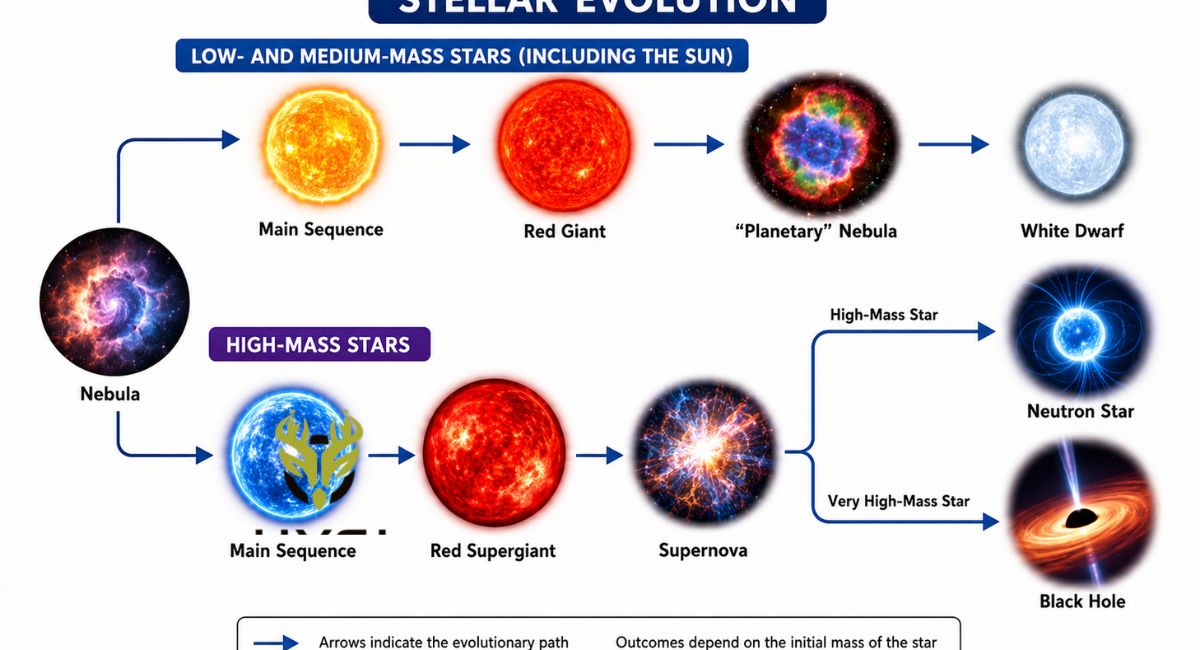
Gravity pulls matter inward, while the pressure produced by hot gas and nuclear energy pushes outward. When these forces remain balanced, the star is in hydrostatic equilibrium. As the fuel available for nuclear fusion changes, this balance changes, causing the star’s structure, temperature, brightness, and size to evolve. Stellar evolution deals with the star changes over the time. Stars can have a range of lifetime from a few million years to trillions of years. The life of a star depends on the mass of the star. All stars are formed from the clouds of gas and dust which are often called nebulae or molecular clouds. This is also called a proto-star. As the cloud contracts, its density and temperature increase due to the rise in K.E. of particles (K.E proportional to T). After millions of years, these proto-stars can become a star having achieved a state of equilibrium. The rms velocity of gases in the star increases with rise of density. This in turn increases the average kinetic energy and finally temperature increases with time.
What Is Stellar Evolution?
Stellar evolution describes the sequence of physical changes that occur in a star from its formation to its final state. The most important factor controlling a star’s evolutionary path is its initial mass.
Massive stars have stronger gravitational forces and therefore require higher internal pressures and temperatures to remain stable. They consume their nuclear fuel much faster than low-mass stars. As a result, a massive star can live for only a few million years, whereas a star similar to the Sun can remain on the main sequence for roughly 10 billion years.
What Is Stellar Evolution?
Stellar evolution describes the sequence of physical changes that occur in a star from its formation to its final state. The most important factor controlling a star’s evolutionary path is its initial mass.
Massive stars have stronger gravitational forces and therefore require higher internal pressures and temperatures to remain stable. They consume their nuclear fuel much faster than low-mass stars. As a result, a massive star can live for only a few million years, whereas a star similar to the Sun can remain on the main sequence for roughly 10 billion years.
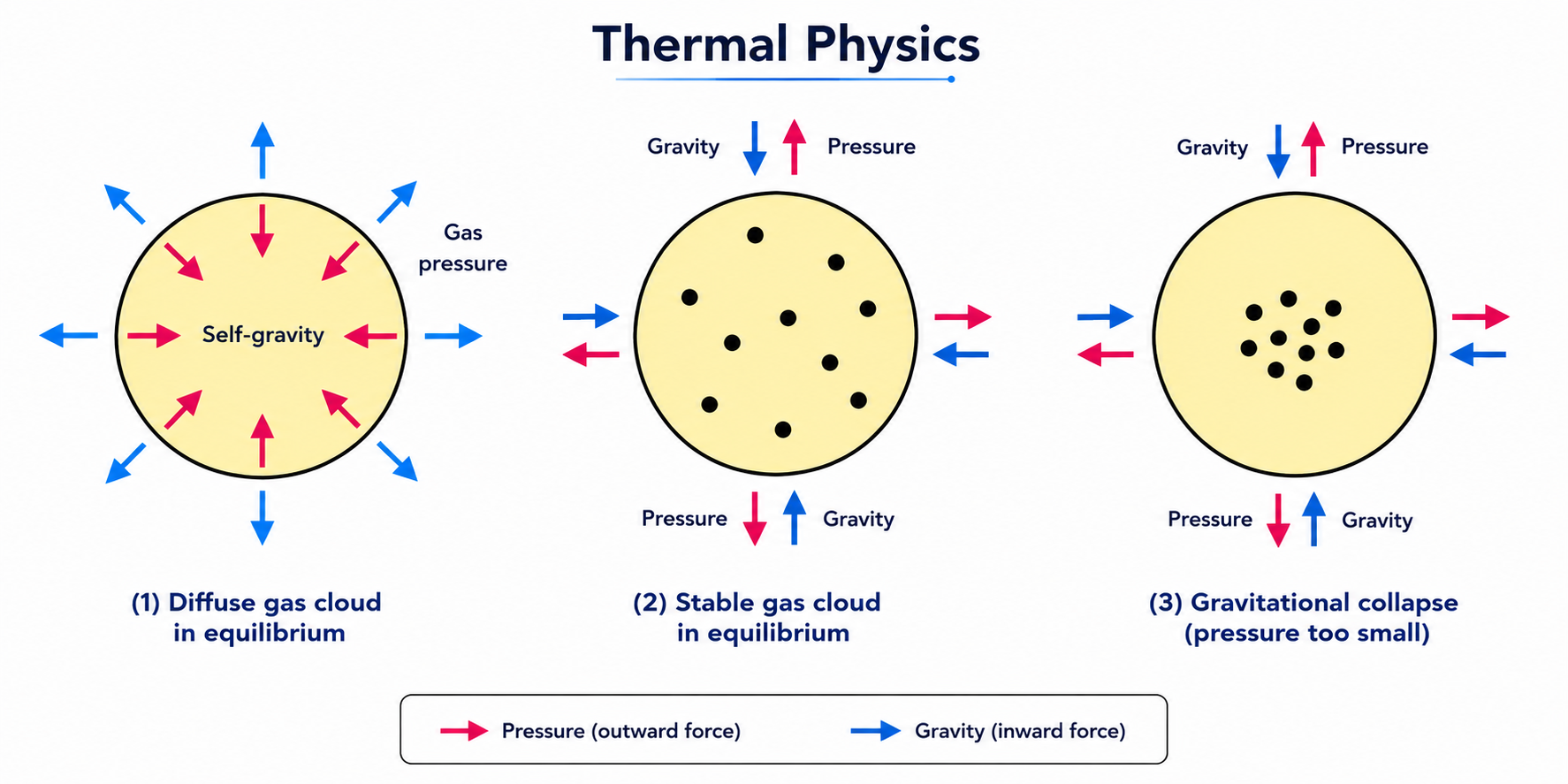
Effect of temperature.
As the temperature increases, the internal pressure also rises. A stable star is formed when the inward gravitational force is exactly balanced by the outward pressure. This condition is described by the hydrostatic equation; 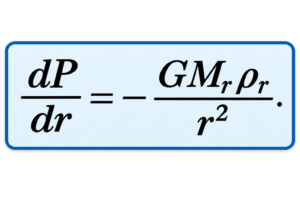
This equation ensures that the star neither collapses under gravity nor expands indefinitely. P is the pressure inside the star, dP/dr is the rate of change of pressure with radius (how pressure changes from the Centre outward), r is distance from the centre of the star, G is gravitational constant (6.67 10-11 Nm2 kg-2)M is mass enclosed within radius r, is r density at radius r, and negative sign indicates that pressure decreases outward, while gravity pulls inward. There are two possibilities if the balance between pressure force and gravitational force is not maintained.
- Gravitational force > Internal pressure
- Gravitational force < Internal pressure
As the temperature within a star’s core rises, nuclear fusion is initiated, allowing hydrogen nuclei to combine and form helium. This process releases an immense amount of energy, which sustains the star and powers it for the majority of its lifetime. The continuous energy production not only maintains equilibrium against gravitational collapse but also leads to a gradual increase in internal temperature. As a consequence, the star begins to expand. With further increases in temperature and changes in core composition, the star may expand significantly to become a red giant. At this stage, stars possessing at least about half the mass of the Sun are capable of initiating helium fusion in their cores, producing heavier elements such as carbon and oxygen. In more massive stars, the process continues with the fusion of even heavier elements in successive stages, forming increasingly complex nuclei up to iron. The final fate of a star depends primarily on its mass. Once a star exhausts its nuclear fuel, it can no longer support itself against gravitational collapse. In low and intermediate mass stars, the core contracts into a dense white dwarf, while the outer layers are expelled into space, forming a planetary nebula. In contrast, stars with masses roughly ten times greater than that of the Sun undergo a dramatic supernova explosion. During this event, the inert iron core collapses under gravity, leading to the formation of dense remnants such as neutron stars or black holes. Red dwarf stars, due to their low mass and highly efficient fuel consumption, follow a much slower evolutionary path. The universe is not yet old enough for any red dwarf to have completed its life cycle. However, theoretical models indicate that these stars will gradually become hotter and more luminous over time before eventually exhausting their hydrogen fuel and evolving into low mass white dwarfs.
-
Birth of a Star: Molecular Clouds
Stars begin inside enormous, cold clouds of gas and dust called molecular clouds. These clouds contain mostly hydrogen, along with helium and small amounts of heavier elements. A region within a molecular cloud can become unstable under gravity. Once gravity begins to overcome internal pressure, the material starts collapsing toward its center.
As the cloud contracts, gravitational potential energy is converted into thermal energy. The central region becomes increasingly dense and hot.
This collapsing object is called a protostar.
-
Protostar Stage
A protostar is a developing star that has not yet begun sustained hydrogen fusion in its core.
As the protostar contracts, its core temperature rises. Material surrounding the protostar may form a rotating accretion disk. Jets of material can also emerge along the rotational axis.
Eventually, the core becomes hot and dense enough for hydrogen nuclei to begin fusing efficiently. For a Sun-like star, hydrogen fusion primarily occurs through the proton–proton chain:
A small amount of mass is converted into energy according to Einstein’s equation:
E=mc^2
When sustained nuclear fusion begins, the object officially becomes a star.
-
Main Sequence
The main sequence is the longest and most stable stage of stellar evolution. During this period, a star converts hydrogen into helium in its core. The energy produced by fusion creates outward pressure that balances the inward pull of gravity.
This balance is called hydrostatic equilibrium. For most of its main-sequence lifetime, a star’s basic structure remains relatively stable. However, hydrogen in the core is gradually consumed, and helium accumulates. The Sun is currently a main-sequence star. It is approximately 4.6 billion years old and has several billion years of main-sequence evolution remaining.
-
Red Giant Stage
Eventually, the hydrogen in the core becomes depleted. Hydrogen fusion in the central region decreases, and the core begins to contract under gravity. As the core contracts, it becomes hotter. Hydrogen fusion then continues in a shell surrounding the helium-rich core.
The increased energy output causes the outer layers of a Sun-like star to expand dramatically. The surface becomes cooler, giving the star its characteristic reddish appearance.
The star enters the red giant stage.
A red giant can become hundreds of times larger than its original size. If the Sun were at this stage, its outer atmosphere would expand dramatically and alter the inner Solar System.
-
Helium Fusion
For a star with a mass similar to the Sun, the contracting core eventually becomes hot enough for helium fusion to begin.The main process is the triple-alpha process, in which three helium nuclei ultimately form a carbon nucleus:
Some carbon can also combine with helium to form oxygen.
The beginning of helium fusion changes the internal structure of the star. In low- and intermediate-mass stars, this stage eventually ends when the core’s helium supply becomes depleted.
-
Formation of a Planetary Nebula
After the helium-burning stage, a Sun-like star cannot continue indefinitely with nuclear fusion. The star becomes unstable and loses its outer layers into space. These expanding layers form a beautiful cloud of gas called a planetary nebula.
Despite its name, a planetary nebula has nothing directly to do with planet formation. The historical name arose because some of these objects appeared somewhat planet-like through early telescopes.
The expelled material enriches interstellar space with elements that can later become part of new stars, planets, and other astronomical objects.
-
White Dwarf
After losing its outer layers, the remaining core of a low- or intermediate-mass star becomes a white dwarf.A white dwarf is extremely dense. It is roughly comparable in size to Earth but can contain a substantial fraction of the Sun’s mass.
Unlike a normal star, a white dwarf does not generate significant energy through ongoing nuclear fusion. Instead, it gradually radiates the thermal energy stored in its interior. Its stability is provided primarily by electron degeneracy pressure, a quantum-mechanical effect.
Over extremely long timescales, an isolated white dwarf would continue cooling. The hypothetical final cold state is called a black dwarf, although the universe is not old enough for any black dwarfs to exist.
-
Evolution of Massive Stars
Stars with much greater initial masses follow a dramatically different evolutionary path.
After hydrogen is exhausted, massive stars can continue nuclear fusion at progressively higher temperatures. They may fuse helium into carbon and oxygen and eventually fuse heavier elements through successive burning stages. The interior of an evolved massive star can develop a structure resembling an onion, with different layers undergoing different nuclear reactions.
Eventually, fusion produces a core rich in iron-group elements. At this point, the situation changes fundamentally.
-
Why Iron Is the Turning Point
Fusion of light nuclei releases energy because the resulting nuclei can have greater binding energy per nucleon. However, fusing iron-group nuclei into heavier nuclei does not provide the same energy source. Therefore, an iron-rich core cannot continue producing enough energy through ordinary fusion to support the star against gravity.
The core eventually collapses extremely rapidly.
This collapse can trigger one of the most powerful explosions in the universe: a core-collapse supernova.
-
Supernova
A supernova is an enormous stellar explosion associated with certain late stages of stellar evolution.During core collapse, the central region of a massive star contracts rapidly. The outer layers can be violently expelled into space.
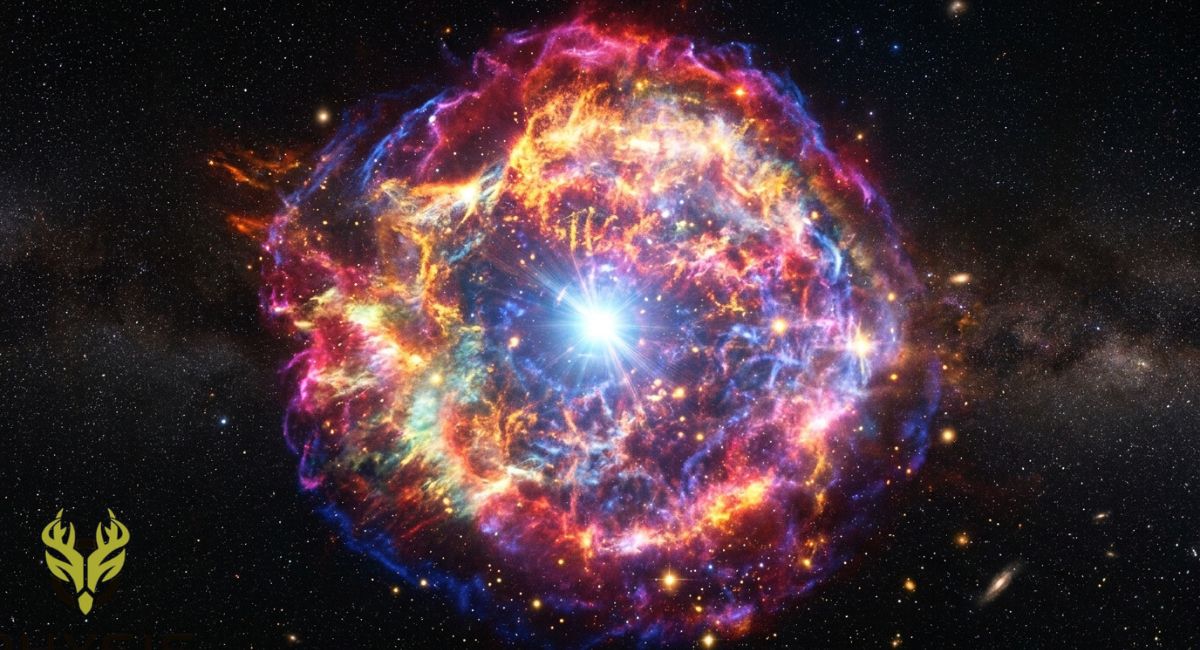
A supernova releases enormous amounts of energy and produces conditions in which many heavy elements can form. The explosion also distributes newly formed and pre-existing elements into the surrounding interstellar medium.
These materials can later participate in the formation of new stars and planetary systems.
In this sense, massive stars contribute to the chemical enrichment of galaxies.
-
Neutron Star
Neutron stars are among the densest known objects in the universe, second only to black holes.If the collapsed stellar core is sufficiently massive but does not exceed the limit for black-hole formation, it can become a neutron star. A neutron star is incredibly compact. A mass comparable to that of the Sun can be compressed into an object only about tens of kilometers across.
Its matter exists at extraordinary densities, and much of the star consists of neutrons and other strongly interacting particles.
The nearest are many parsecs away, making direct study difficult. Due to their extremely high density, matter inside neutron stars behaves like a degenerate gas and their strong gravitational fields make them challenging to model. According to estimates by NASA, there may be up to a billion neutron stars in the Milky Way galaxy. Many of the neutron stars observed so far are relatively young and rotate rapidly, emitting beams of radiation. These are known as pulsars. atmosphere . Section of neutron star Scientists believe that pulsar radiation is produced when strong magnetic fields channel matter toward the magnetic poles of neutron stars. When a star collapses to form a neutron star, not only is its mass compressed, but its magnetic field is also greatly intensified. Magnetic fields represented by field lines become stronger as these lines are squeezed closer together during the collapse of the stellar core. Some neutron stars rotate rapidly and emit beams of electromagnetic radiation. When these beams sweep across Earth, we may observe the object as a pulsar.
A neutron star is so dense that one teaspoon of its material would have 12 a mass over 5.5 × 10 kg, about 900 times the mass of the Great Pyramid of Giza. The entire mass of the Earth at neutron star density would fit into a sphere 305 m in diameter.
-
Black Hole
If the remaining stellar core is sufficiently massive, gravitational collapse can continue until a black hole forms. A black hole has a region called the event horizon, beyond which information cannot escape to distant observers through ordinary signals.
The central region is described by general relativity, although a complete quantum description of the deepest interior remains an open problem in physics.
Stellar-mass black holes can form from the collapse of massive stars.
-
Introduction to black hole
A black hole is an extremely compact region of space where gravity is so strong that nothing, including light, can escape once it crosses a boundary called the event horizon. Black holes are not empty holes in space. They are objects formed when a large amount of matter becomes compressed into an extremely small region.
Black holes are predicted by Einstein’s general theory of relativity, which describes gravity as the curvature of spacetime caused by mass and energy.
How Does a Black Hole Form?
One important pathway occurs when a massive star reaches the end of its life. After the star has exhausted the nuclear fuel needed to support its core, gravity can cause the core to collapse. If the remaining core is sufficiently massive, neither ordinary matter pressure nor neutron degeneracy pressure can prevent further gravitational collapse. The collapse can produce a black hole, often following a core-collapse supernova.
A simplified sequence is:
Massive star→ Fuel exhaustion→ Core collapse→ Black hole
Not every massive star necessarily produces a black hole in exactly this way. The outcome depends on the star’s mass, composition, mass loss, rotation, and other physical conditions.
Event Horizon.
The event horizon is the boundary surrounding a black hole beyond which an outside observer cannot receive signals from the object.
For a non-rotating, uncharged black hole, the radius of the event horizon is called the Schwarzschild radius:
rs =
2GM
c2
where G is the gravitational constant, M is the black hole’s mass, and c is the speed of light.
The Schwarzschild radius increases directly with mass. For example, if the mass of a black hole doubles, its Schwarzschild radius also doubles.
Singularity
In the simplest classical description, the center of a black hole contains a singularity, where spacetime curvature becomes mathematically extreme and the equations of general relativity no longer provide a complete physical description.
However, physicists do not currently regard the classical singularity as a complete explanation of what physically exists at the center. A successful theory of quantum gravity may eventually provide a deeper description.
Why Can’t Light Escape?
According to general relativity, gravity is not simply an invisible pulling force. Massive objects curve spacetime. Near a black hole, spacetime becomes extremely curved. Inside the event horizon, all possible future-directed paths lead deeper into the black hole rather than back toward the outside universe.
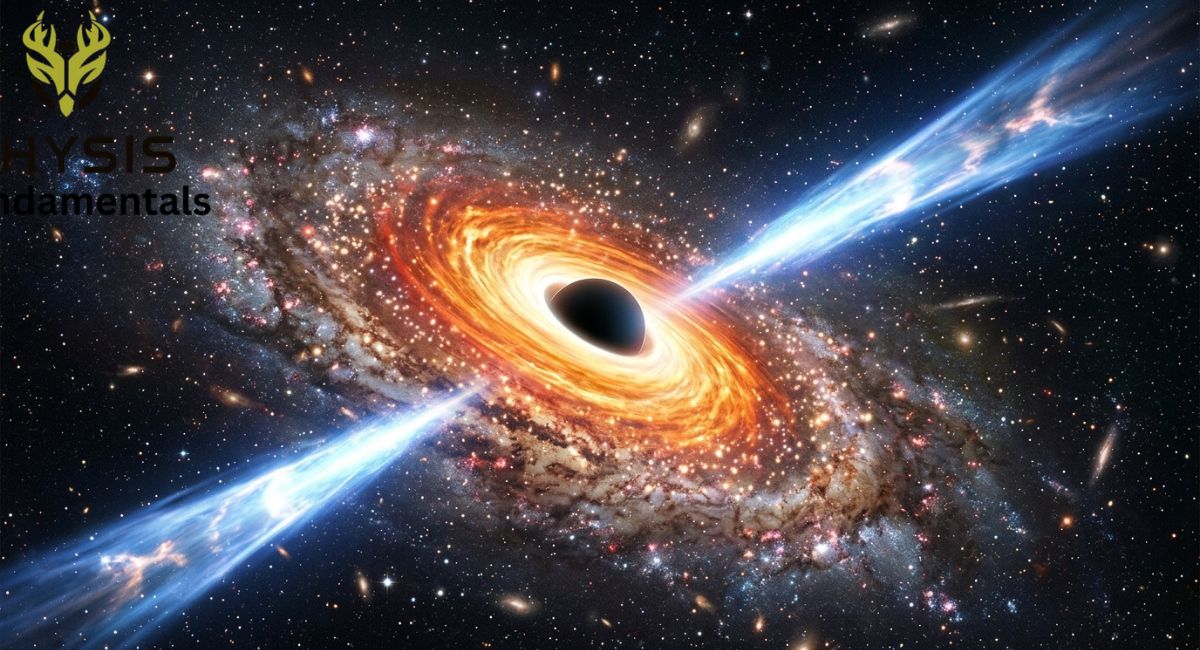
This is why even light cannot escape after crossing the event horizon. Importantly, this does not mean that a black hole is constantly “sucking in” everything around it. From a sufficiently large distance, a black hole’s gravitational influence is determined by its mass just as the gravitational influence of any other object would be
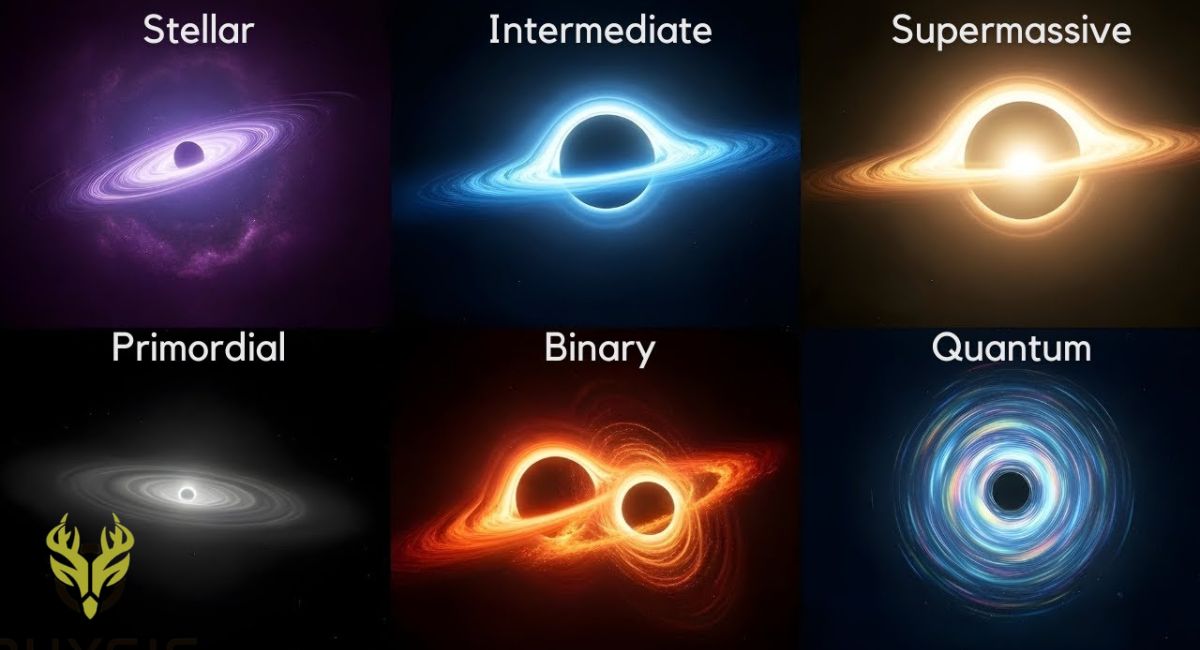
Types of Black Holes.
-
Stellar-Mass Black Holes
Stellar-mass black holes typically form from the collapse of massive stars. Their masses are generally several to dozens of times the mass of the Sun, although the observed population extends beyond that simple range.
-
Intermediate-Mass Black Holes
Intermediate-mass black holes occupy a proposed middle range between stellar-mass and supermassive black holes. Astronomers have found candidates and growing evidence for objects in this category, although their formation and population remain active areas of research.
-
Supermassive Black Holes
Supermassive black holes contain millions to billions of solar masses. They are found at the centers of most large galaxies.
For example, the center of the Milky Way contains Sagittarius A*, a supermassive black hole with a mass of roughly four million Suns.
-
Primordial Black Holes
Primordial black holes are hypothetical black holes that could have formed from extremely dense regions in the early universe rather than from stars. Their existence has not been established.
-
Accretion Disk
Although a black hole itself does not emit light from inside its event horizon, material falling toward it can become extremely bright.
Gas and dust can form a rapidly rotating accretion disk around the black hole. Friction, compression, magnetic processes, and gravitational energy conversion can heat this material to extremely high temperatures. As a result, the surrounding material can emit intense radiation, including X-rays.
This is one of the main ways astronomers detect otherwise invisible black holes.
-
Jets From Black Holes
Some black holes are associated with enormous relativistic jets.
These jets are produced by processes involving magnetized plasma in the environment around the black hole, particularly near the accretion disk. Particles can be accelerated to speeds extremely close to the speed of light and launched along directions roughly aligned with the black hole’s rotation axis.
The jets can extend far beyond the host galaxy.
-
Black Holes and Time
General relativity predicts that gravity affects the passage of time. An observer far from a black hole can see clocks near the black hole appearing to run increasingly slowly as they approach the event horizon.
This effect is called gravitational time dilation.
From the viewpoint of a distant observer, an object approaching the event horizon can appear increasingly slowed and its light increasingly redshifted. However, an observer falling through the event horizon does not locally experience time simply stopping at that boundary.
-
Gravitational Waves
When two black holes orbit each other, they can lose orbital energy through gravitational waves.
Eventually, the black holes can merge into a larger black hole. The resulting gravitational waves travel through spacetime and can be detected by instruments such as LIGO, Virgo, and KAGRA.
These observations provide a powerful way of studying black holes without relying only on electromagnetic radiation.
-
Hawking Radiation
In the framework of quantum field theory applied to curved spacetime, Stephen Hawking predicted that black holes should emit extremely weak thermal radiation.
This phenomenon is called Hawking radiation.
The associated temperature is. TH =
ℏc3
8πGMkB
where ℏ is the reduced Planck constant, c is the speed of light, G is the gravitational constant, M is the black-hole mass, and kB is the Boltzmann constant.
The equation shows that smaller black holes have higher Hawking temperatures, while larger black holes have lower temperatures.
For astrophysical black holes, Hawking radiation is expected to be extraordinarily weak.
Black Hole vs Neutron Star
| Feature | Black Hole | Neutron Star |
| Main formation route | Collapse of a sufficiently massive stellar core | Collapse of a massive stellar core |
| Surface | No ordinary material surface | Has a physical surface |
| Event horizon | Yes | No |
| Typical size | Event-horizon radius depends on mass | Roughly tens of kilometers |
| Main support | No known pressure stops collapse inside horizon | Neutron and nuclear pressure effects |
| Light from object | Cannot escape from inside event horizon | Can escape from its surface |
How Do Scientists Detect Black Holes?
Astronomers generally cannot see a black hole directly because it does not emit ordinary light from inside its event horizon. Instead, they detect its effects on its surroundings.A black hole can reveal itself through the motion of a companion star, radiation from an accretion disk, gravitational lensing, relativistic jets, or gravitational waves produced when black holes merge.
In 2019, the Event Horizon Telescope produced the first image showing the shadow of a black hole, the supermassive black hole in the center of the galaxy Messier 87. The image does not show the black hole’s interior; it shows the dark central shadow surrounded by glowing emission from extremely hot material near the black hole.
Our Star (SUN).
The Sun is the star at the center of our Solar System and the primary source of energy for Earth. It is a nearly spherical ball of extremely hot, ionized gas called plasma, held together by its own gravity. Although it appears much larger and brighter than other stars because it is relatively close to Earth, the Sun is actually an ordinary main-sequence star compared with many stars in the universe.
The Sun’s energy comes from nuclear fusion occurring deep within its core. During this process, hydrogen nuclei combine to form helium and release enormous amounts of energy. That energy eventually travels outward and reaches Earth as sunlight.
Basic Facts About the Sun.
The Sun has a mass of approximately 1.99×10^30 kg, which is about 333,000 times the mass of Earth. Its radius is approximately 696,000 km, making its diameter about 1.39 million km. The average distance between Earth and the Sun is about 149.6 million km, a distance known as one astronomical unit (AU).
The Sun is approximately 4.6 billion years old and is currently in the main-sequence stage of stellar evolution. It is expected to remain a main-sequence star for roughly another five billion years.
Composition of the Sun.
The Sun is composed primarily of hydrogen and helium. By mass, it contains roughly 73% hydrogen and 25% helium, with the remaining few percent consisting of heavier elements such as oxygen, carbon, neon, and iron. Because the Sun is extremely hot, its material exists primarily as plasma rather than ordinary solid, liquid, or neutral gas.
The plasma is electrically charged, which means the Sun’s magnetic field plays an important role in many solar phenomena.
The Sun is the nearest star to Earth and the main source of heat and light for our planet. It was formed about 4.6 billion years ago from a huge cloud of gas and dust called a solar nebula. Due to gravitational contraction, the temperature at the centre increased and a protostar was formed. When the core became extremely hot, nuclear fusion started in which hydrogen changed into helium and released a large amount of energy. The life stages of the Sun are: nebula, protostar, main sequence, red giant, planetary nebula, and white dwarf. At present, the Sun is in the main sequence stage, where it is producing heat and light by converting hydrogen into helium. In thermal physics, the Sun is important because it is a natural source of enormous heat energy and transfers this energy mainly by radiation.
Structure of the Sun.
The Sun does not have a solid surface like Earth. Instead, scientists describe it using several layers based on their physical properties and how energy moves through them.
The major regions are the core, radiative zone, convection zone, photosphere, chromosphere, and corona.
Core
The core is the central region of the Sun and the location where nuclear fusion takes place. The temperature in the core is approximately 15 million K. Under these extreme conditions, hydrogen nuclei move rapidly enough for nuclear fusion reactions to occur.
For the Sun, the dominant process is the proton–proton chain.
A small amount of the original mass is converted into energy according to:
E=mc^2
This energy is ultimately responsible for the Sun’s enormous luminosity.
Radiative Zone
Outside the core lies the radiative zone. Energy moves outward through this region mainly by the repeated absorption and re-emission of electromagnetic radiation.
41H →42He +2e+ +2νe + energy
A photon can undergo an enormous number of interactions before the energy eventually reaches the outer regions of the Sun.
Convection Zone
Above the radiative zone is the convection zone. Here, energy is transported primarily by the movement of hot plasma. Hot material rises toward the surface, cools, and sinks again. This continuous circulation is called convection.
Photosphere.
The photosphere is the visible layer of the Sun that we normally mean when we refer to the Sun’s “surface. Its temperature is approximately 5,800 K. Features such as sunspots and granulation can be observed in the photosphere.
Chromosphere.
Above the photosphere lies the chromosphere. It is a relatively thin layer of the solar atmosphere that can become especially visible during a total solar eclipse.
The chromosphere has a reddish appearance in certain wavelengths because of emission from hydrogen.
Corona.
The outermost major layer of the Sun’s atmosphere is the corona.
Interestingly, the corona is much hotter than the photosphere, with temperatures reaching around one to several million kelvin depending on conditions. The mechanism responsible for heating the corona to such high temperatures is an important topic in solar physics called the coronal heating problem.
Nuclear Fusion in the Sun
The Sun continuously converts hydrogen into helium through nuclear fusion. In the proton–proton chain, the overall process can be represented approximately as:
41H →42He +2e+ +2νe + energy
The mass of the resulting helium nucleus is slightly less than the combined mass of the original hydrogen nuclei. The missing mass appears as energy.
This conversion is extremely small on an individual reaction scale, but the enormous number of reactions occurring in the Sun’s core produces approximately 3.8 ×10^26 W of power.
Solar Energy Reaching Earth.
The energy produced in the Sun eventually travels through space as electromagnetic radiation.The Sun emits energy across a broad range of wavelengths, including visible light, infrared radiation, ultraviolet radiation, X-rays, and other wavelengths.
Only a small fraction of the Sun’s total energy reaches Earth, but that fraction is enormously important.
Solar radiation drives Earth’s climate system, supports photosynthesis, and provides energy that ultimately powers many biological and atmospheric processes.
Sunspots.
Sunspots are relatively dark regions on the photosphere that appear cooler than their surroundings. They are associated with strong concentrations of magnetic fields. Although they appear dark compared with the surrounding photosphere, they are still extremely hot.
The number of sunspots changes over an approximately 11-year solar activity cycle.
Solar Flares.
A solar flare is a sudden, intense release of electromagnetic energy from the Sun.
Solar flares are associated with changes and reconnection in the Sun’s magnetic fields. They can produce strong emissions across the electromagnetic spectrum, including X-rays and ultraviolet radiation.
Powerful solar flares can affect radio communication, satellite operations, and other technological systems around Earth.
Coronal Mass Ejections.
A coronal mass ejection (CME) occurs when a large amount of magnetized plasma is expelled from the Sun’s corona into space.
If a CME reaches Earth and interacts strongly with Earth’s magnetosphere, it can contribute to a geomagnetic storm.
These events can produce beautiful auroras but can also interfere with satellites, radio communication, navigation systems, and electrical infrastructure.
Solar Wind.
The solar wind is a continuous stream of charged particles flowing outward from the Sun.
It consists mainly of protons and electrons, along with smaller amounts of other ions.
The solar wind extends throughout the Solar System and creates the heliosphere, a vast region influenced strongly by the Sun’s particle outflow and magnetic field.
The Sun’s Magnetic Field.
Because the Sun consists of electrically conducting plasma, its rotation and internal motions generate complex magnetic fields.The Sun does not rotate as a solid body. Different parts of it rotate at different rates, a phenomenon called differential rotation.
This contributes to the development and evolution of the Sun’s magnetic field and helps drive phenomena such as sunspots, solar flares, and coronal mass ejections.
The Sun’s Rotation.
The Sun rotates about its axis, but its rotation period varies with latitude. Regions near the solar equator rotate faster than regions near the poles. The Sun’s equatorial rotation period is roughly 25 days, while the rotation period near the poles is longer.This differential rotation is important for understanding solar magnetic activity.
The Sun’s Role in the Solar System
The Sun contains approximately 99.86% of the total mass of the Solar System. Its gravitational field keeps planets, dwarf planets, asteroids, comets, and other objects in their orbits.
The Sun and Earth.
The Sun is approximately 8 light-minutes from Earth. This means sunlight takes about eight minutes and twenty seconds to travel from the Sun to Earth. The Sun’s radiation warms Earth’s surface and atmosphere. It also powers the water cycle and contributes to atmospheric circulation.
Earth’s magnetic field and atmosphere protect life from much of the Sun’s harmful radiation and charged-particle environment.
The Future of the Sun.
The Sun is currently in the main-sequence stage of stellar evolution. It is steadily converting hydrogen into helium in its core.When the core hydrogen becomes depleted, the Sun will no longer be able to maintain its current structure. The core will contract while the outer layers expand.
The Sun will eventually become a red giant .During later stages, helium fusion will occur in the core. Eventually, the Sun will lose its outer layers, producing a planetary nebula.
Conclusion.
Kinetic theory and statistical physics reveal how the unpredictable motion of individual particles gives rise to the reliable, measurable properties of matter pressure, temperature, and entropy that govern everything from a gas in a container to the interior of a star. This same microscopic-to-macroscopic thinking extends dramatically into astrophysics, where the balance between gravity and pressure drives stars through their life cycles: from collapsing molecular clouds and protostars, through the stable main sequence, to dramatic endpoints as white dwarfs, neutron stars, or black holes. Our own Sun exemplifies these principles in action, powered by nuclear fusion and shaping life on Earth through radiant energy. Together, these fields show how the same fundamental physical laws connect the smallest particles to the largest structures in the universe, offering a unified framework for understanding matter and energy at every scale.
FAQs
- What is kinetic theory?
Kinetic theory is a model that explains the physical properties of matter — like pressure and temperature — based on the motion and interactions of its microscopic particles, particularly gas molecules. - What assumptions does kinetic theory make about gas particles?
It assumes gas molecules have negligible volume, move randomly in straight lines between collisions, undergo perfectly elastic collisions, and exert no significant forces on each other except during collisions. - What is the Boltzmann distribution?
It describes how particles are distributed among different energy states at thermal equilibrium, showing that more particles occupy lower energy states than higher ones, with the probability decreasing exponentially with energy. - What is the difference between a microstate and a macrostate?
A microstate describes the exact position and momentum of every particle in a system, while a macrostate describes the system using measurable bulk quantities like pressure, volume, and temperature. Many microstates can correspond to one macrostate. - How does statistical physics relate to entropy?
Entropy is statistically linked to the number of microscopic arrangements (microstates) available to a macrostate — expressed by Boltzmann’s relation S = kB ln Ω — providing a microscopic basis for the second law of thermodynamics. - What determines how a star evolves and dies?
A star’s initial mass determines its evolutionary path and lifespan — low-to-intermediate mass stars end as white dwarfs, while very massive stars end in supernovae, becoming neutron stars or black holes. - What is the difference between a neutron star and a black hole?
A neutron star has a physical surface and is supported by neutron degeneracy pressure, while a black hole has no surface, possesses an event horizon from which nothing can escape, and forms when gravitational collapse is not halted by any known pressure. - Why can’t light escape a black hole?
Inside the event horizon, spacetime is curved so extremely that all possible future paths lead deeper into the black hole rather than back outward, making escape impossible according to general relativity. - How hot is the Sun’s core compared to its surface?
The Sun’s core reaches about 15 million K, while its visible surface (photosphere) is much cooler at approximately 5,800 K.