
Types of Waves in Physics: Definition, Types & Examples.
Introduction to waves.
Waves are everywhere. When you hear music, watch ocean water rise and fall, use a mobile phone, or see light from the Sun, you are experiencing waves. Although waves can look very different, they share one important idea: a wave is a disturbance that transfers energy from one place to another without permanently carrying matter along with it. Every source of energy travel in form of wave. Understanding waves is one of the most useful parts of physics because waves connect many everyday experiences with important scientific technologies. Sound, light, radio communication, earthquakes, ocean waves, and even some microscopic phenomena can be understood using the basic principles of wave motion.
We are familiar with different types of waves, such as water waves in the ocean and circular ripples produced when raindrops fall on still water. When a musician plucks a guitar string, it produces sound waves that travel through the air and reach our ears us to hear music. The energy from the Sun travels through space and reaches the Earth in the form of light waves. In this chapter, we will study the formation, propagation, and applications of different types of waves.
What Is a Wave?
A wave is a moving disturbance that transfers energy through a medium or through space. The medium can be air, water, a solid material, or, in the case of electromagnetic waves, no material medium at all.
Think about dropping a small stone into a calm pond. Circular ripples move outward from the point where the stone enters the water. The water itself does not travel outward with the ripple over a long distance. Instead, particles of water move up and down while the disturbance carries energy across the surface.

Mathematically, wave behavior can often be described using the relationship:
How Waves Transfer Energy.
Imagine standing at the edge of a swimming pool and watching someone create a wave by moving their hand through the water. The wave travels across the pool, and you can see the disturbance moving away from the person. But here is the interesting part: the water itself does not travel all the way across the pool with the wave. Instead, the water particles mainly move up and down while the wave carries energy from one place to another.
Wave Motion in Everyday Life.
Wave motion is not something that happens only in a physics laboratory. You see it, hear it, and use it almost every day. When you listen to music, watch sunlight enter a room, use a cellphone, see ripples in water, or even experience an earthquake, you are observing the effects of waves.
Water Waves.
One of the easiest examples of wave motion is the movement of waves on water. If you drop a small stone into a calm pond, circular ripples spread outward from the point where the stone hits the water.
It may look as if the water is moving outward with the ripple, but the individual water particles mainly move up and down and slightly back and forth. What travels outward is the wave disturbance and its energy. This is why a floating leaf may rise and fall as a wave passes without traveling all the way from the center of the pond to its edge.
Sound Waves.
Every time you speak, listen to music, or hear a car horn, you are experiencing wave motion.
When a speaker produces sound, it vibrates the surrounding air. The vibrating air produces alternating regions of compression and rarefaction. These disturbances travel through the air until they reach your ears.
Your eardrum then vibrates, and your brain interprets those vibrations as sound. So when someone talks to you, the air molecules from their mouth do not simply travel into your ears. Instead, their vibrations are passed from one region of air to the next.
Waves on a Rope.
A rope provides a simple way to visualize wave motion. If you hold one end of a rope and move your hand up and down, a disturbance travels along the rope.
Your hand supplies energy to the rope. Each part of the rope interacts with the neighboring part, allowing the disturbance to move forward.This is an example of a transverse wave, because the rope moves mainly up and down while the wave travels horizontally.
Ocean Waves.
Ocean waves are another familiar example. Wind transfers energy to the surface of the ocean, producing waves that can travel over large distances.
When these waves approach a beach, their behavior changes because the water becomes shallower. The waves slow down, become taller, and eventually break. Ocean waves are important not only for nature but also for surfing, coastal processes, marine transportation, and the study of ocean energy.
Light Waves.
You do not need a material medium to experience every type of wave. Light is an electromagnetic wave, and it can travel through empty space. The light coming from the Sun travels through the vacuum of space before reaching Earth. It carries energy that warms our planet and supports life through photosynthesis.
When you turn on a flashlight, electromagnetic waves travel from the source and allow you to see objects around you.
Radio and Cellphone Communication.
Modern communication depends heavily on wave motion. Cellphones, radio stations, television broadcasting, Wi-Fi, and many satellite systems use electromagnetic waves to transmit information.
For example, when you make a cellphone call, information is converted into signals that are carried by electromagnetic waves. A receiving system detects the signal and converts it back into information that you can hear. This allows information to travel enormous distances without physically moving the original object.
Earthquake Waves.
Wave motion can also be extremely powerful. During an earthquake, energy released inside Earth travels through the planet as seismic waves.
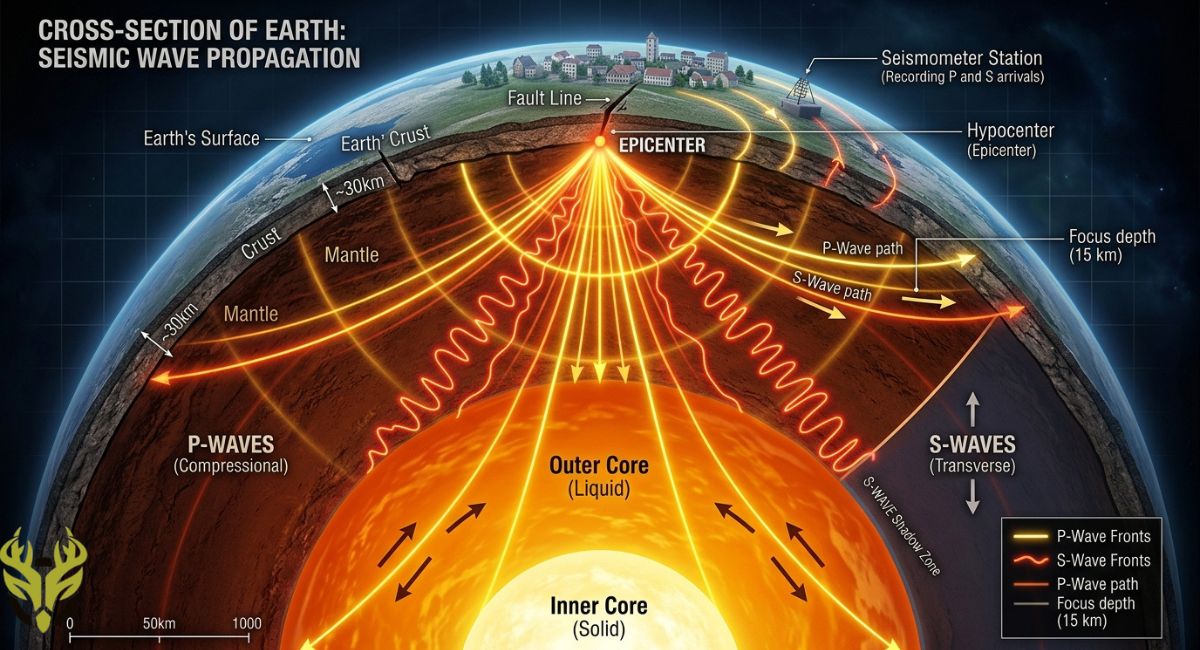
Different types of seismic waves move through Earth’s interior in different ways. Scientists study these waves to learn about Earth’s internal structure and to understand how earthquakes behave. Earthquake waves demonstrate that wave motion can transfer enormous amounts of energy through solid materials
Waves in Musical Instruments.
Musical instruments are another everyday example of wave motion. When you play a guitar, the strings vibrate. These vibrations cause the surrounding air to vibrate, producing sound waves.
In a flute, vibrating air inside the tube produces sound. In a drum, the stretched membrane vibrates and transfers energy to the surrounding air. The frequency of the vibration strongly influences the pitch that you hear, while the amplitude and characteristics of the vibration influence the sound’s loudness and quality.
Waves in Medical Technology.
Waves are also important in modern medicine. Ultrasound waves are used to create images of structures inside the human body. These are high-frequency sound waves that travel through body tissues and produce echoes when they encounter boundaries between different materials.
Doctors can analyze these echoes to create images and monitor certain conditions, including fetal development during pregnancy. Other medical technologies use electromagnetic radiation, such as X-rays, to obtain images of structures inside the body.
Main Types of Waves.
Waves can be classified in several ways. One common method is based on whether they require a material medium. Another classification considers the direction in which particles or fields oscillate compared with the direction of wave propagation.
| Type of wave | Requires a medium? | Example |
| Mechanical wave | Yes | Sound waves |
| Electromagnetic wave | No | Light |
| Transverse wave | Usually particles oscillate perpendicular to travel direction | Waves on a rope |
| Longitudinal wave | Particles oscillate parallel to travel direction | Sound in air |
| Surface wave | Travels along an interface | Ocean waves |
These categories can overlap. For example, a sound wave is both a mechanical wave and, in air, a longitudinal wave.
Mechanical Waves.
A mechanical wave is a wave that needs a material medium to travel. The medium can be a solid, liquid, or gas. Unlike electromagnetic waves, mechanical waves cannot travel through a vacuum because there are no particles available to vibrate and pass the disturbance from one place to another.
The medium can be a solid, liquid, or gas.
- Sound waves
- Water waves
Types of Mechanical Waves .
- Transverse mechanical waves
- Longitudinal mechanical waves
Transverse Mechanical Waves.
In a transverse wave, the particles of the medium vibrate perpendicular to the direction in which the wave travels.
Example: Waves traveling along a stretched rope are a common example of transverse mechanical waves.
A transverse wave has crests and troughs. The highest points are called crests, while the lowest points are called troughs.
Longitudinal Mechanical Waves.
In a longitudinal wave, the particles of the medium vibrate parallel to the direction in which the wave travels.
Longitudinal waves contain alternating regions called compressions and rarefactions.
- Compression is a region where particles are close together.
- Rarefaction is a region where particles are farther apart.
For example, when you push and pull a slinky along its length, you can see compressed and stretched regions moving along the spring. This provides a simple model of a longitudinal wave.
Surface Mechanical Waves.
Surface waves travel along the boundary between two different media, such as the surface of water. The particles near the surface can move in a combination of up-and-down and back-and-forth motion.
When a stone falls into a pond, ripples spread outward from the point where the stone enters the water. The water does not travel outward with the ripple as a whole; instead, the disturbance carries energy across the surface.
Electromagnetic Waves.
Electromagnetic waves are different because they do not require a material medium. They can travel through the vacuum of space.
c=3108{ m/s}
in a vacuum.
For example, the light reaching your eyes from the Sun is an electromagnetic wave. It travels approximately 150 million kilometers through space without needing air, water, or any other material.
Main Types of Electromagnetic Waves
Electromagnetic waves form a continuous range called the electromagnetic spectrum. They are classified mainly according to their frequency and wavelength.
| Type | General wavelength | Common uses |
| Radio waves | Longest | Radio, TV, communication |
| Microwaves | Shorter than radio waves | Radar, communication, cooking |
| Infrared | Longer than visible light | Remote controls, thermal imaging |
| Visible light | About 400–700 nm | Vision, lighting, photography |
| Ultraviolet (UV) | Shorter than visible light | Sterilization, tanning |
| X-rays | Very short | Medical imaging |
| Gamma rays | Shortest | Cancer treatment, nuclear physics |
Matter Waves.
Matter waves are waves associated with moving particles of matter. The idea comes from the de Broglie hypothesis, proposed by French physicist Louis de Broglie in 1924. He suggested that if light, which was traditionally considered a wave, can also behave like particles, then particles such as electrons might also show wave-like behavior.

Example of Matter Waves
Consider an electron moving with a certain momentum. Its de Broglie wavelength can be large enough, on atomic scales, to interact with the regular arrangement of atoms in a crystal. The electron can then produce a diffraction pattern.
This behavior is used in technologies such as electron diffraction and electron microscopy, where the wave nature of electrons helps scientists investigate extremely small structures.
De Broglie Wavelength.
According to de Broglie, every moving particle has an associated wavelength
Give feedback
λ=h/P
Since momentum is
p=mv
we can also write:
λ=h/mv
where λ is the de Broglie wavelength, h is Planck’s constant, p is momentum, m is the particle’s mass, and v is its velocity.
The important idea is that the greater the momentum of a particle, the shorter its matter wavelength.
Why Do We Not Notice Matter Waves?
You might wonder: if every moving object has a wavelength, why don’t we see waves associated with a football, car, or person?
The answer is that Planck’s constant is extremely small:
h=6.626×10^−34 J\s
For everyday objects, the mass and momentum are large enough that their de Broglie wavelengths become incredibly tiny. They are far too small to produce noticeable wave effects. For very small particles, such as electrons, the wavelength can become significant enough to observe through experiments.
Matter Waves and Electrons.
Electrons provide one of the clearest examples of matter-wave behavior. When electrons pass through a suitable crystal or diffraction setup, they can produce diffraction and interference patterns, behaviors normally associated with waves.
Wave-Particle Duality.
Matter waves are closely connected with the idea of wave-particle duality.
In quantum physics, particles such as electrons can demonstrate particle-like behavior in some experiments and wave-like behavior in others. Similarly, electromagnetic radiation can behave as both waves and particles.
Important Terms Used in Waves.
To understand waves properly, you need to know a few basic terms: amplitude, wavelength, frequency, time period, wave speed, and phase. These quantities describe how a wave looks, how quickly it oscillates, and how fast the disturbance travels.
Amplitude.
Amplitude is the maximum displacement of a particle from its equilibrium or rest position.
For a transverse wave, the amplitude is measured from the equilibrium position to a crest or trough. It is not the distance from crest to trough.
The SI unit of amplitude is usually meter (m) when displacement is measured in meters.
A larger amplitude generally means the wave carries more energy. For many waves, the energy is proportional to the square of the amplitude:
E∝A^2
Wavelength.
Wavelength is the distance between two consecutive points on a wave that are in the same phase.
It is commonly represented by the Greek letter:
λ
For a transverse wave, the wavelength can be measured from one crest to the next crest or from one trough to the next trough.
For a longitudinal wave, it can be measured from one compression to the next compression or from one rarefaction to the next rarefaction.
The SI unit of wavelength is meter (m).
Frequency.
Frequency tells you how many complete oscillations or cycles occur in one second.
It is represented by:
f
The SI unit of frequency is hertz (Hz).
1Hz=1cycle per second
A higher frequency means the wave oscillates more rapidly, while a lower frequency means the oscillations occur more slowly.
For sound waves, frequency is closely related to pitch. A high-frequency sound is generally perceived as higher in pitch, while a low-frequency sound is perceived as lower in pitch.
Time Period.
The time period is the time required for one complete oscillation or cycle of a wave.
It is represented by:
T
The SI unit of time period is the second (s).
Frequency and time period are reciprocals of each other:
T=1/f
and
f=1/T
For example, if a wave has a frequency of 5 Hz:
T=1/5=0.2s
This means one complete cycle takes 0.2 seconds.
Wave Speed.
Wave speed is the distance traveled by a wave disturbance per unit time.
It is represented by:
v
The SI unit of wave speed is meter per second (m/s).
The fundamental relationship between wave speed, frequency, and wavelength is:
v=fλ
where:
v=wave speed
f=frequency
λ=wavelength
Phase.
Phase describes the position and stage of oscillation of a particle at a particular moment.
phase tells us where a particle is in its cycle.
Consider two particles on a wave. If both are at the same position and moving in the same direction at the same time, they are said to be in phase.
If one particle is at a crest while another is at a trough, they are 180° out of phase.
The phase difference can be expressed in degrees or radians.
One complete cycle corresponds to:
means that the two oscillations are half a cycle apart.
Progressive Waves.
A progressive wave is a wave that travels continuously from one place to another, carrying energy through a medium or through space.
Types.
-
Transverse Progressive Waves
In a transverse progressive wave, the particles of the medium vibrate perpendicular to the direction of wave propagation.
Examples
Waves traveling along a stretched string are a common example. Seismic S-waves are another example of transverse mechanical waves
Longitudinal Progressive Waves.
In a longitudinal progressive wave, the particles of the medium vibrate parallel to the direction in which the wave travels.
Longitudinal waves contain alternating regions of compression and rarefaction.
Compression is a region where particles are relatively close together, while rarefaction is a region where particles are relatively far apart.
Equation of a Progressive Wave.
The mathematical equation of a progressive wave describes how the displacement of a particle changes with position and time.
A common form of the equation for a wave traveling in the positive x-direction is:
y=Asin(ωt−kx+ϕ)
where:
y=displacement of the particle
A=amplitude
ω=angular frequency
t=time
k=wave number
x=position
ϕ=initial phase
For a wave traveling in the opposite direction, a common form is:
y=Asin(ωt+kx+ϕ)
The sign before kx indicates the direction of propagation when using this convention.
The angular frequency and wave number are related to frequency and wavelength by:
ω=2πf
and
The wave speed is:
v=fλ
or equivalently:
v=ω/k
| Examples | Type of Progressive Wave | How It Travels |
| Stretched rope | Transverse | Along the rope |
| Sound in air | Longitudinal | Through air |
| Water ripples | Surface | Along the water surface |
| Earthquake P-waves | Longitudinal | Through Earth |
| Earthquake S-waves | Transverse | Through solids |
| Spring/slinky | Longitudinal | Along the spring |
| Light | Electromagnetic | Through space or a medium |
| Radio waves | Electromagnetic | Through space or a medium |
| Guitar string | Mainly transverse | Along the string |
| Tuning fork sound | Longitudinal | Through air |
Conclusion.
Waves shape nearly every part of daily life, from the sound waves that carry a friend’s voice to the electromagnetic waves streaming video to your phone. Whether mechanical or electromagnetic, every wave shares one core job: moving energy from one place to another without hauling matter along for the ride. amplitude, wavelength, frequency, and wave speed — unlocks a much deeper understanding of physics as a whole. These same wave properties explain earthquakes, medical ultrasound, and even the strange quantum behavior of electrons. Once you see the pattern, water ripples and radio signals start looking like cousins rather than strangers.
FAQs.
What are the main types of waves in physics?
Waves fall into three broad categories: mechanical waves (need a medium, like sound), electromagnetic waves (no medium needed, like light), and matter waves (associated with moving particles, like electrons).
What’s the difference between transverse and longitudinal waves?
In a transverse wave, particles move perpendicular to the wave’s direction, creating crests and troughs. In a longitudinal wave, particles move parallel to the wave’s direction, forming compressions and rarefactions.
Can waves travel without a medium?
Yes. Electromagnetic waves, including light and radio waves, travel through the vacuum of space without needing air, water, or any other material.
What is the formula that relates wave speed, frequency, and wavelength?
Wave speed equals frequency multiplied by wavelength: v = fλ. This relationship applies to virtually every type of wave.
Why don’t we notice matter waves in everyday objects?
Because Planck’s constant is extremely small, the de Broglie wavelength of large objects (like a football or a car) is far too tiny to detect. Only small particles, such as electrons, show measurable matter wave behavior.
How are waves used in medicine?
Ultrasound uses high-frequency sound waves to image internal body structures, while X-rays use electromagnetic radiation for similar diagnostic purposes.