
Introduction to Physics: Matter, Energy , Motion & Force
Introduction to Physics.
Physics is an experimental science that studies the physical world around us.
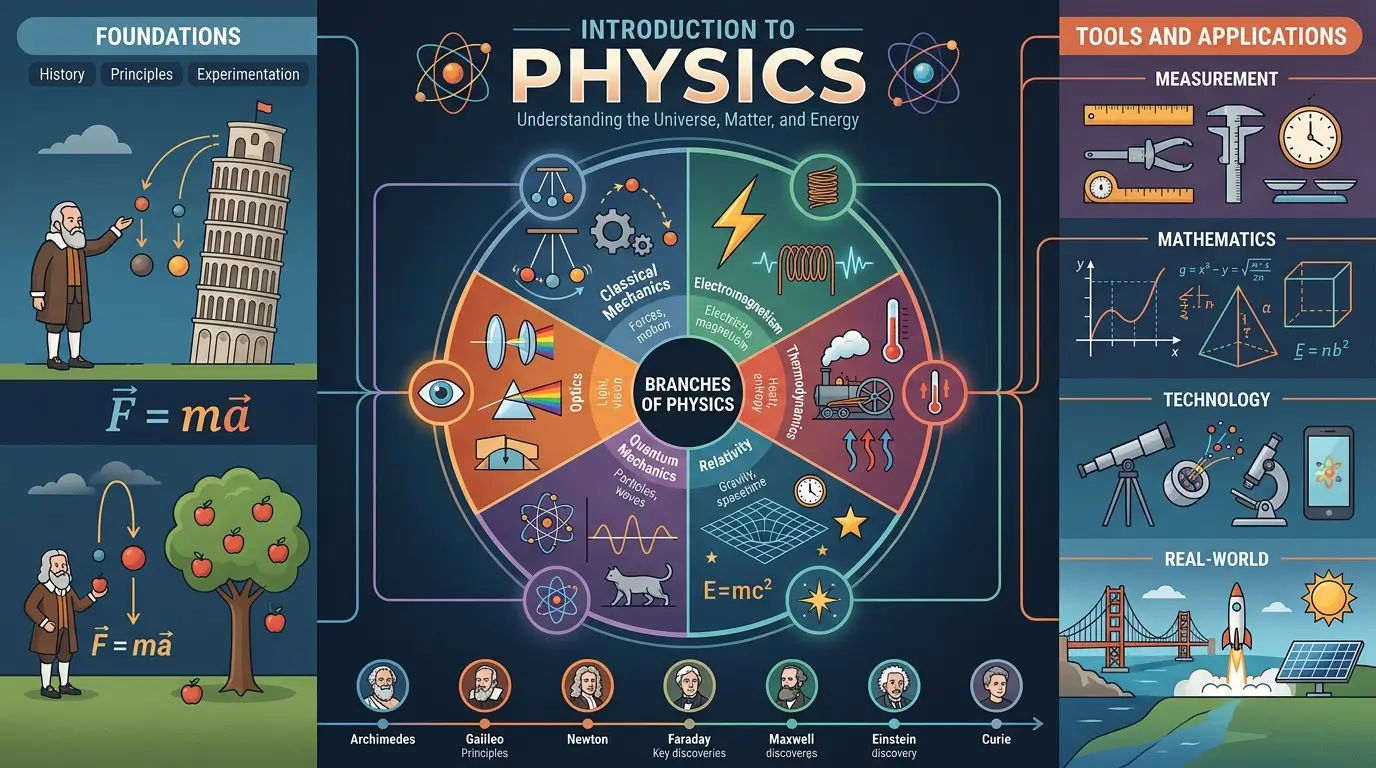
Physics mainly studies three worlds:
- The extremely large world: The universe, galaxies, and stars.
- The extremely small world: Particles such as electrons, protons, and neutrons.
- The world of complex matter: Molecules and objects ranging from very small particles to the Earth.
Fundamental physics is considered the heart of science because it helps us understand the basic laws of nature.
Physics.
Physics is the branch of natural science that studies matter, energy, motion, forces, space, time, and the interactions between them..
Examples of Physics in Daily Life.
- A ball falling to the ground → gravitational force
- A car moving on a road → motion and force
- A bulb producing light → electricity and energy
- A fan rotating → electrical energy converted into mechanical energy
- A rainbow forming → reflection, refraction, and dispersion of light
- A mobile phone working → electricity, electromagnetism, and electronics
- A rocket moving upward → Newton’s laws of motion
- Matter — What is everything made of?
- Energy — How is energy transferred and transformed?
- Motion — How and why do objects move?
- Forces — What causes changes in motion?
- Space and time — Where and when do physical events occur?
- Interactions — How do objects and particles affect one another?
Core Areas of Physics
These are the traditional branches physics is organized into, each studying a distinct type of phenomenon.
Core Area |
What It Studies |
|
Motion of everyday objects under force |
|
Heat, temperature, and energy transformation |
|
Electric charge, magnetic fields, and light |
|
Behavior and properties of light |
|
Behavior and properties of sound |
|
Behavior of matter at the atomic and subatomic scale |
|
Space, time, and gravity at extreme speeds and masses |
|
Structure and behavior of the atomic nucleus |
|
Fundamental particles and their interactions |
|
Structure and behavior of solids and liquids |
|
Large-scale behavior arising from particle statistics |
Interdisciplinary Areas of Physics.
These fields apply physics principles directly to problems in other sciences, sitting at the overlap between physics and a second discipline.
| Interdisciplinary Area | Combines Physics With |
|
Physics + Astronomy |
|
Physics + Biology |
|
Physics + Earth Science |
|
Physics + Chemistry |
|
Physics + Medicine |
|
Physics + Environmental Science |
|
Physics + Economics |
|
Physics + Computer Science |
|
Physics + Engineering |
|
Physics + Computer Science |
|
Physics + Space Science/Fusion |
Role of Physics in Technology.
Physics plays a very important role in the development of modern technology. It provides the basic principles that help scientists and engineers design, develop, and improve machines, devices, and systems.
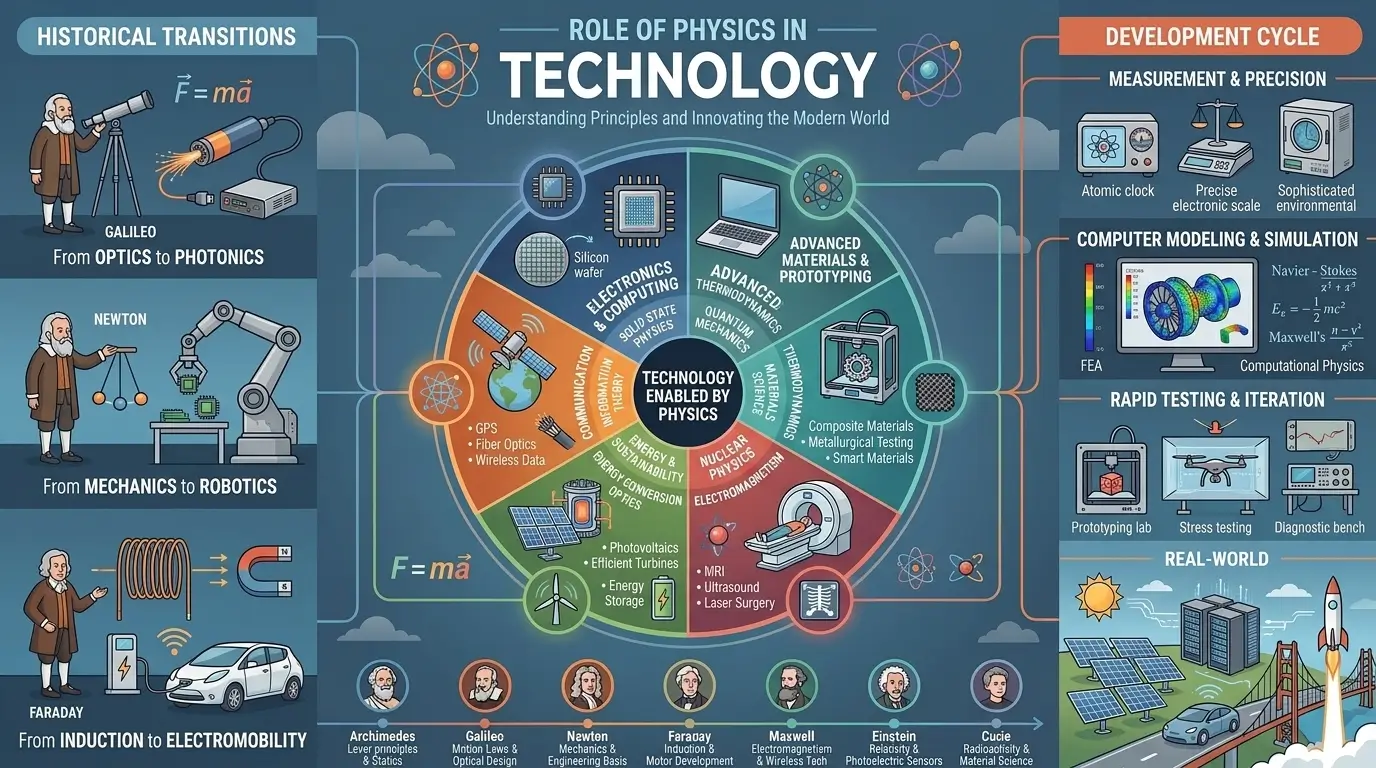
Electricity and Electronics.
- Computers
- Mobile phones
- Television
- Radios
- Electric motors
Communication Technology
- Mobile communication
- Radio
- Television
- Wi-Fi
- Satellites
- Internet communication
Medical Technology.
- X-ray machines
- Ultrasound
- MRI
- CT scans
- Radiation therapy
Transportation
- Cars
- Trains
- Aero planes
- Ships
- Rockets
- Spacecraft
Energy Production.
- Solar panels
- Hydroelectric power plants
- Wind turbines
- Nuclear power plants
- Batteries
Space Technology.
- Satellites
- Rockets
- Space stations
- Space telescopes
- Planetary exploration
Role of Physics Outside Earth.
Physics plays a very important role in studying and exploring outer space. It helps scientists understand objects and phenomena beyond Earth, such as the Sun, Moon, planets, stars, galaxies, black holes, and the entire universe.
Study of Planets and Moons.
- The motion of planets around the Sun
- The gravity of planets and moons
- The atmosphere of other planets
- The surface and internal structure of celestial bodies
Example: Newton’s law of gravitation helps explain why planets remain in their orbits.
Space Travel and Rockets.
The principles of Newton’s laws of motion are used to design and launch rockets.
When gases are expelled from a rocket at high speed, the rocket moves in the opposite direction.
Satellites.
Physics is used to place satellites into orbit around Earth and other celestial bodies.
Satellites are used for:
- Communication
- GPS
- Weather forecasting
- Earth observation
Study of Stars.
Physics helps scientists understand:
- How stars are formed
- How stars produce energy
- How stars change over time
- How stars eventually die.
Black Holes.
The principles of gravity and relativity help scientists study black holes and their effects on space and time.
Space Communication.
Electromagnetic waves are used to transmit information between Earth and spacecraft.
For example, spacecraft send images and scientific data to Earth using radio waves.
Understanding the Universe.
- The origin of the universe
- Galaxies
- Dark matter
- Dark energy
- The expansion of the universe
Space Exploration.
- Spacecraft
- Space stations
- Space telescopes
- Space probes
- Mars rovers
Role of Physics in Galaxies.
Physics plays a fundamental role in understanding how galaxies form, move, evolve, and interact. A galaxy is a huge system containing stars, planets, gas, dust, and dark matter, all held together mainly by gravity.
Gravity Holds Galaxies Together.
Gravity is the most important force in the large-scale structure of a galaxy. It keeps stars, gas, and other objects bound together.
Example: The Sun and billions of other stars remain part of the Milky Way because of gravitational attraction.
Motion of Stars.
Physics helps scientists study the movement of stars around the center of a galaxy.
The laws of motion and gravitation help explain why stars follow particular orbits.
Formation of Galaxies.
Physics helps explain how galaxies formed from huge clouds of gas and matter in the early universe. Gravity gradually brought matter together, leading to the formation of stars and galaxies.
Formation and Life of Stars.
The laws of nuclear physics explain how stars produce energy through nuclear fusion. This energy produces the light and heat emitted by stars.
Black Holes.
Physics, especially relativity, helps scientists study black holes. A black hole has extremely strong gravity, which can affect nearby stars, gas, light, and even space and time.
Dark Matter.
The motion of stars and galaxies cannot always be explained by visible matter alone. Physics helps scientists investigate dark matter, an invisible form of matter believed to influence the movement and structure of galaxies.
Galaxy Collisions.
Physics helps scientists understand what happens when galaxies interact or collide. Gravity can change their shapes and influence the formation of new stars.
Light and Electromagnetic Waves
Scientists use physics to study the light coming from galaxies. By analyzing this light, they can learn about:
- The age of stars
- The chemical composition of galaxies
- The temperature of stars
- The motion of galaxies
- The distance of galaxies from Earth
Role of Physics in the Human Body.
Physics plays an important role in understanding how the human body works. Many functions of the body follow the laws and principles of physics.
- Movement Mechanics explains how muscles, bones, and joints help us walk, run, and move.
- Blood Circulation Fluid mechanics explains the flow of blood through blood vessels. The heart acts like a pump.
- Breathing Pressure differences help air move into and out of the lungs.
- Vision Optics explains how the eye focuses light to form images on the retina.
- Hearing Acoustics explain how sound waves enter the ear and allow us to hear.
- Nerve Signals Electricity explains how electrical signals travel through nerve cells.
- Body Temperature Thermodynamics explains how the body produces and loses heat to maintain a suitable temperature.
Major Branches of Physics.
-
Mechanics
The study of motion, forces, and the equilibrium of objects.
-
Thermodynamics.
The study of heat, temperature, work, and energy transfer.
-
Electromagnetism.
The study of electric charges, electricity, electric fields, magnetism, and magnetic fields.
-
Optics.
The study of light and its properties, such as reflection, refraction, and dispersion.
-
Acoustics.
The study of sound and mechanical vibrations.
-
Quantum Physics.
The study of matter and energy at atomic and subatomic levels.
-
Relativity.
The study of space, time, motion, and gravity, especially at very high speeds and in strong gravitational fields.
-
Atomic Physics
The study of the structure and behavior of atoms, especially electrons and their energy levels.
-
Nuclear Physics
The study of the atomic nucleus, radioactivity, and nuclear reactions.
-
Particle Physics.
The study of fundamental particles and the forces between them, such as quarks, electrons, and neutrinos.
-
Astrophysics.
The application of physics to stars, planets, galaxies, black holes, and other celestial objects.
-
Cosmology.
The study of the origin, structure, evolution, and ultimate fate of the universe.
-
Condensed Matter Physics.
The study of the properties of solids and liquids, including materials such as metals, crystals, and semiconductors.
-
Plasma Physics.
The study of plasma, a state of matter consisting of charged particles.
Examples: the Sun, stars, lightning, and fusion reactors.
-
Solid-State Physics.
The study of the physical properties of solid materials, such as crystals, metals, and semiconductors.
-
Mathematical Physics.
The application of mathematical methods and theories to solve problems in physics.
-
Computational Physics.
The use of computers and numerical methods to solve complex physical problems.
-
Biophysics.
The application of physics to living organisms and biological systems.
The application of physics in medicine and healthcare.
Examples: X-rays, MRI, CT scans, ultrasound, and radiation therapy.
-
Geophysics.
The study of the Earth using the principles of physics.
Examples: earthquakes, Earth’s magnetic field, gravity, and Earth’s interior.
-
Atmospheric Physics.
The study of the physical processes occurring in Earth’s atmosphere.
Examples: weather, clouds, storms, and climate.
-
Environmental Physics.
The application of physics to environmental systems and problems.
Examples: pollution, climate change, energy, and environmental monitoring.
-
Chemical Physics.
The application of physics to understand chemical systems, atoms, molecules, and chemical reactions.
-
Molecular Physics
The study of the structure, properties, and behavior of molecules.
-
Plasma Astrophysics.
The study of plasma and electromagnetic processes in space, such as those occurring in stars and galaxies.
-
Nuclear Astrophysics.
The study of nuclear reactions occurring inside stars and other astronomical objects.
-
Particle Astrophysics.
The study of fundamental particles and cosmic phenomena in the universe.
-
Nanophysics.
The study of matter and physical phenomena at the nanoscale.
-
Accelerator Physics.
The study of the design and operation of particle accelerators.
-
Quantum Information Physics
The study of quantum systems, information, and quantum computing.
Why Is Physics Important?
Understanding the importance of physics is not just for scientists. Physics shapes phones, bridges, medicine, and space travel. It connects matter and energy in ways that power modern life. Without physics, there would be no electricity, no cars, and no computers
Frequently Asked Questions.
What is the simplest definition of physics?
Physics is the natural science that studies matter, energy, and how they interact through forces across space and time. It aims to describe the universe using a small set of testable, mathematical laws rather than assumption or observation alone.
What is the difference between classical and modern physics?
Classical physics, developed largely before the 20th century, explains everyday-scale motion, energy, and electromagnetism. Modern physics, built on relativity and quantum theory, modifies these classical laws specifically for extremely fast, massive, or small-scale phenomena.
Why is physics considered the most fundamental science?
Physics is considered fundamental because its core principles underlie chemistry, biology, and engineering. Chemical bonding, biological processes, and engineered structures can all ultimately be explained using physical laws governing matter and energy.
What are the four fundamental forces in physics?
The four fundamental forces are gravity, electromagnetism, the strong nuclear force, and the weak nuclear force. Together, they explain virtually every physical interaction observed in the universe, from falling objects to nuclear decay.
How is a physics law different from a physics theory?
A theory is a conceptual framework built to explain and predict physical phenomena. When a theory’s predictions are repeatedly confirmed through experiment, physicists refer to that relationship as a law, though any law remains open to revision if new evidence requires it.
What role does mathematics play in physics?
Mathematics provides the precise language physics uses to express relationships between physical quantities. Without standardized mathematical description, physical findings couldn’t be reliably tested, compared, or reproduced across different research settings.
Why do professors consider physics essential outside physics degrees?
Physics builds analytical and problem-solving skills that transfer directly into engineering, medicine, and applied science fields. Its core reasoning process, testing predictions against controlled observation, remains valuable regardless of a student’s eventual specialization.
Conclusion.
Physics is far more than a school subject built around formulas. It’s the quiet framework running underneath nearly everything you’ve just read about, from a fan spinning in your living room to a galaxy holding itself together across unimaginable distance. The same handful of ideas, matter, energy, force, and motion, explain a falling apple, a beating heart, a rocket leaving Earth’s atmosphere, and a star collapsing into a black hole.
What makes physics genuinely remarkable is its reach. It powers the phone in your pocket and the MRI machine that can see inside your body. It explains why planets stay in orbit and why your blood keeps circulating without you thinking about it. Whether the scale is a single nerve cell or an entire galaxy, the same physical laws apply, tested, refined, and trusted across centuries of observation.
Measurement → Units → Vectors → Motion → Forces → Energy → Waves → Electricity → Thermal Physics → Modern Physics.