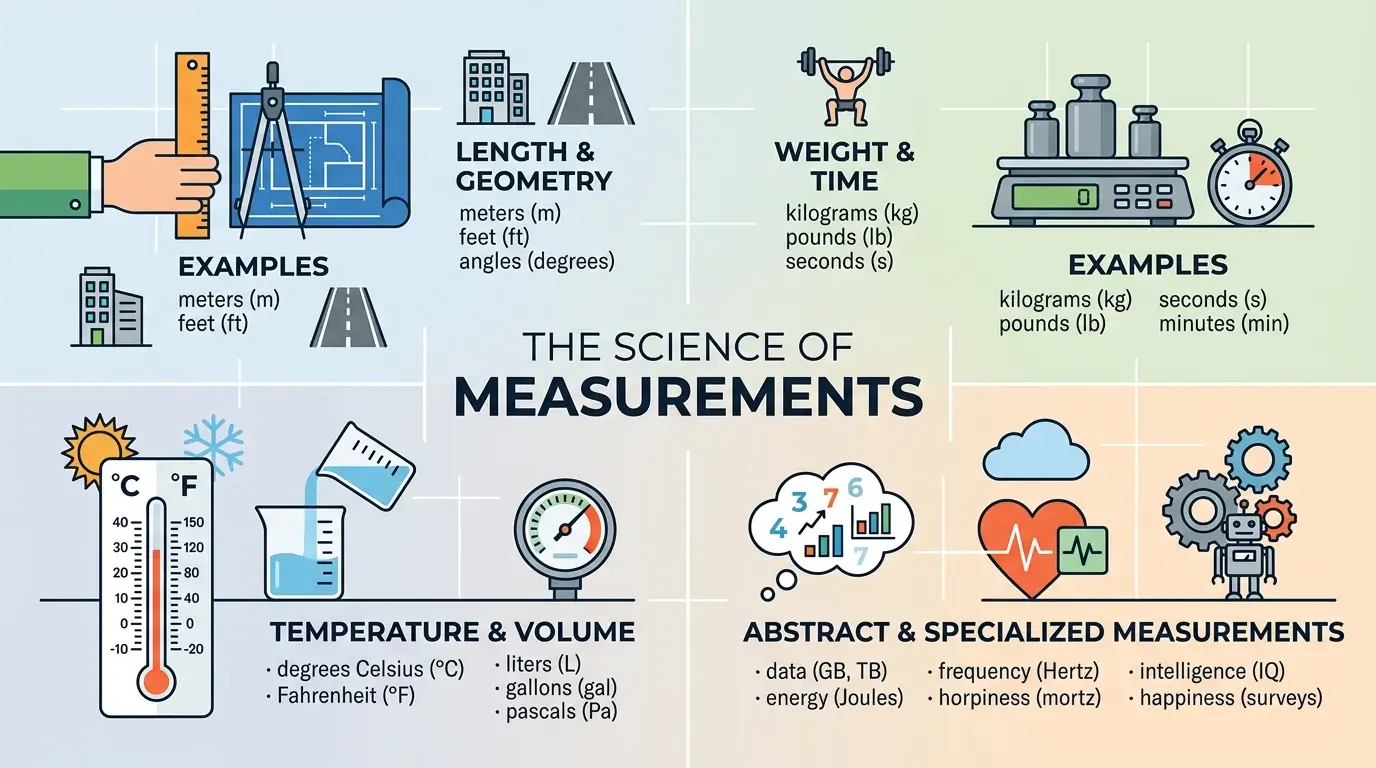
Measurement.
Measurements in physics rest on one quiet assumption: that a number actually means something reliable. This guide pulls together everything that idea depends on, from the history of how humans agreed on units in the first place, to the modern rules of precision, error, and dimensional analysis that keep science trustworthy today.

History of Measurement.
Measurement didn’t start in a lab. It started with people needing to solve real, everyday problems: how much land does this farm cover, how far is that village, how much grain fits in this basket? This is the story of how humanity slowly figured out reliable, agreed-upon ways to answer questions like that, eventually landing on the global system scientists use today.
Measuring With What You Had On Hand.
Long before rulers or scales existed, people simply used their own bodies to measure things, since a body was always available and never left at home. A hand, a foot, a span, a cubit, a pace, all of these came straight from human anatomy. A cubit, for instance, was simply the distance from someone’s elbow to their fingertips.
The obvious problem: everyone’s body is a slightly different size. A cubit measured by a tall person and a cubit measured by a short person weren’t the same length at all, which made this system genuinely unreliable the moment two people needed to agree on anything precise.
How Ancient Civilizations Solved This Problem.
Egypt.
Around 3000 BCE, Egypt tackled this head-on by creating the Royal Cubit, a single official standard used consistently across construction projects, including the pyramids themselves. Builders relied on stone or wooden measuring rods calibrated against this one master standard, which is exactly why ancient Egyptian monuments still show such impressive precision today.
Mesopotamia.
Mesopotamian societies built their own measurement systems for length, weight, and volume, and they’re also responsible for something you still use constantly without realizing it: the base-60 counting system. That’s why a clock has 60 minutes and a circle has 360 degrees, an inheritance from Mesopotamian mathematics thousands of years later.
The Indus Valley.
Around 2500 BCE, the Indus Valley Civilization was using carefully shaped stone weights that archaeologists later found to be remarkably consistent. That level of uniformity suggests these were genuinely sophisticated traders, not people just guessing at fair exchange.
Ancient China.
China developed its own standard units for length, weight, and volume as well, and different ruling dynasties kept refining them over time, mainly to make taxation, construction, and trade run more smoothly across a very large empire.
Greece and Rome Took It Further.
Greek scholars applied real mathematics and geometry to measurement, which sharpened how accurately people could measure land, buildings, and even the movement of stars. Rome then took this further still, rolling out standardized units like the Roman foot and Roman mile across its entire empire, which is exactly how Roman engineers managed to build such consistent roads, bridges, and aqueducts across vastly different regions.
Then Everything Got Messy Again.
During the Middle Ages, this hard-won consistency fell apart. Nearly every kingdom and town in Europe used its own local units, and confusingly, the exact same unit name often meant a completely different amount depending on where you were standing. Merchants trading across regions ran into this constantly, and as international trade kept expanding, the pressure for one shared, universal standard kept building right along with it.
France Fixes Everything With the Metric System.
The real turning point arrived during the French Revolution. In 1791, French scientists proposed something genuinely new: a measurement system built entirely around powers of ten, rather than the messy, irregular fractions older systems relied on. This gave the world the meter, the kilogram, and the liter, units that made calculation dramatically simpler than anything that came before.
The Modern Global Standard: SI Units.
As science kept advancing, the metric system needed a global home. In 1960, scientists formally established the International System of Units, known as SI, building directly on the metric system’s foundation. SI defines seven base units, and every other unit in physics gets built from these seven in some combination.
| Physical Quantity | SI Base Unit | Symbol |
| Length | meter | m |
| Mass | kilogram | kg |
| Time | second | s |
| Electric Current | ampere | A |
| Temperature | kelvin | K |
| Amount of Substance | mole | mol |
| Luminous Intensity | candela | cd |
Nearly every country on Earth now relies on this same system for science, medicine, engineering, and trade.
Measurement Gets Almost Unbelievably Precise.
Modern tools have pushed measurement into territory earlier generations couldn’t have imagined: laser instruments, atomic clocks, digital sensors, and satellite navigation systems, all capable of detecting values with staggering accuracy. One particularly big moment came in 2019, when several SI base units were redefined using fixed constants of nature instead of physical objects, a change that made global measurement more stable and reliable than ever before.
Why Any of This Actually Matters.
None of this is just historical trivia. Standardized measurement quietly makes fair international trade possible, lets engineers build things that don’t collapse, gives scientific research a shared, trustworthy language, and keeps global manufacturing consistent from one country to the next. Space exploration, modern medicine, and worldwide commerce all depend entirely on this same invisible foundation.
Milestones at a Glance.
| Period | Development |
| Around 3000 BCE | Egypt introduces the Royal Cubit |
| Around 2500 BCE | Indus Valley Civilization uses standardized stone weights |
| Ancient Greece | Mathematics sharpens measurement accuracy |
| Roman Empire | Standardized units support engineering and trade empire-wide |
| 1791 | France introduces the metric system |
| 1875 | The Metre Convention formalizes international cooperation |
| 1960 | The International System of Units (SI) is officially adopted |
| 2019 | SI base units redefined using fundamental physical constants |
assuring something closer to real science, using math to explain length, area, and volume, though a “foot” in one kingdom still didn’t match a “foot” elsewhere. That changed dramatically during the Scientific Revolution, when Galileo and Newton replaced assumption with careful experiment, proving that good science depends entirely on trustworthy measurement.
The 18th century brought the metric system out of France, finally letting scientists compare results without confusion. By the 1900s, the International System of Units (SI) became the global standard, and today, tools like laser interferometers and atomic clocks measure values with a precision earlier centuries couldn’t have imagined.
Historical Period |
Major Development |
Importance to Physics |
| Ancient Egypt & Mesopotamia | Early measuring systems | Supported construction, agriculture, and trade |
| Ancient Greece | Mathematical measurement | Connected geometry with physical science |
| Scientific Revolution | Experimental measurement | Improved observation and discovery |
| 18th Century | Metric system introduced | Created uniform units of measurement |
| 19th Century | Rise of metrology | Improved calibration and measurement quality |
| 20th Century | SI units established | Set worldwide measurement standards |
| Modern Era | Digital, automated measurement | Enabled extremely precise scientific and industrial work |
What Is Measurement?
Measurement is the process of assigning a number to a physical quantity by comparing it against a recognized standard unit. Without that shared standard, a number on its own means nothing to anyone else..
| Type of Measurement | What It Means | Example |
| Direct Measurement | Reading a value straight from an instrument | Measuring a desk with a ruler |
| Indirect Measurement | Calculating a value from other measured quantities | Finding speed using distance and time |
| Fundamental Measurement | Measuring a basic quantity on its own | Measuring mass on a beam balance |
| Derived Measurement | Measuring a quantity built from fundamentals | Measuring density using mass and volume |
Physical Quantities: Fundamental, Derived, and Supplementary
A physical quantity is anything measurable that describes a law of physics, like length, force, or velocity. Physics organizes these quantities into three categories.
Fundamental (base) quantities.
Those quantities are the independent building blocks physics can’t reduce any further. The international body responsible for scientific standards, the CGPM (General Conference on Weights and Measures), recognizes exactly seven of these: length, mass, time, electric current, thermodynamic temperature, amount of substance, and luminous intensity.
Beyond these base units, the metric system scales cleanly using simple prefixes. A kilometer equals 1,000 meters, a centimeter equals 0.01 meters, and a nanometer equals a billionth of a meter, a clean, predictable pattern that makes conversion far easier than older, fraction-based systems.
The seven SI base units, which are comprised of:
- Length – meter (m)
- Time – second (s)
- Amount of substance – mole (mol)
- Electric current – ampere (A)
- Temperature – kelvin (K)
- Luminous intensity – candela (cd)
- Mass – kilogram (kg)
Derived quantities.
These quantities are built by combining two or more base quantities mathematically. Speed, force, energy, pressure, and density all fall into this category, and none of them have an independent unit of their own; they borrow and combine units from the base quantities instead.
| Derived Quantity | Formula | SI Unit |
|---|---|---|
| Area | Length × Length | square meter (m²) |
| Volume | Length × Length × Length | cubic meter (m³) |
| Speed | Distance ÷ Time | meter per second (m/s) |
| Velocity | Displacement ÷ Time | meter per second (m/s) |
| Acceleration | Change in Velocity ÷ Time | meter per second squared (m/s²) |
| Density | Mass ÷ Volume | kilogram per cubic meter (kg/m³) |
| Force | Mass × Acceleration | newton (N) |
| Pressure | Force ÷ Area | pascal (Pa) |
| Work | Force × Distance | joule (J) |
| Energy | Work Done | joule (J) |
| Power | Work ÷ Time | watt (W) |
| Momentum | Mass × Velocity | kg·m/s |
| Frequency | 1 ÷ Time | hertz (Hz) |
| Electric Charge | Current × Time | coulomb (C) |
| Voltage | Power ÷ Current | volt (V) |
Supplementary quantities.
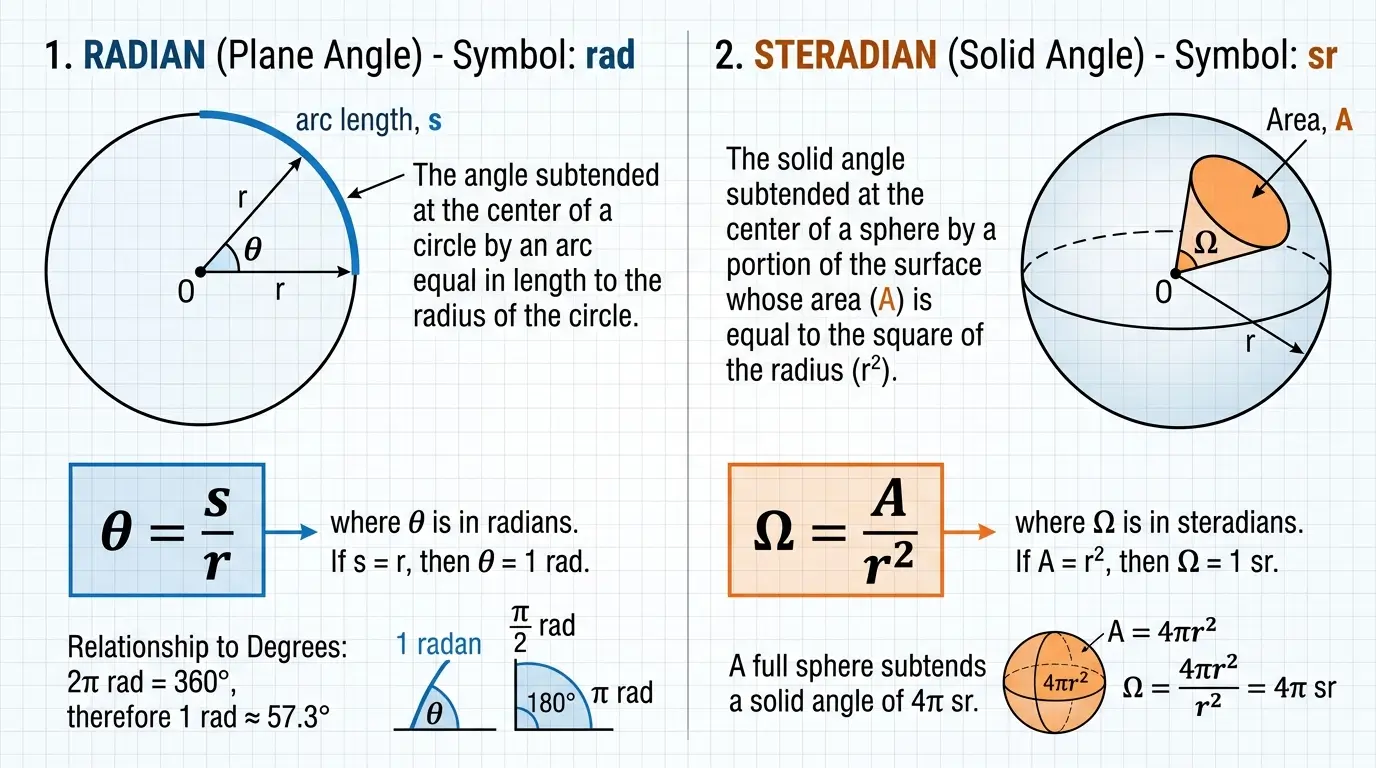
These quantities were once treated as a separate third category in the SI system, covering plane angle and solid angle. A plane angle, measured in radians, describes the angle between two intersecting lines, like the angle created when you open a door. A solid angle, measured in steradians, describes how large an object appears from a specific point in three-dimensional space, similar to how light spreads outward from a streetlamp.
| Supplementary Quantity | SI Unit | Symbol | Description |
| Plane Angle | Radian | rad | Angle formed by an arc equal in length to its radius |
| Solid Angle | Steradian | Sr | 3D angular spread at the center of a sphere |
Units of Measurement and the SI System
Units give a physical quantity a common language. Without standardized units, scientists in different countries couldn’t reliably compare experimental results at all. The International System of Units (SI) solves this by defining exactly seven base units, one for each fundamental quantity.
| Physical Quantity | Base Unit | Symbol |
| Length | meter | m |
| Mass | kilogram | kg |
| Time | second | s |
| Electric current | ampere | A |
| Thermodynamic temperature | kelvin | K |
| Amount of substance | mole | mol |
| Luminous intensity | candela | cd |
Beyond these base units, the metric system scales cleanly using simple prefixes. A kilometer equals 1,000 meters, a centimeter equals 0.01 meters, and a nanometer equals a billionth of a meter, a clean, predictable pattern that makes conversion far easier than older, fraction-based systems.
Derived Units.
Derived units are built by mathematically combining two or more SI base units, since many physical quantities simply can’t be measured using a single base unit alone. Speed combines length and time, giving meters per second. Force combines mass, length, and time, giving the newton.
| Quantity | Unit Name | Symbol | Built From |
| Area | square meter | m² | Length × Length |
| Volume | cubic meter | m³ | Length × Length × Length |
| Density | kg per cubic meter | kg/m³ | Mass ÷ Volume |
| Speed | meters per second | m/s | Length ÷ Time |
| Force | newton | N | kg·m/s² |
| Energy | joule | J | kg·m²/s² |
| Pressure | pascal | Pa | kg/(m·s²) |
| Power | watt | W | kg·m²/s³ |
| Frequency | hertz | Hz | 1/s |
| Electric charge | coulomb | C | A·s |
Imperial Units and Key Conversions.
While SI dominates global science, Imperial units still show up constantly in American daily life, from road signs measured in miles to grocery items weighed in pounds. Common Imperial length units include the inch, foot, yard, and mile, while weight relies on ounces, pounds, and tons.
| Common Conversion | Value |
| 1 mile | 1,609 meters |
| 1 foot | 30.48 centimeters |
| 1 pound | 0.454 kilogram |
| 1 gallon (U.S.) | 3.785 liters |
| 1 bar | 100,000 pascals |
| 1 calorie | 4.2 joules |
| 1 horsepower | 746 watts |
Dimensions and Dimensional Analysis.
A dimension describes what a physical quantity is fundamentally made of, expressed through the base quantities: Length (L), Mass (M), Time (T), Current (I), Temperature (Θ), Amount of substance (N), and Luminous intensity (J). While a unit tells you how much of something you have, a dimension tells you what kind of quantity you’re dealing with. Speed, for instance, is measured in meters per second, but its dimension is written as [LT⁻¹], since it depends purely on length and time.
This distinction turns out to be genuinely useful. Dimensional analysis lets scientists check whether an equation is even mathematically possible before running a single experiment, convert between unit systems like CGS and SI, and catch calculation errors that might otherwise slip through unnoticed.
| Physical Quantity | Dimensional Formula |
| Length | [L] |
| Mass | [M] |
| Time | [T] |
| Speed/Velocity | [LT⁻¹] |
| Acceleration | [LT⁻²] |
| Force | [MLT⁻²] |
| Work/Energy | [ML²T⁻²] |
| Power | [ML²T⁻³] |
| Pressure | [ML⁻¹T⁻²] |
| Density | [ML⁻³] |
| Area | [L²] |
| Volume | [L³] |
Dimensional constants.
These are quantities that have both dimensions and a fixed value, like the gravitational constant or Planck’s constant. Dimensionless quantities,
These quantities like pi or the trigonometric ratios, carry a fixed value but no dimensions at all. It’s worth noting that dimensional analysis has real limits: it can’t determine dimensionless proportionality constants, and it doesn’t work with trigonometric, logarithmic, or exponential functions.
Scientific Notation.
Scientific notation solves an obvious problem: writing out the mass of a planet or the diameter of an atom in full digits is clumsy and error-prone. Instead, scientists express a number as a value between 1 and 10, multiplied by a power of ten, following the general form a × 10ⁿ.
If a decimal point shifts left to create that format, the exponent turns positive, like 45,000 becoming 4.5 × 10⁴. If it shifts right, the exponent turns negative, like 0.00072 becoming 7.2 × 10⁻⁴.
| Quantity | Scientific Notation |
| Speed of light | 3.0 × 10⁸ m/s |
| Distance from sun | 1.496 × 10¹¹ m |
| Mass of an electron | 9.11 × 10⁻³¹ kg |
| Diameter of a hydrogen atom | 1.06 × 10⁻¹⁰ m |
| Avogadro’s number | 6.022 × 10²³ |
Significant Figures.
Here’s a strange fact worth remembering: writing “2.0 grams” and “2.00 grams” doesn’t actually mean the same thing in science. Significant figures are the digits in a measurement that carry genuine, meaningful precision, based on how carefully something was actually measured. More significant figures signal a more precise measurement; fewer signal a rougher one, even if the numbers look similar at a glance.
Every non-zero digit always counts as significant. A zero sitting between two other digits counts too, like the zero in 2,005. A zero at the very start of a number never counts, since it’s only holding a place, not adding real precision. But trailing zeros after a decimal point, like in 5.700, absolutely do count, because someone deliberately measured that precisely.
| Measurement | Significant Figures | Why |
| 7.25 m | 3 | All digits are significant |
| 0.0036 kg | 2 | Leading zeros don’t count |
| 120.0 cm | 4 | Trailing zero after the decimal counts |
| 9,080 s | 3 | Middle zero counts, trailing zero usually doesn’t |
It’s worth being honest about one limitation here: significant figures only capture uncertainty from an instrument’s scale. They don’t account for other real sources of error, like a miscalibrated device, a distracted reading, or a sudden temperature swing during the experiment.
Accuracy, Precision, and Uncertainty.
Accuracy .
Accuracy describes how close a measurement sits to the true value.
Accurate measurements which has fractional uncertainty.
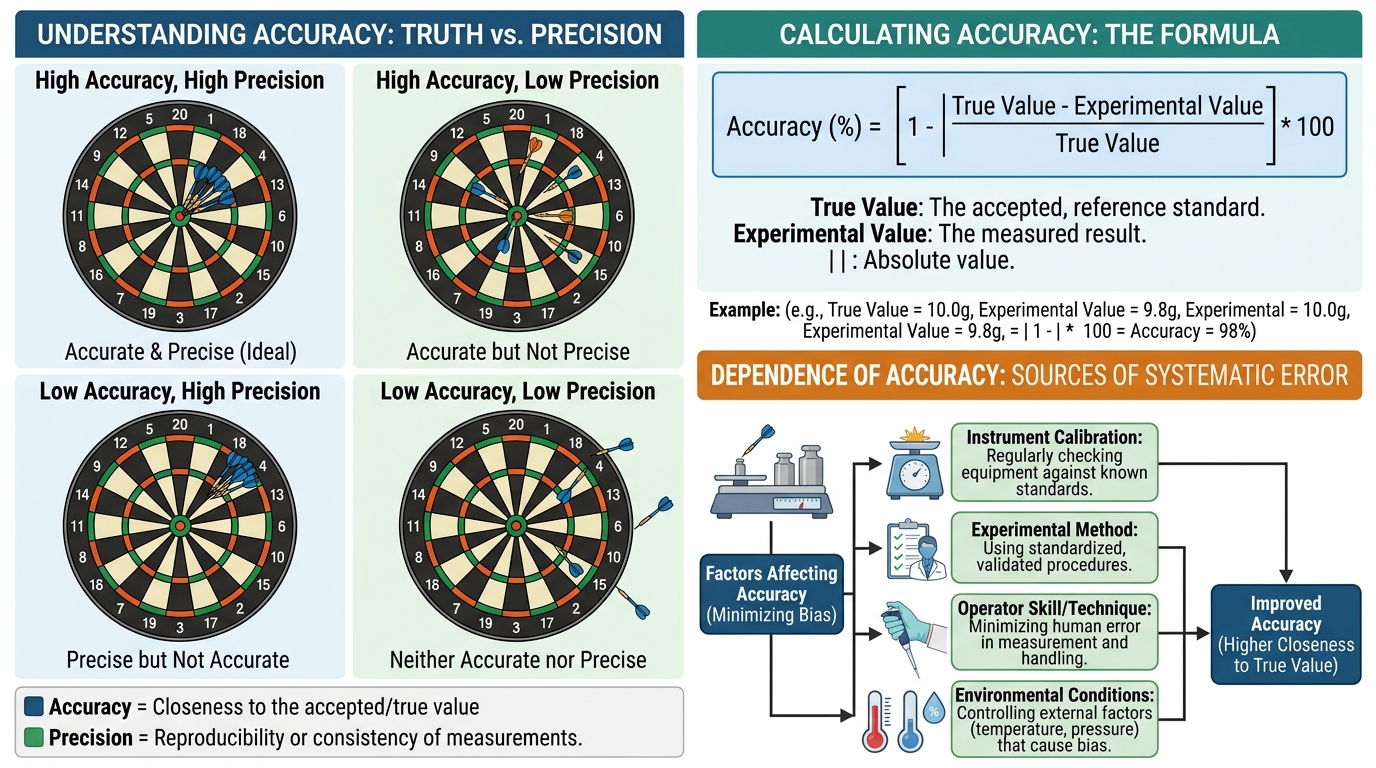
Absolute Uncertainty
Fractional Uncertainty=─────────────────────
Measured Value
Absolute Uncertainty
Percentage Uncertainty = ─────────────────────────× 100
Measured Value
Precision.
describes how consistently repeated measurements agree with each other, regardless of whether they’re actually correct.
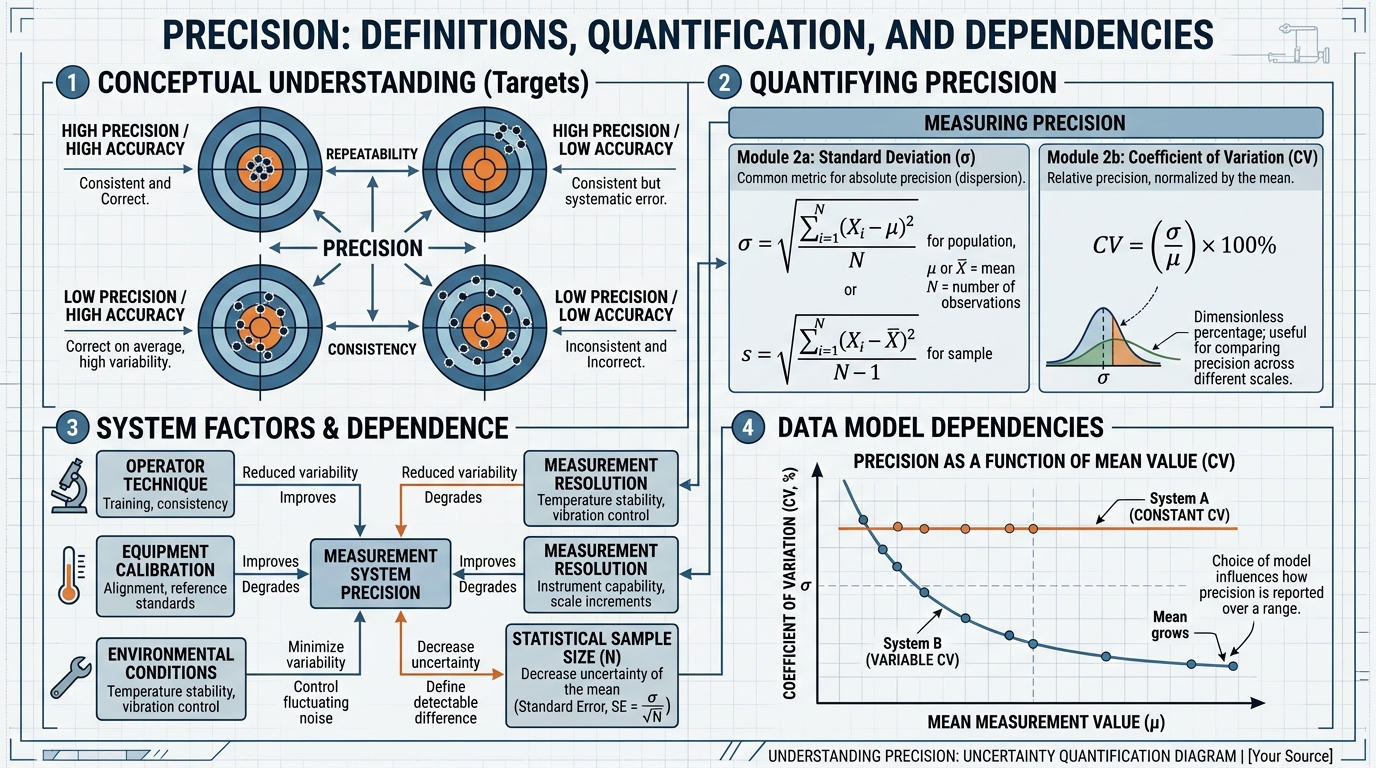
Absolute uncertainty =_+Least count
- Meter rod: Least count =0.1cm
- Vernier caliper: Least count =0.01cm
- Micrometer screw gauge: Least count =0.001cm
| Scenario | Example Measurements (True Value = 100 cm) | Result |
| High accuracy, high precision | 99.9, 100.0, 100.1, 100.0 | Close to true value and to each other |
| High precision, low accuracy | 95.1, 95.2, 95.1, 95.2 | Consistent, but far from true value |
| High accuracy, low precision | 97, 103, 100, 100 | Averages correctly, but inconsistent |
| Low accuracy, low precision | 88, 95, 109, 92 | Neither correct nor consistent |
Every measurement also carries uncertainty, the estimated doubt built into any reading, since no instrument is perfectly accurate. Absolute uncertainty is expressed in the same unit as the measurement itself, like ±0.01 cm for a Vernier caliper. Relative uncertainty, sometimes called fractional or percentage uncertainty, compares that absolute uncertainty against the size of the measurement, making it easier to judge just how significant an error really is.
Errors in Measurement:
An error in physics is simply the gap between a measured value and the true or accepted value. No instrument or method is perfectly accurate, so the real goal of good science isn’t eliminating error entirely, it’s understanding and minimizing it.
Systematic errors.
Errors push every reading consistently in the same direction, often caused by a miscalibrated instrument, like a scale that always reads half a kilogram too heavy.
Random errors
Errors causes unpredictable variation from one reading to the next, often from small environmental fluctuations or slight differences in how a scale is read. Gross errors are simple human mistakes, like recording the wrong number entirely or misreading a scale.
| Error Type | Formula | Example |
| Absolute Error | |Measured − True Value| | |49.6 − 50.0| = 0.4 cm |
| Relative Error | Absolute Error ÷ Measured Value | 0.4 ÷ 49.6 = 0.0081 |
| Percentage Error | Relative Error × 100 | 0.81% |
Errors can be reduced through proper calibration, choosing more precise instruments, taking multiple readings and averaging them, and carefully controlling the environment an experiment runs in. They can never be eliminated entirely, but consistent good practice keeps them small enough to trust.
Important Physical Constants
Certain values in physics stay fixed no matter where or when they’re measured, and knowing them by heart genuinely speeds up problem-solving.
| Constant | Value |
| Speed of light in vacuum (c) | 3 × 10⁸ m/s |
| Acceleration due to gravity (g) | 9.81 m/s² |
| Avogadro’s number (N) | 6.023 × 10²³/mol |
| Planck’s constant (h) | 6.626 × 10⁻³⁴ Js |
| Universal gravitational constant (G) | 6.67 × 10⁻¹¹ Nm²kg⁻² |
| Boltzmann’s constant (K) | 1.381 × 10⁻²³ JK⁻¹ |
| Absolute zero | −273.15°C (0 K) |
Frequently Asked Questions
What is the definition of measurement in physics? Measurement in physics is the process of comparing a physical quantity to a recognized standard unit, producing a numerical value that can be verified and reproduced across different experiments.
What are the seven fundamental physical quantities? The seven fundamental quantities recognized by the CGPM are length, mass, time, electric current, thermodynamic temperature, amount of substance, and luminous intensity. Every other physical quantity is derived from these.
What is the difference between accuracy and precision? Accuracy measures how close a value is to the true answer, while precision measures how consistent repeated measurements are with each other. A measurement can be precise without being accurate, and vice versa.
Why do significant figures matter? Significant figures communicate how precise a measurement genuinely is, preventing calculations from appearing more accurate than the original data actually supports.
What is the difference between an error and a mistake? An error is a natural, largely unavoidable part of measurement caused by instrument limits or environmental factors. A mistake is a human blunder, like misreading a scale, that careful work can usually prevent entirely.
Conclusion
Measurement is the quiet foundation underneath every physics result, from a simple ruler reading to a laser interferometer detecting gravitational waves. Understanding units, physical quantities, significant figures, and error isn’t just academic bookkeeping, it’s what makes a measurement trustworthy enough for anyone else, anywhere in the world, to rely on.