
Wave Behavior Unveiled: Interference, Reflection & Doppler effect.
introduction.
Wave behavior shapes almost everything you experience, from the sound reaching your ears to the light bouncing off a mirror. Superposition and interference are two closely related ideas that explain what happens when two or more waves meet at the same location…
Superposition and Interference of Waves.
Superposition and interference are two closely related ideas that explain what happens when two or more waves meet at the same location. Instead of simply passing through without affecting the resulting disturbance, the waves combine according to the principle of superposition. This combination can make the resulting wave larger, smaller, or even temporarily zero.
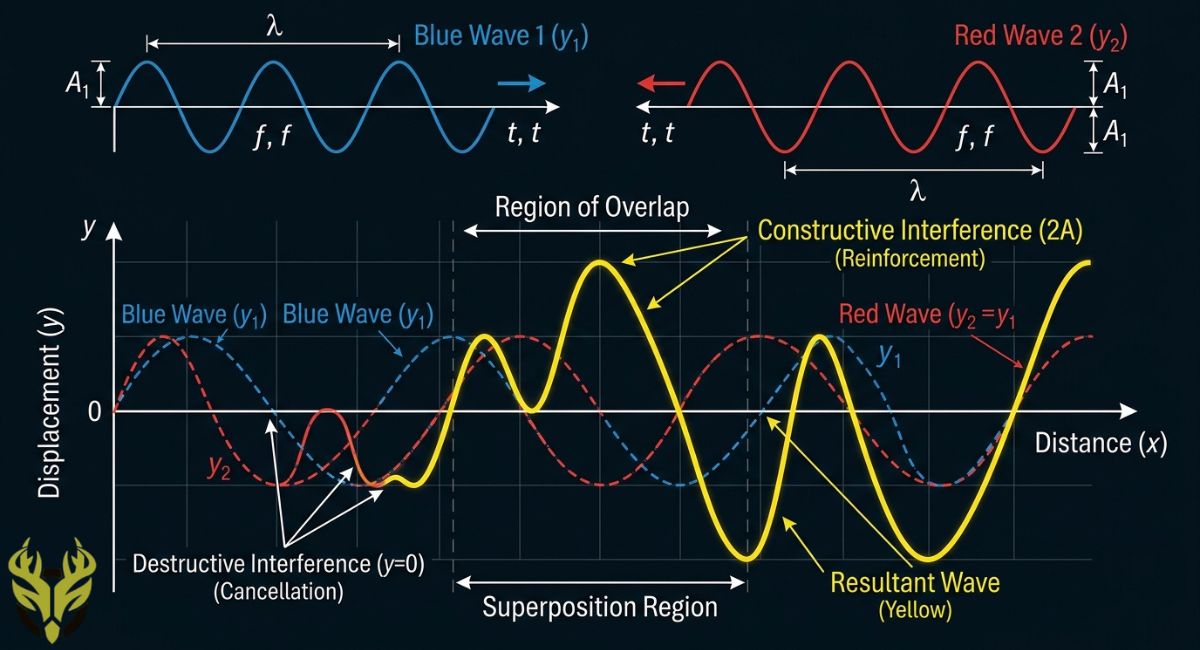
These concepts are important in understanding sound, light, water waves, musical instruments, noise cancellation, and many other wave phenomena.
What Is Superposition?
The principle of superposition states that when two or more waves overlap, the resultant displacement at any point is equal to the algebraic sum of the individual displacements at that point.
In simple words, imagine two people creating waves on the same rope. When the waves meet, their effects combine. If both waves push the rope upward at the same point, the displacement becomes larger. If one pushes upward while the other pushes downward, their effects partially or completely cancel.
Mathematically:
y=y1+y2
where y is the resultant displacement, while y1 and y2 are the displacements produced by the individual
Constructive Interference.
Constructive interference occurs when two waves meet in such a way that their displacements reinforce each other. The resulting amplitude becomes larger than the amplitude of either individual wave.
For two waves having the same amplitude and frequency, if their crests meet crests and troughs meet troughs, the waves reinforce one another.
For two waves with equal amplitude A:
The condition for constructive interference is:Δϕ=2nπ
where n=0,1,2,3,…
In terms of path difference:
Δx=nλ
This means the waves arrive in phase.
Simple Example
Imagine two water waves reaching the same point at the same time. If both waves raise the water surface together, the resulting wave becomes higher.This is constructive interference.
Destructive Interference.
Destructive interference occurs when two waves meet with opposite displacements and partially or completely cancel each other.For example, if the crest of one wave meets the trough of another wave of equal amplitude, the displacements can cancel completely.For two waves having equal amplitude:
The condition for complete destructive interference is:
Δϕ=(2n+1)π
In terms of path difference:
Δx=(n+1/2)λ
This means the waves are 180° out of phase.
Simple Example
Imagine two people pushing a swing in opposite directions with equal strength at exactly the same time. Their effects can cancel rather than making the swing move more strongly.
Applications of Superposition.
The principle of superposition is not just a mathematical idea. It helps explain many technologies and natural phenomena.
Sound and Music.
When sound waves from different sources reach your ears, they can combine through superposition. This can make some sounds louder and others quieter.
Noise-Canceling Headphones.
Noise-canceling systems use a form of destructive interference. The headphones produce a sound wave designed to oppose unwanted sound, reducing the resulting pressure variations reaching your ears.
Musical Instruments.
The sounds produced by strings, air columns, and other vibrating components involve combinations of waves. Superposition helps explain harmonics, resonance, and the quality of musical sounds.
Radio and Communication.
Electromagnetic signals can overlap in space. Wave superposition is important in understanding how signals combine and how communication systems separate or process them.
Medical Ultrasound.
Ultrasound systems use wave behavior to create information about structures inside the body. Interference and superposition are important concepts in advanced ultrasound techniques.
Reflection of Waves.
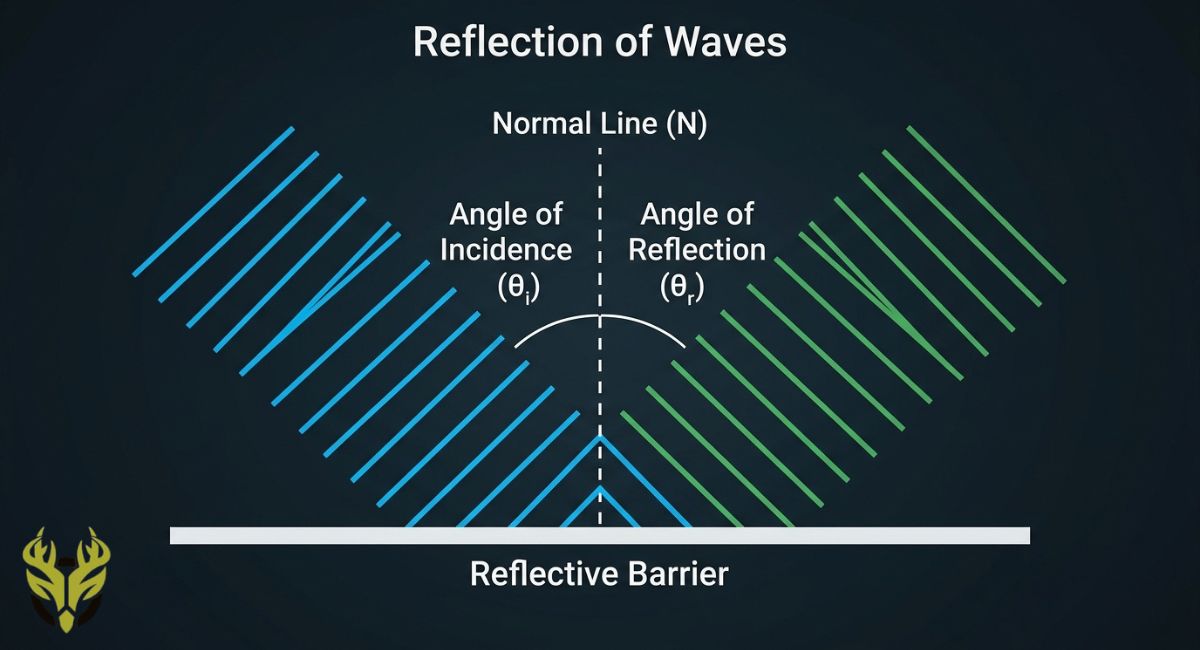
Reflection of waves is the phenomenon in which a wave bounces back into the same medium after reaching a boundary or surface.
Laws of Reflection.
The reflection of waves follows two basic principles.
First Law of Reflection.
The angle of incidence is equal to the angle of reflection:
θi=θr
The angle of incidence θi is measured between the incident wave and the normal, while the angle of reflection θr is measured between the reflected wave and the normal.
The normal is an imaginary line drawn perpendicular to the reflecting surface at the point where the wave strikes.
Second Law of Reflection.
The incident wave, reflected wave, and normal all lie in the same plane.
These laws apply broadly to wave reflection, although the exact behavior can depend on the type of wave and the boundary.
A Simple Example
Imagine throwing a tennis ball toward a wall. The ball reaches the wall and bounces back. A wave behaves similarly at a reflecting boundary: the direction changes, and the disturbance travels back into the original medium.
Reflection of Sound Waves.
Sound waves can be reflected when they encounter a hard or sufficiently large surface. The reflected sound can travel back toward the source or toward another listener.
The most familiar example is an echo. If you shout near a large building, cliff, or mountain, the sound travels toward the surface, reflects, and returns to your ears. For a distinct echo, the reflected sound must reach your ears sufficiently separated in time from the original sound. In air, this typically requires the reflecting surface to be far enough away for the delay to be noticeable.
Echo.
An echo is a reflected sound that is heard separately from the original sound.
The distance to a reflecting surface can be estimated using:
d=vt/2
where d is the distance to the reflecting surface, v is the speed of sound, and t is the total time taken for the sound to travel to the surface and return.
The factor of 2 appears because the sound travels the distance twice: once toward the surface and once back.
Applications of Sound Reflection
Reflection of sound is useful in SONAR, medical ultrasound, architectural acoustics, and determining the distance to underwater objects.
For example, SONAR sends sound pulses through water and detects returning echoes. From the travel time, the system can estimate the distance to an object.
Reflection of Water Waves..
Imagine creating ripples in a shallow tank. When the waves reach a solid barrier, they can reflect and travel back across the water.
The direction of the reflected waves depends on the angle at which the waves meet the boundary. If the waves approach the barrier at an angle, the reflected waves change direction according to the law of reflection.
Example
If straight water waves strike a wall, the waves can return in the opposite direction. If they strike at an angle, they reflect at a corresponding angle.
Water-wave reflection can be observed in pools, ponds, harbors, wave tanks, and coastal environments.
Reflection of Light as a Wave.
Although light is an electromagnetic wave, it also undergoes reflection. When light reaches a suitable surface, some of the electromagnetic energy can return into the original medium.
A smooth surface, such as a polished mirror, produces regular or specular reflection. A rough surface produces diffuse reflection, where reflected rays travel in many different directions.
Applications of Wave Reflection.
Wave reflection has many practical applications in science, medicine, engineering, and everyday technology.
-
SONAR
SONAR uses reflected sound waves to detect underwater objects and measure distances. A sound pulse is sent through water, and the returning echo is detected.
-
Medical Ultrasound
Medical ultrasound uses high-frequency sound waves. Waves are sent into the body, and echoes produced by boundaries between different tissues are detected. These echoes help create images of internal structures.
-
Echoes and Acoustics
Reflection of sound is important when designing concert halls, theaters, classrooms, recording studios, and auditoriums. Engineers carefully control reflections so that sound reaches listeners clearly without excessive echoes.
-
Mirrors and Optical Devices
Mirrors rely on the reflection of light. They are used in cameras, telescopes, periscopes, vehicle mirrors, microscopes, and many other optical systems.
-
Radar
Radar systems transmit electromagnetic waves and detect reflected signals from objects. The returning waves provide information about the object’s distance, position, and sometimes its motion.
-
Seismic Exploration
Geophysicists study reflected seismic waves to investigate structures beneath Earth’s surface. Changes in underground materials can cause seismic waves to reflect at boundaries, providing useful information about geological layers.
Refraction of Waves.
Refraction of waves is the change in the direction and speed of a wave when it passes from one medium or region into another where its speed is different.
A very important point is that when a wave crosses into a new medium, its frequency remains constant, while its speed and wavelength can change.
The basic wave relationship is:
v=fλ
where:
v=wave speed
f=frequency
λ=wavelength
If the frequency remains constant and the speed decreases, the wavelength must also decrease.
For example, if:
v=fλ
and v becomes smaller while f stays constant, then λ becomes smaller as well.
Refraction of Water Waves.
Water waves provide a simple way to observe refraction.
Imagine waves traveling through a shallow water tank. If part of the tank is made shallower, the waves travel more slowly in the shallow region. If the waves enter the shallow region at an angle, the change in speed causes the waves to change direction.
Water Waves Moving From Deep to Shallow Water.
When water waves move from deep water into shallow water, their speed decreases.
Because the frequency remains unchanged:
v=fλ
the wavelength becomes shorter.
If the waves enter the shallow region at an angle, they bend toward the normal.
So:
Deep water → shallow water
Speed decreases Wavelength decreases Frequency remains constant Wave bends toward the normal.
Water Waves Moving From Shallow to Deep Water
When waves move from shallow water into deeper water, their speed increases. Their wavelength therefore increases while their frequency remains constant.
If the waves enter at an angle, they bend away from the normal.
Refraction of Light Waves.
Light is an electromagnetic wave, and it also undergoes refraction when it passes from one transparent medium into another, such as from air into glass or from air into water.
The speed of light is different in different materials.
In vacuum:
c≈3.00×10^8 m/s
When light enters glass or water, its speed decreases. If light enters a denser optical medium at an angle, it generally bends toward the normal.
For example, when a light ray travels from air into glass:
Air→ Glass
the light slows down and bends toward the normal.
When it travels from glass into air:
Glass→ Air
its speed increases and the ray bends away from the normal, provided it is not undergoing total internal reflection.
Snell’s Law.
The refraction of light can be described mathematically using Snell’s law:
n1sinθ1=n2sinθ2
where:
n1 = refractive index of the first medium
n2 = refractive index of the second medium
θ1 = angle of incidence
θ2 = angle of refraction
The refractive index is related to the speed of light by:
n=cv
where c is the speed of light in vacuum and v is its speed in the material.
Example
When light travels from air into glass, its speed decreases. The light ray therefore bends toward the normal.This is why objects viewed through water can appear to be in a different position from where they actually are.
Everyday Examples of Refraction.
A straw in a glass of water can appear bent because light changes direction as it travels from water into air.
A coin at the bottom of a container can appear closer to the surface than its actual position because the light from the coin is refracted when it leaves the water.
Lenses use refraction to bend light and form images. Eyeglasses, cameras, microscopes, telescopes, and many optical instruments depend on this principle. Mirages can also result from refraction of light through layers of air at different temperatures and therefore different optical densities.
Diffraction of Waves.
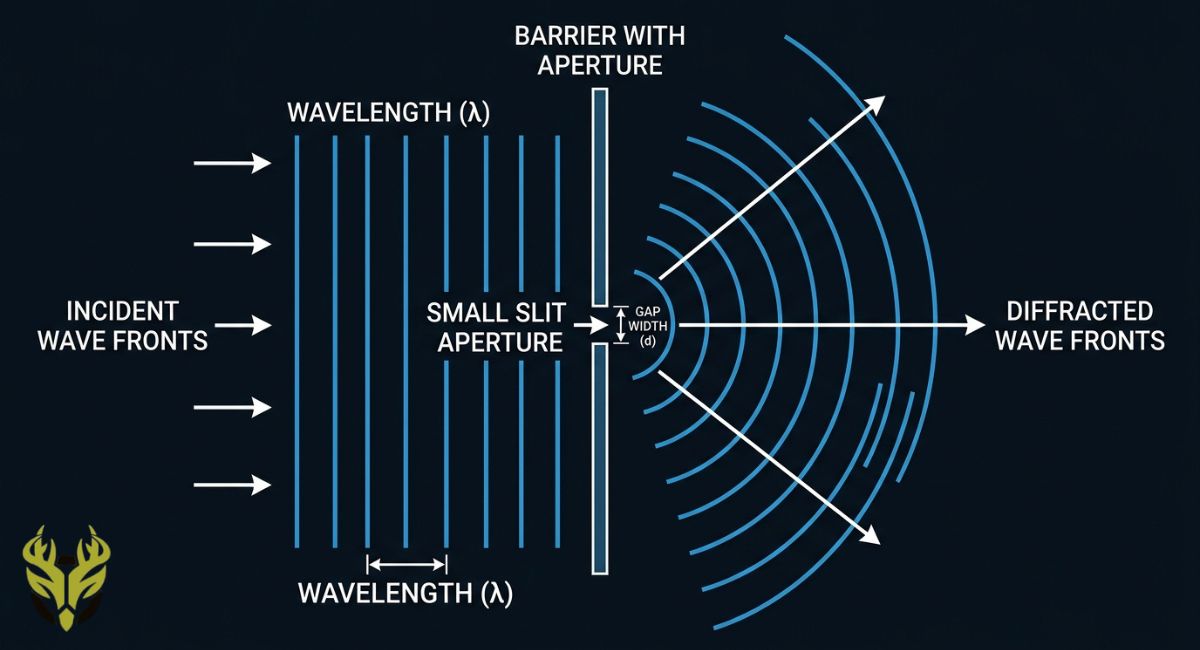
Diffraction is the bending and spreading of waves when they pass through a narrow opening or move around the edge of an obstacle.
When Is Diffraction Strong?
Diffraction becomes significant when the size of the opening or obstacle is comparable to the wavelength:
a∼λ
where a is the width of the opening and λ is the wavelength.
If the opening is much larger than the wavelength, diffraction is generally less noticeable.
Diffraction Through a Single Slit.
A single-slit diffraction pattern can be produced when waves pass through a narrow slit.
For light, a narrow slit allows light to spread out rather than simply continuing in a straight, narrow beam. On a screen behind the slit, this produces a pattern containing a bright central maximum surrounded by darker and weaker bright regions.
For a single slit of width a, the dark fringes occur approximately when:
asinθ=mλ
where:
a = width of the slit
θ = angle measured from the central direction
λ = wavelength
m=1,2,3,…
The first minimum occurs when:
asinθ=λ
This equation is especially useful when studying single-slit diffraction of light.
Central Maximum.
The central bright region is the widest and brightest part of the single-slit diffraction pattern.
The first dark fringes occur on either side of the central maximum. Additional weaker maxima and minima appear farther away.
A useful approximation for small angles is:
θ≈λ/a
This shows directly that a larger wavelength produces greater diffraction, while a wider slit produces less angular spreading.
Factors Affecting Diffraction.
Several factors determine how noticeable diffraction will be.
-
Wavelength
When the wavelength increases, diffraction becomes more pronounced.
For example, long-wavelength sound waves can diffract significantly around buildings and through doorways.
Greater wavelength →greater diffraction
-
Width of the Opening
When the opening becomes smaller and closer in size to the wavelength, the wave spreads more strongly.
Smaller opening →greater diffraction
If the opening is extremely large compared with the wavelength, the spreading is much less noticeable.
-
Size of the Obstacle
Diffraction can also occur when waves encounter an obstacle.
If the obstacle has dimensions comparable to the wavelength, the wave can bend and spread around it significantly.
-
Type of Wave
Different waves can show different amounts of diffraction because their wavelengths can be very different.
For example, radio waves can have wavelengths much larger than visible light, so they can diffract around certain obstacles more noticeably.
Daily life Examples of Diffraction.
Diffraction is not limited to laboratory experiments. You encounter it in everyday life.
Sound Around Corners.
You can sometimes hear someone speaking even when you cannot see them because sound waves can diffract around doorways, walls, and other obstacles.
This happens partly because audible sound has wavelengths that can be comparable to common openings and obstacles. Light does not normally bend around everyday objects as noticeably because visible light has a very short wavelength.
Radio Signals.
Radio waves can diffract around certain buildings, hills, and other obstacles. Their relatively long wavelengths allow them to spread into regions that may not be directly visible from the transmitter.
This is one reason radio signals can sometimes reach areas that are not in a simple straight-line path.
Water Waves.
Water waves provide an easy visual demonstration. When waves pass through a narrow opening in a barrier, they spread outward after passing through the gap.
The narrower the gap becomes relative to the wavelength, the stronger the spreading becomes.
CD and DVD Colors.
The closely spaced tracks on a CD or DVD can produce diffraction and interference of light. Different wavelengths are directed in different directions, producing the familiar rainbow-like colors seen from the surface.
Diffraction Gratings.
A diffraction grating contains many closely spaced slits or lines. When light interacts with these structures, diffraction and interference work together to separate different wavelengths. Diffractions gratings are widely used in spectroscopy to study the wavelengths of light emitted or absorbed by materials.
Polarization of Waves.
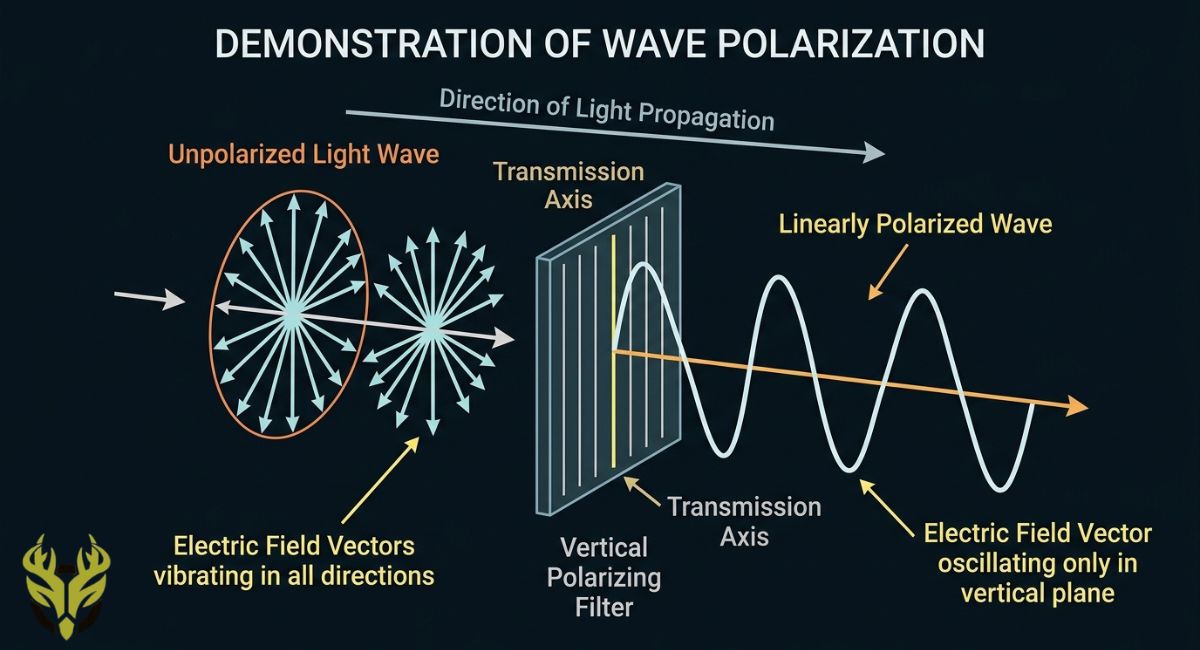
Polarization is a wave phenomenon that describes the direction of oscillation of a transverse wave. It is especially important for understanding light because light is an electromagnetic transverse wave.
Unpolarized and Polarized Waves.
An unpolarized transverse wave has oscillations occurring in multiple directions perpendicular to its direction of propagation.
A polarized wave has oscillations restricted to a particular direction. For light, the direction of polarization refers to the orientation of the electric field.
Polarization of Transverse Waves.
Polarization is possible only for waves that have oscillations perpendicular to their direction of propagation.
This is why polarization provides evidence that a wave is transverse.
Example: A Rope
Imagine a rope stretched horizontally.
- If you move the rope up and down, the wave has vertical oscillations.
- If you move it from side to side, the wave has horizontal oscillations.
If the rope is allowed to vibrate in many transverse directions, it is not polarized in a single direction. If a suitable restriction allows only vertical vibrations, the wave becomes linearly polarized.
Why Longitudinal Waves Cannot Normally Be Polarized.
In a longitudinal wave, the particles oscillate parallel to the direction of propagation.
For example, sound traveling through air involves particles moving back and forth along the direction in which the sound travels. There is no set of transverse directions that can be selected in the same way as for a transverse wave.Therefore, ordinary longitudinal waves such as sound in air cannot be polarized in the usual sense.
This gives us an important principle:
Polarization is a property of transverse waves.
Polarization and Light.
Light is an electromagnetic wave, and electromagnetic waves are transverse.
In an electromagnetic wave, the electric field and magnetic field oscillate perpendicular to each other and to the direction of propagation. For ordinary light, the electric field can oscillate in many directions perpendicular to the direction of travel. Such light is described as unpolarized.
A polarizing filter can restrict the direction of electric-field oscillation.
Polarizing Filters.
A polarizing filter allows light with a particular polarization direction to pass while reducing light polarized in other directions.
If unpolarized light passes through a single ideal polarizer, the transmitted intensity is approximately half the original intensity: I =I0/2
where I0 is the initial intensity.
called an analyzer, the transmitted intensity is
described by Malus’s law:
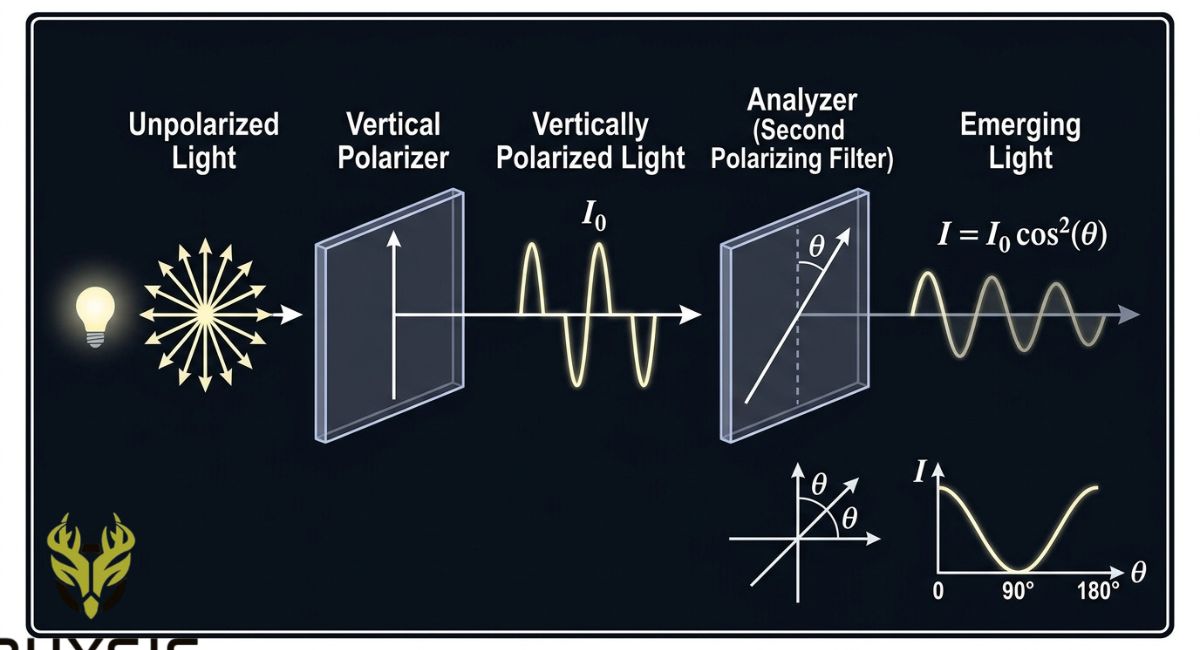
Example
If the two polarizers are aligned:
Ideally, no light passes through.
Types of Polarization.
Light can have different polarization states.
Linear Polarization.
In linear polarization, the electric field oscillates along one fixed direction perpendicular to the direction of propagation.
Circular Polarization.
In circular polarization, the electric-field vector rotates as the wave travels, while maintaining a constant magnitude. The tip of the electric-field vector traces a circle in the plane perpendicular to propagation.
Elliptical Polarization.
In elliptical polarization, the electric-field vector rotates and its tip traces an ellipse.
Linear and circular polarization can be considered special cases of elliptical polarization under suitable conditions.
Applications of Polarization.
Polarization has many applications in science, technology, medicine, and everyday life.
Polarized Sunglasses.
Polarized sunglasses reduce glare from surfaces such as water, roads, and snow.
Reflected light can become partially polarized. Polarizing sunglasses are designed to reduce certain polarization components, making bright reflected glare less intense.
Photography.
Photographers use polarizing filters to reduce reflections from glass and water and to improve the appearance of certain outdoor scenes.A polarizing filter can also reduce unwanted glare and increase contrast in some photographs.
3D Movies and Displays.
Polarization is used in some 3D cinema systems. Separate images intended for the left and right eyes are given different polarization states. Special glasses allow each eye to receive the appropriate image.
This creates the perception of depth.
LCD Screens.
Many LCD displays use polarizing filters as part of their operating principle. The orientation of polarized light is controlled to regulate how much light reaches the viewer.This technology is found in televisions, computer monitors, smartphones, calculators, and other electronic displays.
Stress Analysis.
Polarization can be used to study mechanical stress in transparent materials.
A technique called photo elasticity uses polarized light to reveal patterns associated with stress inside certain transparent materials. Engineers can use these patterns to investigate how forces are distributed.
Optical Instruments.
Polarization is important in various optical instruments and scientific measurements. Polarizing filters and related components are used to analyze materials and investigate properties that cannot easily be observed with ordinary light.
Doppler Effect.
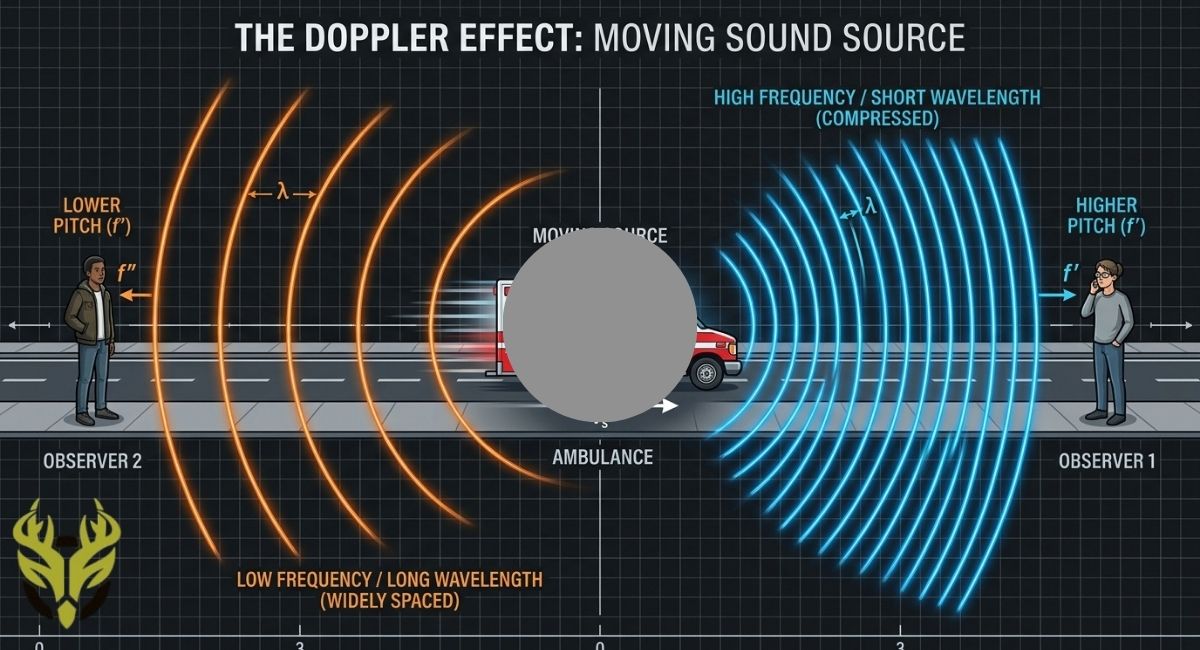
The Doppler effect is a fascinating wave phenomenon that explains why the frequency of a sound or other wave can appear different when the source and observer are moving relative to each other. You have probably experienced it without realizing it. When an ambulance approaches you with its siren on, the siren sounds higher in pitch. As the ambulance passes and moves away, the pitch suddenly becomes lower.
The important point is that the actual frequency produced by the source does not necessarily change. Instead, the frequency received by the observer changes because the relative motion changes the spacing and arrival rate of the wave fronts.
What Is the Doppler Effect?
The Doppler effect is the apparent change in the observed frequency of a wave caused by relative motion between the wave source and the observer.
For sound waves, frequency is closely related to pitch. Therefore, when the observed frequency increases, we hear a higher pitch. When the observed frequency decreases, we hear a lower pitch. The Doppler effect can occur with sound waves, light waves, radio waves, and other types of waves. However, the mathematical details depend on the type of wave and the motion involved.
Example.
Imagine an ambulance moving toward you while its siren produces sound waves. As the ambulance approaches, each new wave crest is produced from a position closer to you than the previous one. The wave fronts become compressed in front of the ambulance.
More wave fronts reach your ears each second, so you observe a higher frequency.
After the ambulance passes you, the wave fronts behind it become more spread out. Fewer wave fronts reach you each second, so you observe a lower frequency.
Doppler Effect in Sound.
The Doppler effect is particularly easy to notice with sound waves because changes in sound frequency are perceived as changes in pitch. Suppose a stationary sound source produces waves with frequency f. If both the source and observer remain stationary relative to the medium, the observer detects approximately the same frequency:
where fo is the observed frequency and fs is the source frequency. When either the source or observer moves, the number of wave fronts reaching the observer per second can change. For sound, a commonly used general expression . fo =fs(
v + vo)(v − vs)
where v is the speed of sound in the medium, vo is the observer’s velocity toward the source, and vs is the source’s velocity toward the observer, using the stated sign convention. The exact signs depend on the chosen directions, so it is often safer to reason physically: motion that brings the source and observer closer increases the observed frequency; motion that separates them decreases it.
source Moving Toward the Observer.
Consider an ambulance approaching a stationary observer.
- As the source moves toward the observer, it produces successive sound wave fronts from positions that are progressively closer to the observer.
The wave fronts in front of the source become closer together. Because wavelength decreases:
λ′<λ
and because:
v=fλ
the observer detects a higher frequency.
Therefore:
fo>fs
The observer hears a higher-pitched sound.
Everyday Example.
Imagine standing beside a road while a police car approaches with its siren operating. Before the car reaches you, the siren seems to become progressively higher in pitch.
This increase in observed pitch is caused by the Doppler effect.
Source Moving Away from the Observer.
Now imagine that the same ambulance passes you and continues moving away.
- The source produces each new wavefront farther away from the observer than the previous one. The wavefronts behind the source become spread out.
The wavelength received by the observer becomes larger:
λ′>λ
Therefore, the observed frequency decreases:
fo<fs
The observer hears a lower-pitched sound.
This is why the siren seems to suddenly drop in pitch as an ambulance passes and moves away.
Easy Way to Remember.
Source approaching → wave fronts compressed → frequency increases → pitch rises.
Source moving away → wave fronts spread out → frequency decreases → pitch falls.
What Happens When the Observer Moves?
The Doppler effect does not require the source itself to move. The observer can also move.
- If you move toward a stationary sound source, you encounter wave fronts more rapidly. Therefore, the observed frequency increases.
- If you move away from the source, you encounter wave fronts less frequently, so the observed frequency decreases.
This means that the Doppler effect depends on relative motion between the source and observer, although for sound the medium also matters because sound propagates through that medium.
-
Doppler Effect When Both Source and Observer Are Moving.
When both the source and observer are moving, the observed frequency depends on whether they are moving toward each other or away from each other. For sound waves, we also have to consider the medium because sound travels through a material medium such as air. The general Doppler-effect equation for sound is: fo =fs
(v ± vo)
(v ± vs)
where:
fo = observed frequency
fs = source frequency
v = speed of sound in the medium
Vo = speed of observer
Vs = speed of source
The signs are chosen according to the actual directions of motion.
-
Both Source and Observer Moving Toward Each Other
Suppose an ambulance is moving toward you while you are also walking or driving toward the ambulance.
The source moves toward you, so the wave fronts are produced closer together. At the same time, you move toward the incoming wave fronts and meet them more frequently.
Therefore, both effects increase the observed frequency.
The formula becomes:
Therefore:
fo>fs
The observer hears a higher pitch.
-
Both Source and Observer Moving Away From Each Other
Now imagine the ambulance is moving away from you while you are also moving away from the ambulance.The source produces increasingly spaced wave fronts in your direction, while you move away from the incoming waves.
Therefore, both effects decrease the observed frequency.
The formula becomes:
fo =fs(
v – vo)(v + vs)
Therefore:
fo<fs
The observer hears a lower pitch.
Source and Observer Moving in Opposite Directions.
The phrase “opposite directions” can mean two different situations, so it is important to identify whether they are moving toward or away from each other.
Moving Toward Each Other.
fo =fs(
v + vo)(v − vs)
Both motions increase the observed frequency.
fo>fs
Moving Away From Each Other
fo =fs(
v – vo)(v + vs)
Both motions decrease the observed frequency.
fo<fs
-
Source and Observer Moving in the Same Direction
There is another important case. Suppose both the source and observer are moving in the same direction.
For example, if the source is moving faster than the observer and is moving away from the observer, the observed frequency decreases. If the observer is moving toward the source from behind, the observer may encounter wavefronts more frequently. So you should not choose the signs simply by looking at whether the velocities are positive or negative.
-
Doppler Effect When Source and Observer Move in the Same Direction at the Same Speed
If the source and observer move in the same direction with the same speed, and the distance between them remains constant, there is an important result:
fo=fs
So, there is no Doppler shift.
-
Real-Life Applications of the Doppler Effect
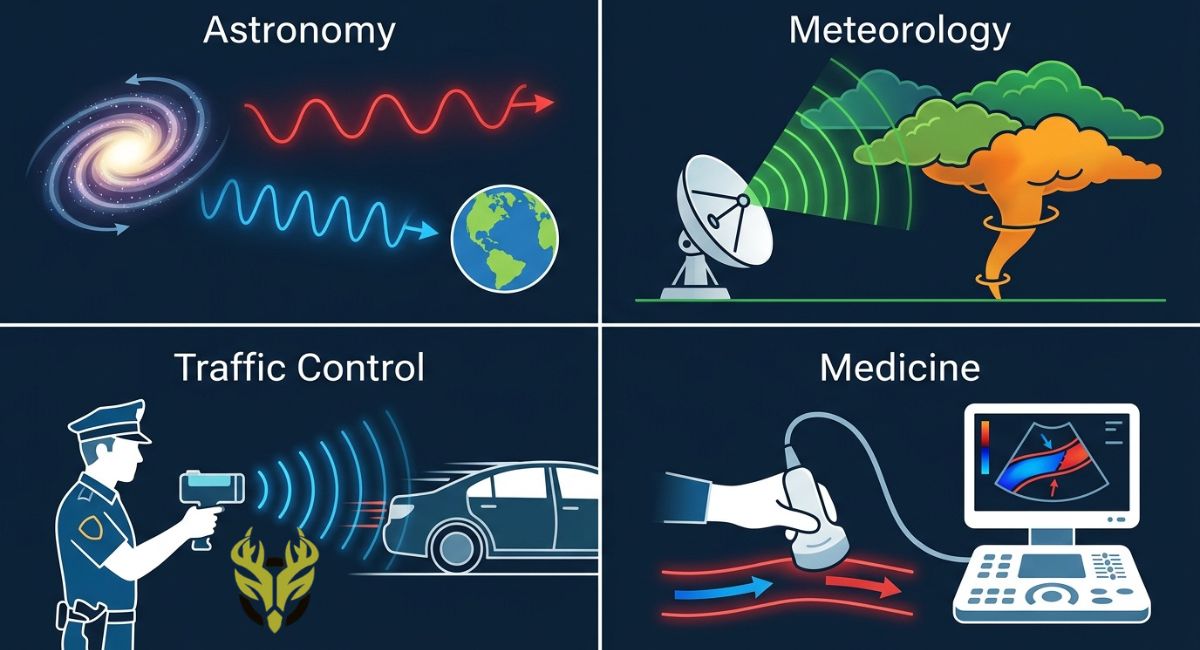
The Doppler effect is much more than an explanation for changing siren pitch. It is widely used in medicine, astronomy, meteorology, transportation, and engineering.
-
Ambulance and Police Sirens
The classic everyday example is an ambulance, fire truck, or police vehicle.
As the vehicle approaches, the sound appears higher in pitch. As it moves away, the pitch becomes lower.
-
Medical Doppler Ultrasound.
Doctors use Doppler ultrasound to study the movement of blood through blood vessels.
Ultrasound waves are sent into the body and reflected from moving blood cells. The frequency of the reflected waves changes because the blood cells are moving relative to the ultrasound source and detector. By analyzing this frequency shift, medical equipment can estimate blood-flow speed and direction.
-
Astronomy
Astronomers use the Doppler effect to determine whether stars and galaxies are moving toward or away from Earth.
- When a celestial object moves away, its spectral lines shift toward longer wavelengths, producing a redshift.
- When it moves toward us, spectral lines shift toward shorter wavelengths, producing a blueshift.
These measurements provide important information about the motion of astronomical objects.
-
Radar Speed Detection
Doppler radar can measure the velocity of moving objects.
For example, traffic radar sends electromagnetic waves toward a vehicle and analyzes the frequency shift in the reflected signal. This allows the system to estimate the vehicle’s speed.
-
Weather Radar.
Meteorologists use Doppler radar to study the movement of rain, snow, and other particles in the atmosphere.
The frequency shift of reflected radar waves provides information about the motion of precipitation. This helps meteorologists analyze storms and estimate wind patterns.
-
Measuring the Motion of Stars
The Doppler effect allows astronomers to measure the radial velocity of stars.
If a star’s spectral lines shift toward the red end of the spectrum, the star is moving away from the observer. If they shift toward the blue end, the star is moving toward the observer. Small periodic shifts can also help astronomers detect exoplanets orbiting distant stars.
-
Doppler Effect in Light
The Doppler effect also occurs with electromagnetic waves, including visible light. For light from astronomical objects, the effect is often described using redshift and blueshift.
Redshift
When a source moves away from the observer, its observed wavelengths become longer. The spectral lines shift toward the red end of the visible spectrum.
λobserved>λsource
Blueshift
When a source moves toward the observer, its observed wavelengths become shorter, shifting spectral lines toward the blue end.
λobserved<λsource
These effects are extremely useful in astronomy because the shift in spectral lines provides information about the motion of distant objects.
Conclusion
Wave behavior doesn’t stop once a wave leaves its source . it bends, bounces, cancels, and shifts in ways that shape technology we rely on daily. Interference explains noise-canceling headphones, reflection powers SONAR and mirrors, and refraction is why a straw looks bent in a glass of water. Diffraction reveals why sound sneaks around corners while light rarely does, and polarization sits behind everything from sunglasses to LCD screens. The Doppler effect ties it all together, connecting a passing ambulance siren to the redshift astronomers use to map an expanding universe. Once you see these five behaviors, wave physics stops feeling abstract and starts explaining the world around you.
FAQs.
Q.What’s the difference between constructive and destructive interference?
Constructive interference happens when two waves align crest-to-crest, producing a larger combined amplitude. Destructive interference happens when a crest meets a trough, partially or fully canceling the wave.
Q.Why does a straw look bent in a glass of water?
This is refraction. Light bends as it moves from water into air because its speed changes between the two media, shifting the straw’s apparent position.
Q.Why can I hear someone around a corner but not see them?
Sound waves have longer wavelengths than light, so they diffract (bend around obstacles) much more noticeably than visible light does.
Q.How do noise-canceling headphones work?
They use destructive interference. The headphones generate a sound wave that’s the mirror opposite of unwanted noise, canceling much of it out before it reaches your ears.
Q.Why does an ambulance siren change pitch as it passes?
This is the Doppler effect. As the ambulance approaches, sound wave fronts compress, raising the pitch. As it moves away, wave fronts spread out, lowering the pitch.
Q.What does polarization tell us about light?
Polarization proves light is a transverse wave, since only transverse waves can have oscillations restricted to one direction. It’s used in sunglasses, cameras, LCD screens, and 3D movies.