
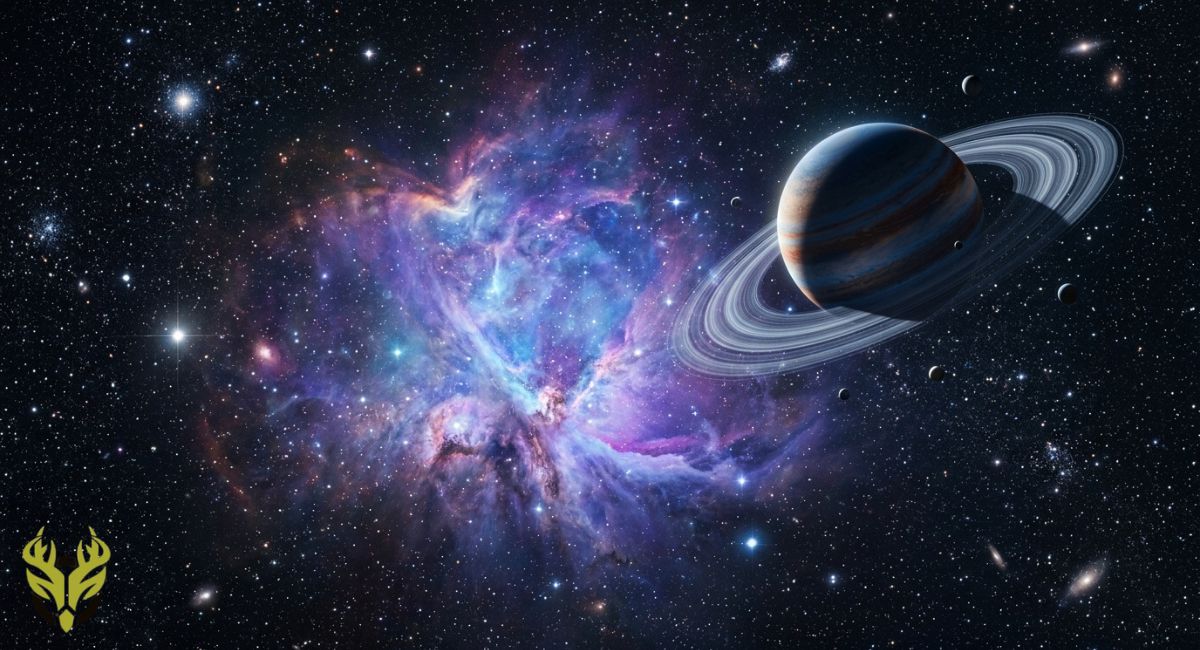
Stand beside the ocean at high tide. Even if the water never touches your feet, you still feel the air, hear the waves, and notice the weather shifting around you. Space works the same way. You can’t reach out and touch it, yet its activity reaches you feel every single day through your phone’s GPS, your weather app, and the satellites quietly circling overhead. The space environment covers everything beyond Earth’s atmosphere: the Sun, the planets, magnetic fields, cosmic particles, radiation, and the near-perfect vacuum that fills the gaps between them. People often picture space as empty and silent. It’s not like that at all.
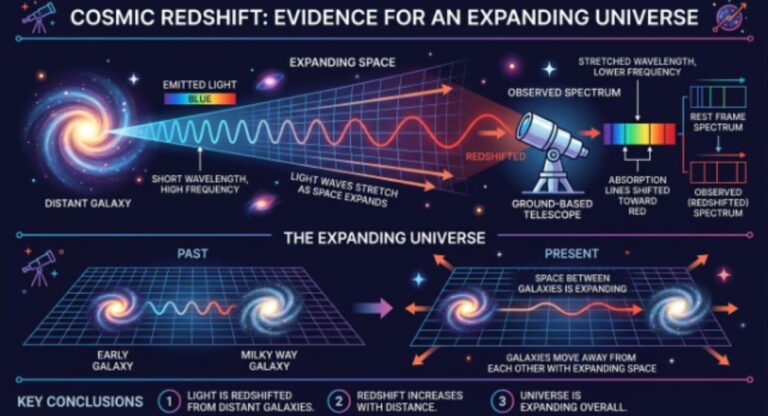
It’s packed with energy, radiation, magnetic fields, and particles racing along at incredible speed. Space and environment are two important and closely related fields that help us to understand both the universe and our planet. Space refers to a region beyond Earth’s atmosphere in which all celestial bodies, such as planets, stars, and galaxies, exist and interact through gravity and electromagnetic radiation. Environment is the surrounding physical, chemical, and biological conditions in which living and non-living systems exist and interact. It includes air, water, land, climate, ecosystems, and all natural processes that support life on the earth. In this chapter, we will explore how stars emit energy (luminosity), how we use tools like standard candles and redshift to measure cosmic distances, and how radiation laws help in estimating the temperature and size of stars. We will also learn how Earth’s climate system functions through complex interactions among air, water, ice, land, and life, and how these elements respond to solar energy, wind, and ocean circulation. Space may appear empty, but it is constantly filled with energy, radiation, magnetic fields, and fast-moving particles. The Space and Environment describes everything beyond Earth’s atmosphere that influences our planet and the technology humans depend on. Space weather and solar radiation continuously shape this invisible environment.
What Is the Space Environment?
The space environment refers to the conditions that exist in outer space and that affect spacecraft, satellites, astronauts, and other objects beyond Earth’s atmosphere.
Key features of the space environment include:
- Vacuum
- Space contains extremely little matter, creating a near-perfect vacuum.
- Without air, there is no atmospheric pressure or sound transmission.
- Microgravity
- Objects in orbit experience continuous free fall, producing the sensation of weightlessness.
- This affects both astronauts and equipment.
- Radiation
- High-energy particles come from the Sun (solar radiation) and from outside the solar system (cosmic rays).
- Radiation can damage electronics and pose health risks to astronauts.
- Extreme Temperatures
- Objects exposed to direct sunlight can become very hot, while shaded areas can become extremely cold.
- Spacecraft require thermal control systems to manage these temperature differences.
- Solar Wind and Magnetic Fields
- The Sun emits a stream of charged particles called the solar wind.
- These particles interact with Earth’s magnetic field, creating phenomena such as the aurora.
- Micrometeoroids and Orbital Debris
- Tiny natural particles and human-made debris travel at very high speeds.
- Even small impacts can damage spacecraft.
- Plasma Environment
- Much of space contains ionized gas (plasma), which can affect spacecraft surfaces and electronic systems.
The space environment varies depending on location. For example:
- Low Earth Orbit (LEO), where the International Space Station operates, still experiences traces of Earth’s atmosphere.
- Deep space has stronger cosmic radiation and lacks Earth’s magnetic protection.
- Environments around other planets, such as Mars or Jupiter, have their own unique conditions.
Why Is Space So Different From Earth?
Earth has everything humans need to survive naturally. We breathe oxygen, drink water, and live under atmospheric pressure that keeps our bodies functioning normally. Space offers none of these comforts.
Instead of fresh air, there is an almost perfect vacuum. Instead of comfortable temperatures, there are scorching hot and freezing cold conditions. Instead of protection from harmful rays, astronauts are exposed to powerful solar and cosmic radiation.
This is why astronauts cannot survive in space without specially designed spacecraft and spacesuits.
The Main Features of the Space Environment
-
Vacuum: A Place Without Air
One of the most important characteristics of space is its vacuum. A vacuum means there are almost no air molecules.
Because there is no air:
- Humans cannot breathe.
- Sound cannot travel.
- There is almost no atmospheric pressure.
- Heat behaves very differently than it does on Earth.
Think about blowing up a balloon. The air inside pushes against the rubber and gives it shape. In space, there is no outside air pressure. Spacecraft must therefore be built like strong pressure containers to keep astronauts alive.
-
Microgravity: Why Astronauts Float
People often say there is “no gravity” in space, but this is not completely true. Gravity exists almost everywhere in the universe.
Astronauts float because spacecraft orbiting Earth are constantly falling toward the planet while moving forward at tremendous speed. This creates microgravity, where everything appears weightless.
Imagine riding an elevator that suddenly falls freely. For a brief moment, you would feel weightless. Astronauts experience this feeling continuously while orbiting Earth.
Microgravity changes everyday activities.
- Water forms floating bubbles.
- Food must be packaged carefully.
- Sleeping requires special sleeping bags.
- Muscles and bones become weaker over time without regular exercise.
Radiation: The Invisible Danger
Unlike Earth, space provides little protection from harmful radiation.
There are two major sources of radiation:
|
Source |
Description |
| Solar Radiation | High-energy particles released by the Sun |
| Cosmic Rays | Extremely energetic particles arriving from distant stars and galaxies |
Radiation can:
- Damage spacecraft electronics.
- Affect communication systems.
- Increase health risks for astronauts.
- Damage human DNA during long missions.
Fortunately, Earth’s magnetic field and atmosphere protect us from most of this dangerous radiation every day.
-
Extreme Temperatures
Temperature in space is very unusual.
A spacecraft facing the Sun may become hotter than a desert afternoon. The shaded side may become colder than Antarctica during winter.
For example:
| Condition | Approximate Temperature |
| Direct Sunlight | Around 120°C |
| Deep Shadow | Around −150°C |
Since there is no air, heat cannot spread the way it does on Earth. Engineers use insulation, reflective materials, and cooling systems to protect spacecraft.
-
Solar Wind
The Sun constantly releases billions of tiny charged particles into space. This stream is called the solar wind.
Although invisible, solar wind can:
- Disturb satellite operations.
- Affect GPS systems.
- Interrupt radio communication.
- Trigger beautiful auroras near Earth’s poles.
Earth’s magnetic field acts like a giant invisible shield that deflects much of the solar wind.
-
Micrometeoroids and Space Debris
Space is not completely empty.
Tiny rocks called micrometeoroids travel naturally through the Solar System. Humans have also created thousands of pieces of space debris, including broken satellites, rocket fragments, and small metal objects.
Even something as small as a paint chip can travel at several kilometers per second. At these speeds, a tiny object can punch holes in spacecraft.
This is one reason why space agencies constantly monitor orbital debris.
-
Plasma
Most of the visible universe is made of plasma, often called the fourth state of matter. Plasma consists of electrically charged particles. It surrounds the Sun, stars, and much of outer space.
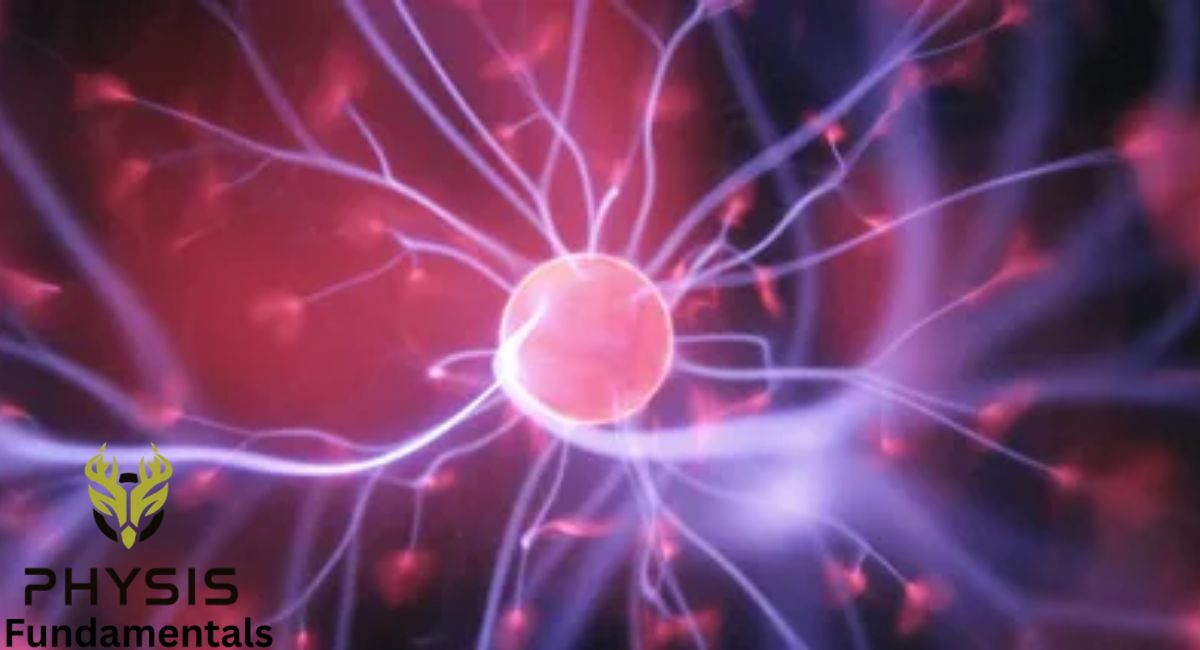
Although humans cannot see it easily, plasma affects:
- Satellite electronics
- Communication signals
- Spacecraft charging
- Scientific measurements
How the Space Environment Affects Humans
Living in space is very different from living on Earth.
Astronauts must adapt to conditions that the human body never evolved to handle.
Some common effects include:
| Space Condition | Effect on Humans |
| Microgravity | Muscle and bone loss |
| Radiation | Increased health risks |
| Vacuum | Requires pressurized suits |
| Isolation | Mental and emotional challenges |
| Temperature Extremes | Need for thermal protection |
This is why astronauts train for years before traveling into space.
How Spacecraft Survive the Space Environment
Every spacecraft is carefully engineered to withstand the harsh conditions of space.
Engineers include:
- Strong protective shields against tiny impacts.
- Thick insulation to control temperature.
- Radiation-resistant electronic systems.
- Solar panels for electrical power.
- Pressurized cabins for astronauts.
- Advanced communication systems.
How Space and Earth’s Environment Work Together.
Earth’s atmosphere and magnetic field act like a giant shield wrapped around the planet. Together, they block most harmful cosmic rays and dangerous radiation, letting only safe, gentle sunlight reach the ground. Strip that shield away, and life as you know it simply couldn’t exist. This partnership between the Sun’s energy and Earth’s protection is the quiet engine behind everything from your morning weather to the water cycle itself. Sunlight warms the surface, drives evaporation, and powers plant growth, all while Earth’s defenses keep the harsher parts of that same sunlight at bay.
Why Studying the Space Environment Matters.
Understanding the space environment helps scientists and engineers design safer missions and more reliable technology. It allows satellites to operate efficiently, supports communication and navigation systems, protects astronauts during long-duration missions, and improves our ability to explore the Moon, Mars, and beyond.
As humanity plans future space colonies and deep-space exploration, knowledge of the space environment becomes even more important.
The Sun: Our Life-Giving Star Explained in Simple Words.
The Sun is much more than a bright object in the sky. Every sunrise marks the beginning of a new day, warms the Earth, powers our weather, helps plants grow, and makes life possible. our body temperature maintained due to this. Without the Sun, our planet would become a frozen world covered in darkness.
People have admired the Sun for thousands of years. Ancient civilizations worshipped it as a god, while modern scientists study it using powerful telescopes and space missions. Today, we know that the Sun is an enormous ball of extremely hot gases held together by its own gravity. It has been shining for about 4.6 billion years, and it will continue providing light and heat for another 5 billion years before reaching the final stages of its life.
What Is the Sun?
Imagine standing outside on a cold winter morning. As the sunlight touches your face, you immediately feel warmth. That warmth has traveled nearly 150 million kilometers (93 million miles) from the Sun. The Sun is a medium-sized star located at the center of our Solar System. Every planet, asteroid, and comet revolves around it because of its powerful gravitational force. Although the Sun appears small in the sky, it is incredibly massive. It contains about 99.86% of all the mass in the Solar System. Size: About 109 times wider than Earth, and large enough to hold over one million Earths. Travel time for light: Sunlight takes about 8 minutes and 20 seconds to reach Earth.
| Property | Value |
| Type | G-Type Main Sequence Star (Yellow Dwarf) |
| Age | About 4.6 Billion Years |
| Diameter | 1.39 Million km |
| Surface Temperature | About 5,500°C |
| Core Temperature | About 15 Million°C |
| Distance from Earth | 149.6 Million km |
| Main Energy Source | Nuclear Fusion |
Why Is the Sun So Important?
The food you eat grows because plants use sunlight during photosynthesis. The air you breathe contains oxygen produced by those same plants. Weather, rainfall, ocean currents, and seasons are all driven by solar energy.
Without the Sun:
- Earth would freeze below −200°C.
- Plants could not make food.
- Animals and humans could not survive.
- Oceans would eventually freeze.
- The atmosphere would collapse over time.
How Was the Sun Created?.
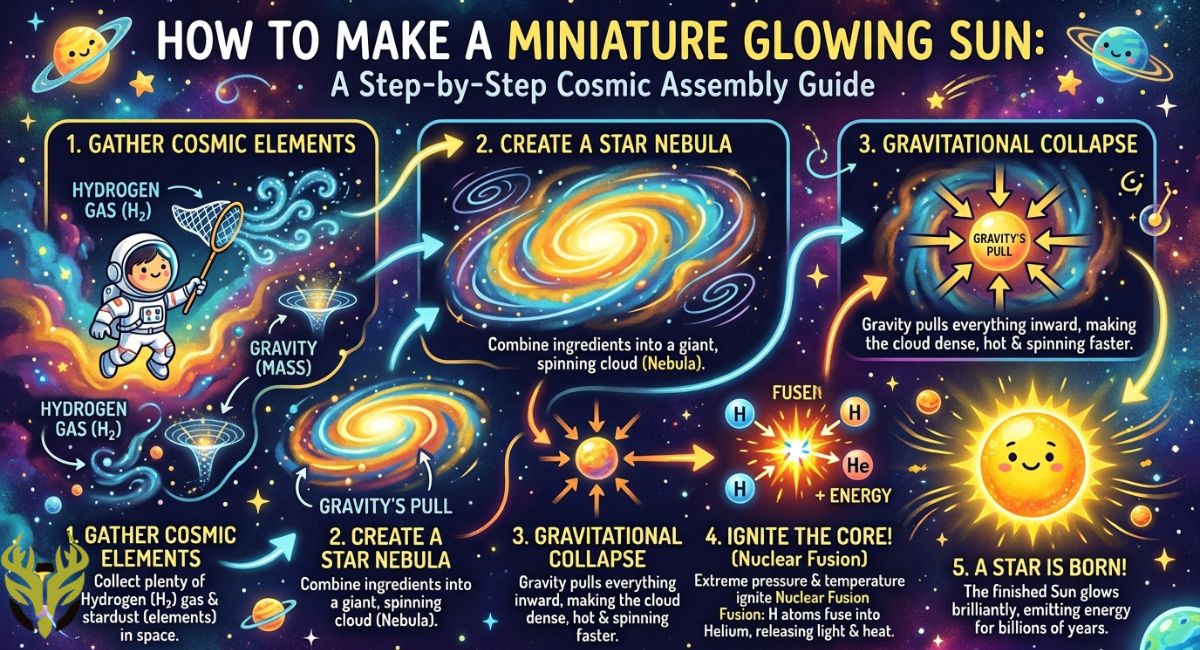
The Beginning of the Sun.
- Around 4.6 billion years ago, our Solar System did not exist. Instead, there was a gigantic cloud of gas and dust floating through space. Scientists call this cloud a solar nebula.
- Most of the cloud consisted of hydrogen and helium, with tiny amounts of heavier elements created by older stars that had exploded long before our Sun was born.
- One day, something disturbed this cloud. It may have been the explosion of a nearby star, called a supernova. The shockwave caused parts of the cloud to collapse under gravity.
- As gravity pulled more material inward, the center became hotter and denser.
- This growing object became known as a protostars, the early stage of a star.
How Did the Sun Become a Star?
As more gas gathered, pressure increased dramatically. The core temperature continued rising until it reached approximately:T=15,000,000°C
At this incredible temperature, hydrogen atoms began joining together.This process is called nuclear fusion.Once fusion started, the Sun officially became a star.From that moment, it began producing enormous amounts of light and heat.
What Is the Sun Made Of?.
Many people think the Sun is made of fire, but that is not correct. The Sun is actually made almost entirely of hot gases and plasma.
Main Gases in the Sun
| Gas | Percentage |
| Hydrogen | About 74% |
| Helium | About 24% |
| Oxygen | Less than 1% |
| Carbon | Less than 1% |
| Neon | Trace |
| Iron | Trace |
| Nitrogen | Trace |
| Silicon | Trace |
| Magnesium | Trace |
Hydrogen is the fuel that powers the Sun.
Helium is produced continuously inside the Sun through nuclear fusion.
What Is Plasma?
The Sun is not made of ordinary gas. Its extremely high temperature strips electrons away from atoms. This creates a special state of matter called plasma. Plasma behaves differently from solids, liquids, or gases because it is electrically charged and strongly influenced by magnetic fields. Scientists often call the Sun a giant sphere of plasma.

How Does the Sun Produce Energy?
The Sun shines because of nuclear fusion occurring in its core. Inside the core: Four hydrogen nuclei combine to form one helium nucleus. A small amount of mass disappears during this reaction. That missing mass becomes energy according to Einstein’s famous equation:
E=mC2
Where:
- E = Energy
- m = Mass
- c = Speed of light
Because the speed of light is extremely large, even a tiny amount of mass produces an enormous amount of energy.
Nuclear Fusion Equation
A simplified fusion reaction is:
41H→4He+Energy
Every second the Sun converts approximately:
- 600 million tons of hydrogen
- into 596 million tons of helium
About 4 million tons of matter become pure energy every second.
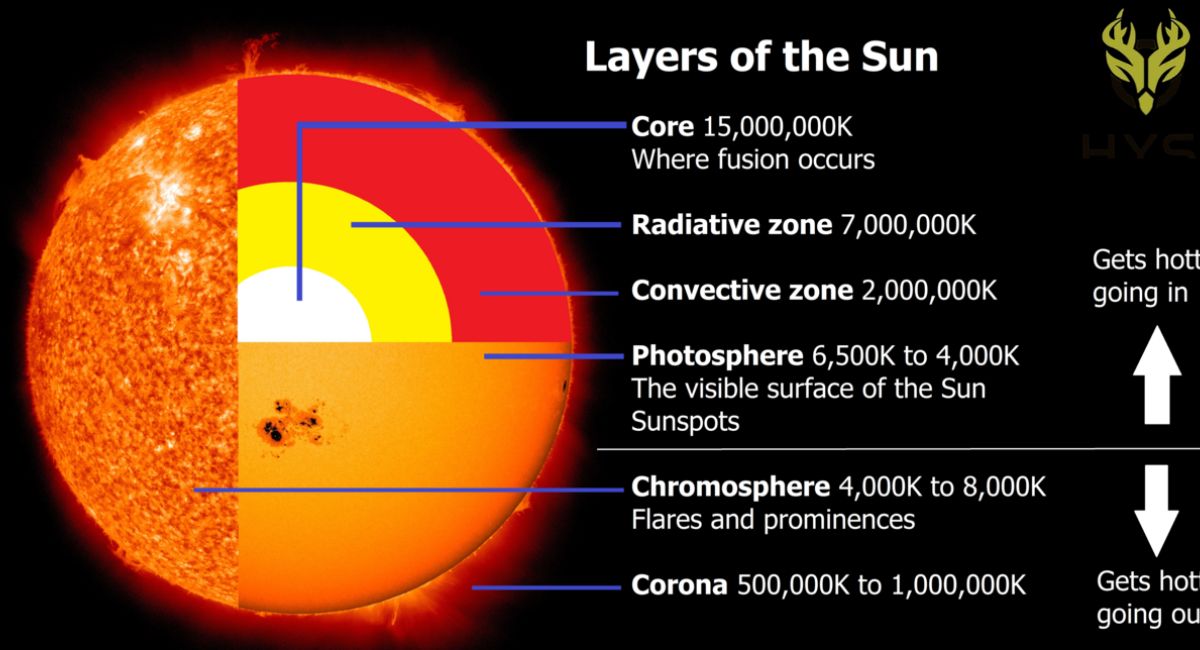
Layers of the Sun.
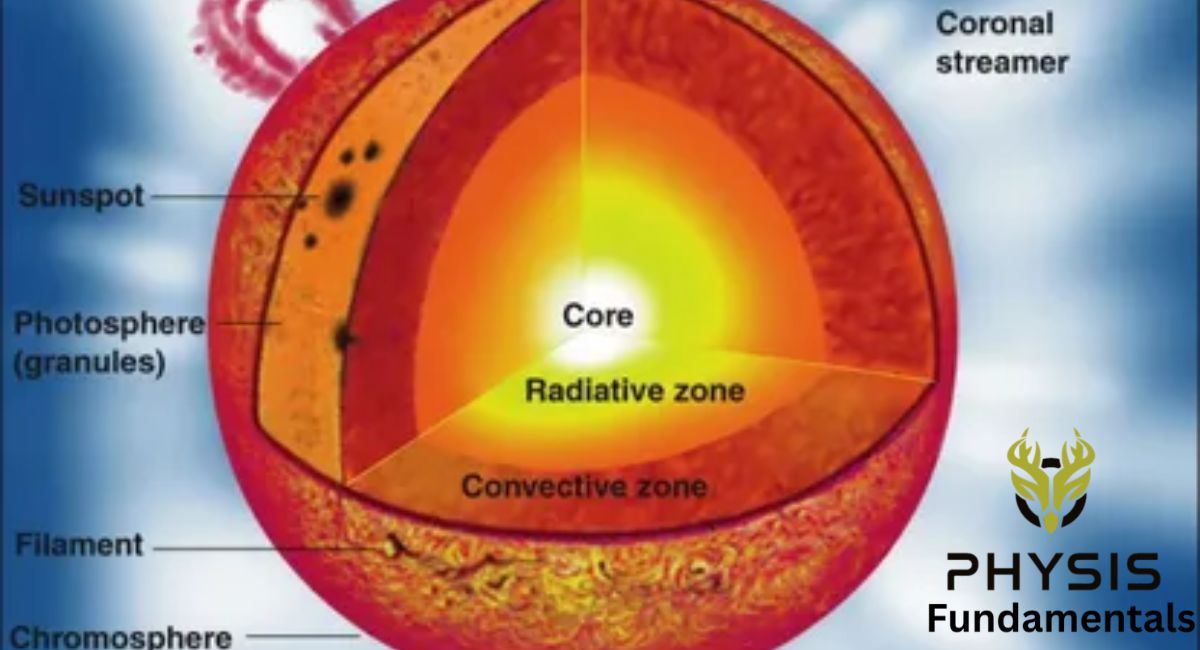
The Sun has several important layers.
-
Core
The core is where nuclear fusion occurs.
-
- Temperature: 15 million°C
- Produces all the Sun’s energy.
-
Radiative Zone
Energy slowly moves outward through radiation.
A single photon may take thousands to hundreds of thousands of years to pass through this region due to constant interactions with particles.
-
Convective Zone
Hot plasma rises.
Cooler plasma sinks.
This movement transfers heat toward the surface.
-
Photosphere
This is the visible surface of the Sun.
Temperature:
Approximately 5,500°C
Sunspots appear here.
-
Chromosphere
A reddish layer visible during total solar eclipses.
Temperature increases rapidly.
-
Corona
The outer atmosphere.
Temperature exceeds one million degrees Celsius, even though it lies above the cooler visible surface.
What Holds the Sun Together?
The Sun contains enormous amounts of hot gas trying to expand outward. Gravity constantly pulls everything inward.
These two forces stay balanced.
- Scientists call this balance hydrostatic equilibrium.
- Without gravity, the Sun would explode outward.
- Without fusion, gravity would collapse the Sun.
Can Humans Make a Sun?
Creating a real star requires an enormous amount of hydrogen—roughly 8% of the Sun’s mass is the minimum needed for a small star to sustain hydrogen fusion. Humans do not have anywhere near that amount of matter or the ability to compress it with enough gravity.
However, scientists can recreate a tiny part of the Sun’s energy-producing process in laboratories.
Artificial Fusion
Machines called tokamaks and stellarators heat hydrogen isotopes to temperatures above 100 million°C in an attempt to achieve controlled nuclear fusion.
This research aims to produce clean, nearly limitless energy.
Scientists are not making a miniature Sun. They are trying to reproduce the same type of fusion reaction that naturally powers stars.
Why Doesn’t the Sun Burn Like Fire?
Fire on Earth requires oxygen.The Sun does not burn using chemical fire.Instead, it produces energy through nuclear fusion, which does not require oxygen.That is why the Sun can shine in the vacuum of space.
How Long Will the Sun Live?
The Sun is currently about halfway through its life. Scientists estimate its total lifetime will be around 10 billion years. It has already existed for approximately:4.6 billion years it still has roughly:5 billion years remaining.
What Will Happen When the Sun Dies?
The Sun will not explode like a massive supernova because it is not large enough.
Instead, it will follow these stages:
- Hydrogen fuel in the core runs low.
- The Sun expands into a Red Giant.
- It may engulf Mercury and Venus, and could reach Earth’s orbit.
- The outer layers drift into space, forming a planetary nebula.
- The remaining core becomes a White Dwarf.
- Over an immense period, the white dwarf cools and fades.
Interesting Facts About the Sun
| Facts | Information |
| Age | 4.6 Billion Years |
| Shape | Nearly Perfect Sphere |
| Diameter | 109 Times Earth’s Diameter |
| Mass | 333,000 Times Earth’s Mass |
| Gravity | About 28 Times Stronger Than Earth’s Surface Gravity |
| Rotation | About 25 days at the equator and about 35 days near the poles |
| Energy Output | Around 3.8×10263.8 \times 10^{26}3.8×1026 watts |
| Light Travel Time to Earth | About 8 Minutes 20 Seconds |
Role of the Sun in Earth’s Climate
The Sun is the primary source of energy that drives Earth’s climate. Every change in temperature, weather pattern, season, and wind begins with the sunlight reaching our planet. Without the Sun, Earth would become a frozen, lifeless world where no plants, animals, or humans could survive
How the Sun Controls Earth’s Climate.
The Sun influences Earth’s climate by providing the energy that powers almost every natural process on our planet. This energy is unevenly distributed because Earth is spherical and tilted on its axis. As a result, some regions receive more sunlight than others, leading to differences in temperature and climate.
-
Heating the Earth’s Surface
Solar radiation warms the Earth’s land, oceans, lakes, and atmosphere. The equator receives more direct sunlight throughout the year, making it much warmer than the polar regions, where sunlight arrives at a lower angle. This uneven heating creates temperature differences across the planet, which are the foundation of Earth’s climate system.
Example
Deserts near the equator, such as the Sahara, receive intense sunlight and experience very high temperatures. In contrast, Antarctica receives much less solar energy and remains extremely cold throughout the year.
-
Driving the Water Cycle
The Sun supplies the energy needed for the water cycle, one of the most important processes controlling climate.Solar heat causes water to evaporate from oceans, rivers, lakes, and soil. The water vapor rises into the atmosphere, cools, forms clouds, and eventually falls back to Earth as rain or snow.
This continuous cycle distributes freshwater around the world and influences regional climates.
Water Cycle Process.
| Step | Description |
| Evaporation | Sun heats water, turning it into vapor. |
| Condensation | Water vapor cools and forms clouds. |
| Precipitation | Rain, snow, or hail falls to Earth. |
| Collection | Water returns to rivers, lakes, and oceans. |
-
Creating Winds
The Sun heats Earth’s surface unevenly. Warm air becomes lighter and rises, while cooler air sinks.This movement creates air pressure differences, causing winds that transport heat and moisture across the globe.Without solar heating, there would be little or no large-scale wind circulation.
Example
Sea breezes occur because land heats up faster than water during the day. Warm air rises over the land, and cooler air from the sea moves inland to replace it.
-
Driving Ocean Currents
The Sun also influences the movement of ocean water.Warm water near the equator flows toward the poles, while cold water moves back toward the equator. These ocean currents help redistribute heat across the planet and moderate regional climates.
Example
The Gulf Stream carries warm water from the Gulf of Mexico across the Atlantic Ocean, helping keep parts of Western Europe much warmer than other regions at similar latitudes.
-
Causing the Seasons
Earth’s axis is tilted by about 23.5° as it orbits the Sun.This tilt changes the angle and duration of sunlight received by different parts of Earth throughout the year, creating the four seasons.The changing seasons affect temperature, rainfall, agriculture, ecosystems, and wildlife.
-
Forming Climate Zones
The unequal distribution of solar energy creates Earth’s major climate zones.
| Climate Zone | Sunlight Received | Climate |
| Tropical | Highest | Hot and humid |
| Temperate | Moderate | Mild with four seasons |
| Polar | Lowest | Very cold throughout the year |
These climate zones determine the types of plants, animals, and ecosystems found around the world.
-
Supporting Photosynthesis
The Sun provides the light energy needed for photosynthesis, the process by which plants make food.
Using sunlight, water, and carbon dioxide, plants produce glucose and release oxygen into the atmosphere.
Photosynthesis supports nearly every food chain on Earth and helps regulate atmospheric carbon dioxide, which influences climate.
Photosynthesis Equation
6CO2+6H2O+Sunlight→C6H12O6+6O2
-
Influencing Long-Term Climate
The amount of solar energy reaching Earth changes only slightly over time, but these small variations can influence long-term climate patterns. Earth’s orbit and axial tilt also change slowly over thousands of years, affecting how sunlight is distributed across the planet. These natural changes have contributed to periods such as ice ages. However, scientists have found that the rapid global warming observed since the Industrial Revolution is primarily driven by increased greenhouse gases from human activities, rather than changes in the Sun’s energy output.
What Is Electromagnetic Radiation?
Electromagnetic radiation (EMR) is energy that travels through space as oscillating electric and magnetic fields. Unlike sound waves, electromagnetic waves do not need air, water, or any other material to travel. They can move through the vacuum of space, which is why sunlight can reach Earth.
Electromagnetic radiation behaves both like a wave and like tiny packets of energy called photons. This dual nature is known as the wave-particle duality of light. A simple example is sunlight. The warmth you feel on your skin and the light that allows you to see are both forms of electromagnetic radiation.
Is Electromagnetic Radiation Made of Gases?
This is a common question, but the answer is no. Electromagnetic radiation is not made of gases. It is a form of energy, not matter. However, it is often produced by hot gases or plasma. For example, the Sun is composed mainly of hydrogen and helium. Inside the Sun, nuclear fusion releases enormous amounts of energy, which is emitted as electromagnetic radiation.
Gases in the Sun That Produce Electromagnetic Radiation
| Gas | Approximate Percentage | Role |
| Hydrogen | 74% | Main fuel for nuclear fusion |
| Helium | 24% | Produced during fusion |
| Oxygen | Less than 1% | Minor element |
| Carbon | Less than 1% | Contributes to the Sun’s composition |
| Neon | Trace | Heavy element present in small amounts |
| Iron | Trace | Present in tiny quantities |
These gases do not become electromagnetic radiation. Instead, the energy released from nuclear fusion in the Sun’s core is emitted as electromagnetic waves.
How Is Electromagnetic Radiation Created?.
Electromagnetic radiation is created whenever charged particles accelerate or change direction. This can happen in many natural and artificial processes.
-
Nuclear Fusion in the Sun
The Sun produces energy through nuclear fusion, where hydrogen nuclei combine to form helium. A small amount of mass is converted into energy according to Einstein’s famous equation:
E=mc2
This energy eventually escapes the Sun as electromagnetic radiation, including visible light, infrared radiation, ultraviolet radiation, X-rays, and radio waves.
-
Excited Atoms
When atoms absorb energy, their electrons move to higher energy levels. As the electrons return to lower levels, they release energy as electromagnetic radiation.
This process occurs in:
- Neon signs
- Fluorescent lamps
- Lasers
- Fireworks
-
Accelerating Charged Particles
Whenever charged particles such as electrons accelerate, they emit electromagnetic waves. This principle is used in radio transmitters, antennas, and synchrotron facilities.
How Does Electromagnetic Radiation Travel?
Electromagnetic radiation travels as mutually perpendicular electric and magnetic fields that continuously generate each other as they move forward.
Unlike sound waves, electromagnetic waves do not require any medium. They can travel through:
- Empty space (vacuum)
- Air
- Water
- Glass
- Many other transparent materials
All electromagnetic waves travel at the speed of light in a vacuum:
c=3.0×10⁸ m/s
where c is the speed of light.
Properties of Electromagnetic Radiation
Electromagnetic radiation has several important properties that determine how it behaves.
| Property | Description |
| Speed | Travels at the speed of light in a vacuum |
| Medium | Does not require a medium to travel |
| Nature | Exhibits both wave-like and particle-like behavior |
| Energy | Depends on frequency |
| Wavelength | Distance between two consecutive wave crests |
| Frequency | Number of wave cycles passing a point each second |
The relationship between speed, wavelength, and frequency is:
c=λf
where:
- c = speed of light
- λ= wavelength
- f = frequency
The Electromagnetic Spectrum
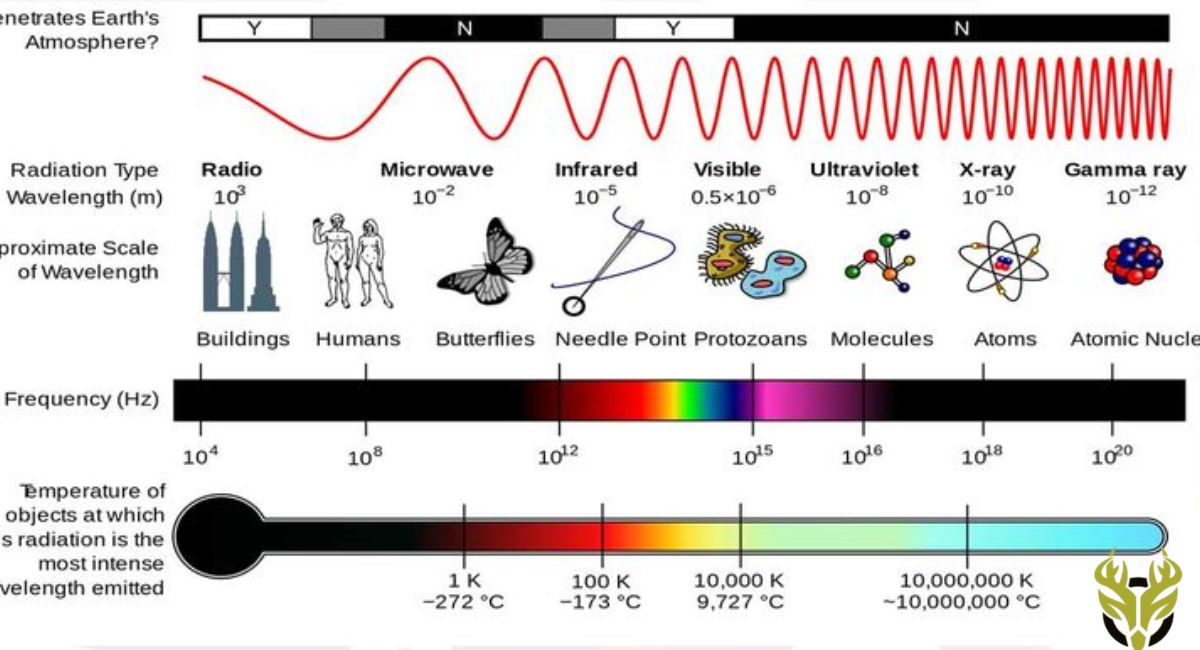
Electromagnetic radiation covers a wide range of wavelengths and frequencies, known as the electromagnetic spectrum.
| Type | Wavelength | Main Use |
| Radio Waves | Longest | Communication |
| Microwaves | Shorter | Cooking, radar, Wi-Fi |
| Infrared | Heat | Thermal imaging |
| Visible Light | Visible to humans | Vision |
| Ultraviolet | Short | Sterilization, tanning |
| X-Rays | Very short | Medical imaging |
| Gamma Rays | Shortest | Cancer treatment, astronomy |
As wavelength decreases, frequency and energy increase.
Electromagnetic Radiation from the Sun
The Sun emits nearly every type of electromagnetic radiation.
| Radiation Type | Reaches Earth’s Surface? | Main Effect |
| Radio Waves | Yes | Communication and astronomy |
| Microwaves | Partially | Atmospheric interactions |
| Infrared | Yes | Heating Earth’s surface |
| Visible Light | Yes | Vision and photosynthesis |
| Ultraviolet | Partially | Vitamin D production and sunburn |
| X-Rays | Mostly blocked by the atmosphere | Space weather studies |
| Gamma Rays | Mostly blocked by the atmosphere | Scientific observations |
Earth’s atmosphere protects life by absorbing most harmful X-rays and gamma rays.
Why Is Electromagnetic Radiation Important?
Electromagnetic radiation is essential for both nature and modern society.
It allows us to see, keeps Earth warm, powers photosynthesis in plants, enables wireless communication, and supports many medical technologies. Satellites use electromagnetic waves to transmit television broadcasts, GPS signals, and internet data. In hospitals, X-rays help doctors diagnose broken bones, while gamma rays are used to treat certain cancers.
Without electromagnetic radiation from the Sun, Earth would receive no light or heat, plants could not produce food, and life as we know it would not exist.
Everyday Examples of Electromagnetic Radiation.
You encounter electromagnetic radiation throughout your day, often without noticing it.
- Sunlight warming your skin is visible and infrared radiation.
- A television remote control uses infrared waves.
- Wi-Fi routers and mobile phones communicate using radio waves and microwaves.
- Microwave ovens heat food using microwave radiation.
- Medical X-ray machines create images of bones.
- Ultraviolet lamps are used to disinfect equipment and water.
These examples show that electromagnetic radiation is a natural part of both the environment and modern technology.
What Is Ultraviolet Radiation?
Ultraviolet (UV) radiation is a type of electromagnetic radiation with wavelengths shorter than visible light but longer than X-rays. Because its wavelength is too short for the human eye to detect, it is known as invisible radiation.
Like all electromagnetic radiation, ultraviolet radiation travels at the speed of light through the vacuum of space. When sunlight reaches Earth, it contains visible light, infrared radiation, and ultraviolet radiation.
Although UV rays make up only a small percentage of the Sun’s total energy reaching Earth, they have a significant impact on living organisms and materials.
Is Ultraviolet Radiation Made of Gases?
No. Ultraviolet radiation is not made of gases. It is energy, not matter.
However, ultraviolet radiation is produced inside extremely hot stars such as the Sun. The Sun itself is composed mainly of hydrogen and helium, with small amounts of heavier elements.
These gases do not become ultraviolet radiation. Instead, the energy released by nuclear fusion inside the Sun is emitted as many forms of electromagnetic radiation, including ultraviolet rays.
How Is Ultraviolet Radiation Created?
Ultraviolet radiation is produced when atoms and charged particles release energy.
-
Nuclear Fusion in the Sun
The primary source of ultraviolet radiation reaching Earth is the Sun.
Inside the Sun’s core, hydrogen nuclei combine to form helium through nuclear fusion.
41H→4He+Energy
This process releases enormous amounts of energy. As this energy moves outward through the Sun’s layers, part of it is emitted as ultraviolet radiation.
-
Extremely Hot Gases and Plasma
The Sun’s outer atmosphere, known as the corona, has temperatures exceeding one million degrees Celsius. At these temperatures, atoms become ionized, forming plasma, a state of matter made of charged particles.
These energetic particles emit ultraviolet radiation, especially extreme ultraviolet (EUV) rays.
-
Electric Discharges
Ultraviolet radiation can also be produced on Earth by electrical discharges.
Examples include:
- Lightning
- Electric welding
- Mercury vapor lamps
- UV sterilization lamps
Types of Ultraviolet Radiation
Scientists divide ultraviolet radiation into three main categories based on wavelength.
| Type | Wavelength | Characteristics |
| UVA | 315–400 nm | Lowest energy, reaches Earth’s surface |
| UVB | 280–315 nm | Medium energy, partially absorbed by ozone |
| UVC | 100–280 nm | Highest energy, almost completely absorbed by the atmosphere |
UVA Radiation
UVA has the longest wavelength among ultraviolet rays.
It reaches Earth’s surface almost completely because it is not significantly blocked by the ozone layer.
Characteristics
- Causes skin aging
- Penetrates deep into the skin
- Contributes to wrinkles
- Can damage skin cells over time
UVB Radiation
UVB carries more energy than UVA.
Most UVB is absorbed by the ozone layer, but some reaches Earth’s surface.
Characteristics
- Causes sunburn
- Helps the body produce vitamin D
- Can damage DNA
- Increases the risk of skin cancer
UVC Radiation
UVC is the most energetic type of ultraviolet radiation.
Fortunately, Earth’s atmosphere, especially the ozone layer, absorbs almost all natural UVC radiation before it reaches the surface.
Artificial UVC is commonly used for sterilization because it can destroy bacteria and viruses.
Benefits of Ultraviolet Radiation.
Although ultraviolet radiation is often associated with health risks, moderate exposure also provides several important benefits.
Vitamin D Production.
When UVB rays strike the skin, they trigger the production of vitamin D. This vitamin is essential for healthy bones, muscles, and the immune system.
Sterilization.
Artificial UVC lamps are widely used to disinfect water, air, and medical equipment because they kill many microorganisms.
Medical Treatments.
Doctors sometimes use controlled ultraviolet light to treat certain skin conditions, including psoriasis and vitiligo.
Damage Due to Ultraviolet Radiation
Excessive exposure to ultraviolet radiation can damage living tissues because UV rays carry enough energy to alter molecules inside cells, including DNA.
-
Skin Damage.
The skin absorbs most ultraviolet radiation that reaches the body.
Too much UV exposure can cause:
- Sunburn
- Premature skin aging
- Wrinkles
- Dark spots
- Loss of skin elasticity
Repeated exposure over many years greatly increases the risk of skin cancer.
-
DNA Damage.
Ultraviolet radiation can damage DNA inside skin cells.
When DNA is altered faster than the body can repair it, harmful mutations may develop. Some mutations can eventually lead to skin cancers.
-
Eye Damage.
Ultraviolet radiation can also affect the eyes.
Long-term exposure increases the risk of:
- Cataracts
- Phot keratitis (sunburn of the cornea)
- Damage to the retina
- Vision problems
Wearing sunglasses that block UVA and UVB rays helps reduce these risks.
Immune System Effects.
Excessive ultraviolet exposure may temporarily suppress parts of the immune system, reducing the skin’s ability to respond to infections or repair damage efficiently.
Material Damage.
Ultraviolet radiation does not only affect living organisms.
It can also:
- Fade paint
- Crack plastics
- Weaken rubber
- Damage fabrics
- Fade photographs
How Does Earth Protect Us from Ultraviolet Radiation?
Fortunately, Earth’s atmosphere acts as a natural shield.
The ozone layer, located in the stratosphere, absorbs:
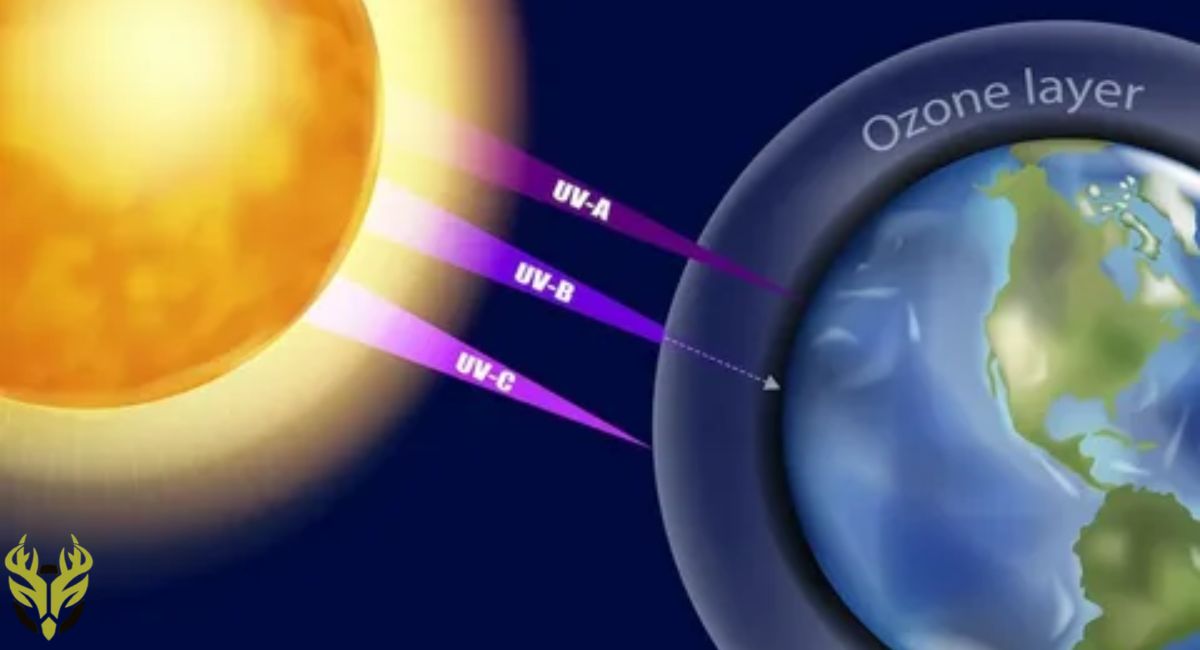
- Nearly 100% of UVC
- Most UVB
- Only a small amount of UVA
Without the ozone layer, life on Earth’s surface would be exposed to much higher levels of harmful ultraviolet radiation.
How Can You Protect Yourself from UV Radiation?
Simple daily habits can significantly reduce ultraviolet exposure.
| Protection Method | Benefit |
| Wear sunscreen (SPF 30 or higher) | Reduces skin damage |
| Wear sunglasses with UV protection | Protects the eyes |
| Wear long-sleeved clothing | Covers exposed skin |
| Seek shade during midday | Reduces UV exposure |
| Wear a wide-brimmed hat | Protects the face and neck |
What Are X-Rays?
X-rays are a type of electromagnetic radiation with very short wavelengths and very high energy. They carry much more energy than visible light and ultraviolet radiation but less than gamma rays. Like all electromagnetic waves, X-rays travel at the speed of light and do not require air or any other material medium to move through space. Although invisible to the human eye, X-rays can pass through many materials that ordinary light cannot penetrate. This unique property makes them extremely useful in medicine and scientific research.
Are X-Rays Made of Gases?
No.
X-rays are not made of gases. They are pure electromagnetic energy.
However, X-rays are produced in extremely hot environments where gases become plasma, a state of matter consisting of electrically charged particles.
The Sun is mainly composed of:
| Gas | Approximate Percentage | Purpose |
| Hydrogen | About 74% | Main fuel for nuclear fusion |
| Helium | About 24% | Produced during fusion |
| Oxygen | Less than 1% | Minor element |
| Carbon | Less than 1% | Heavy element |
| Neon | Trace | Heavy element |
| Iron | Trace | Heavy element |
These gases do not become X-rays directly. Instead, the tremendous energy released inside the Sun causes charged particles to emit X-ray radiation.
How Are X-Rays Created?
X-rays are produced whenever extremely energetic charged particles suddenly slow down, collide, or change direction. In nature, the Sun creates X-rays through several physical processes.
Nuclear Fusion Inside the Sun
Deep inside the Sun’s core, hydrogen atoms fuse together to form helium.
41H→4He+Energy
This nuclear fusion releases enormous amounts of energy. As this energy moves outward through the Sun, some of it eventually appears as high-energy electromagnetic radiation, including X-rays.
Hot Plasma in the Sun’s Corona
The Sun’s outer atmosphere, called the corona, has temperatures exceeding one million degrees Celsius. At these temperatures, atoms lose electrons and become ionized, forming plasma. The rapid movement and collisions of charged particles in this plasma generate X-rays.
Solar Magnetic Activity
The Sun has an extremely powerful magnetic field. Sometimes magnetic field lines twist, stretch, and suddenly reconnect. This process releases enormous amounts of stored magnetic energy, producing:
- Solar flares
- Coronal mass ejections
- Powerful bursts of X-rays
How Do X-Rays Travel?
Like all electromagnetic radiation, X-rays travel through space at the speed of light.
c=3.0×10⁸ m/s
The X-rays produced by the Sun travel approximately 150 million kilometers to Earth in about 8 minutes and 20 seconds.
Fortunately, Earth’s atmosphere absorbs nearly all solar X-rays before they reach the ground.
Properties of X-Rays
| Property | Description |
| Type | Electromagnetic Radiation |
| Visibility | Invisible to humans |
| Wavelength | Approximately 0.01–10 nanometers |
| Frequency | Very High |
| Energy | Very High |
| Speed | Speed of Light |
| Medium Required | No |
Types of X-Rays
Scientists divide X-rays into two broad categories.
Soft X-Rays
Soft X-rays have lower energy and longer wavelengths.
They are commonly produced during ordinary solar activity and are useful for observing the Sun’s atmosphere.
Hard X-Rays
Hard X-rays have much higher energy and shorter wavelengths.
They are produced during:
- Solar flares
- Violent explosions
- Extremely energetic particle collisions
Hard X-rays can penetrate materials more effectively than soft X-rays.
X-Rays from the Sun.
Although the Sun continuously emits X-rays, the amount changes depending on solar activity.
During quiet periods, the Sun produces relatively small amounts of X-rays.
During solar flares, X-ray production increases dramatically within minutes.
These sudden increases can disturb Earth’s upper atmosphere and interfere with radio communications and satellite systems.
Uses of X-Rays
X-rays have transformed many areas of science and technology.
Medical Imaging
Doctors use X-rays to detect:
- Broken bones
- Tooth decay
- Lung diseases
- Joint problems
Airport Security
Security scanners use X-rays to examine luggage without opening it.
Astronomy
Astronomers observe X-rays from:
- The Sun
- Black holes
- Neutron stars
- Supernova remnants
- Galaxy clusters
These observations reveal extremely hot and energetic regions of the universe.
Industrial Inspection
Engineers use X-rays to inspect:
- Aircraft parts
- Pipelines
- Welded joints
- Bridges
This helps detect hidden cracks without damaging the structure.
Harmful Effects of X-Rays.
Because X-rays carry high energy, excessive exposure can damage living cells.
Possible health risks include:
- DNA damage
- Skin burns
- Increased cancer risk
- Eye damage
- Radiation sickness (at very high doses)
For this reason, hospitals carefully control the amount of X-ray exposure during medical procedures.
How Does Earth Protect Us from Solar X-Rays?
Earth has two natural protective systems.
The Atmosphere
Most solar X-rays are absorbed by the upper atmosphere before reaching the surface.
Without this protection, life on Earth would face much higher levels of harmful radiation.
The Magnetic Field
Earth’s magnetic field helps shield the planet from charged particles associated with solar activity, reducing some of the indirect effects of intense solar events.
What Are Radio Waves?
Radio waves are a type of electromagnetic radiat ion with the longest wavelengths and lowest frequencies in the electromagnetic spectrum. Like visible light, X-rays, and gamma rays, radio waves are a form of energy that travels through space at the speed of light .Unlike sound waves, radio waves do not need air, water, or any other material to travel. They can move through the vacuum of space, allowing signals from the Sun and distant galaxies to reach Earth. Radio waves are invisible to the human eye, but they are one of the most important technologies in modern life because they make wireless communication possible.
Are Radio Waves Made of Gases?
No.
Radio waves are not made of gases. They are electromagnetic energy, not matter.
However, radio waves are often produced by hot gases or plasma. The Sun, for example, is made mostly of hydrogen and helium. Inside the Sun, nuclear fusion releases energy, while moving charged particles in the Sun’s hot plasma generate radio waves.
How Are Radio Waves Created?
Radio waves are produced whenever charged particles accelerate or oscillate.
-
. Radio Waves Produced by the Sun
The Sun naturally emits radio waves.
Inside the Sun, hydrogen nuclei fuse into helium, releasing enormous amounts of energy.
41H→4He+Energy
This energy heats the Sun’s gases until they become plasma. Electrons moving through the Sun’s strong magnetic fields emit radio waves. Solar flares and coronal mass ejections can greatly increase radio-wave emissions.
Oscillating Electrons in Antennas
Humans create radio waves using antennas.
When an alternating electric current flows through an antenna, electrons move back and forth rapidly. This changing motion creates changing electric and magnetic fields that radiate outward as radio waves.
This principle is used in:
- Radio broadcasting
- Television transmission
- Mobile phone networks
- Wi-Fi
- Bluetooth
- Satellite communication
- Lightning
Lightning is another natural source of radio waves. The sudden movement of electric charges during a lightning strike produces bursts of radio energy that can be detected over great distances.
How Do Radio Waves Travel?
Radio waves travel as oscillating electric and magnetic fields.
Like every electromagnetic wave, they move through empty space without requiring any material medium.
Their speed in a vacuum is:
c=3.0×10^8 m/s
The relationship between wave speed, frequency, and wavelength is shown by:
v=fλ
where:
- v = wave speed
- f = frequency
- λ (lambda) = wavelength
Because radio waves have very long wavelengths, they have lower frequencies and lower energy than other forms of electromagnetic radiation.
Properties of Radio Waves
| Property | Description |
| Type | Electromagnetic Radiation |
| Visibility | Invisible |
| Wavelength | About 1 millimeter to more than 100 kilometers |
| Frequency | About 3 kHz to 300 GHz |
| Energy | Lowest in the electromagnetic spectrum |
| Speed | Speed of light in a vacuum |
| Medium Required | No |
Radio Waves from the Sun
The Sun continuously emits radio waves because of activity in its atmosphere.
Most solar radio waves originate from:
The Corona
The Sun’s outer atmosphere contains extremely hot plasma. Fast-moving electrons interacting with magnetic fields produce radio emissions.
Solar Flares
During solar flares, enormous amounts of magnetic energy are suddenly released. This accelerates electrons, producing intense bursts of radio waves.
Coronal Mass Ejections (CMEs)
When the Sun ejects huge clouds of plasma into space, the moving charged particles generate additional radio emissions. These events can interfere with communication and navigation systems on Earth.
Everyday Uses of Radio Waves.
Radio waves are essential to modern life.
Radio Broadcasting
AM and FM radio stations transmit music, news, sports, and weather information using radio waves.
Television
Television stations broadcast audio and video signals through radio-frequency transmissions.
Mobile Phones
Every phone call, text message, and mobile internet connection relies on radio waves traveling between your phone and nearby cell towers.
Wi-Fi and Bluetooth
Wireless internet and Bluetooth devices communicate by sending and receiving radio waves over short distances.
GPS Navigation
Satellites transmit radio signals that allow GPS receivers to calculate precise locations almost anywhere on Earth.
Radar
Air traffic control, weather forecasting, ships, and military systems use radio waves to detect objects and measure distances.
Space Communication
Spacecraft and satellites communicate with Earth using radio waves because these signals can travel vast distances through the vacuum of space.
Can Radio Waves Be Harmful?
Radio waves belong to the non-ionizing part of the electromagnetic spectrum. This means they do not carry enough energy to remove electrons from atoms or directly damage DNA, unlike X-rays and gamma rays.
At the power levels used for everyday communication, radio waves are generally considered safe. However, very strong radio-frequency sources can heat tissues, which is why workers around high-power transmitters follow established safety guidelines.
Solar radiation torque forms through a series of natural processes that begin deep inside the Sun.
Step 1: Nuclear Fusion Produces Energy
Inside the Sun’s core, hydrogen nuclei combine to form helium through nuclear fusion.
41H→4He+Energy
Step 2: Energy Leaves the Sun as Photons
The energy generated in the core travels outward through the Sun and is emitted into space as electromagnetic radiation, including visible light, infrared radiation, ultraviolet rays, and other forms of radiation.
These light particles, called photons, travel through space at the speed of light.
Step 3: Photons Strike a Spacecraft
When photons hit a spacecraft, they transfer a tiny amount of momentum to its surface. This produces a small force called solar radiation pressure.
Step 4: Off-Center Force Produces Torque
If the force does not pass through the spacecraft’s center of mass, it creates a turning effect known as torque.
The basic torque relationship is:
τ=rFsin(θ) = Torque
- r = Distance from the center of mass to the point where the force acts (lever arm)
- F = Force produced by solar radiation pressure
- θ = Angle between the force and the lever arm
Why Does Solar Radiation Torque Occur?
A perfectly symmetrical spacecraft with sunlight acting exactly through its center of mass experiences little or no solar radiation torque.
However, most spacecraft have:
- Solar panels
- Antennas
- Scientific instruments
- Cameras
- Irregular shapes
Because sunlight does not strike every surface equally, different parts experience different forces, producing a small rotational effect.
Solar Radiation Pressure vs. Solar Radiation Torque
Although the terms are related, they describe different effects.
| Solar Radiation Pressure | Solar Radiation Torque |
| Pushes an object in a straight line | Rotates an object |
| Caused by photon momentum | Caused by an off-center photon force |
| Changes linear motion | Changes rotational motion |
| Acts on the entire spacecraft | Depends on spacecraft shape and force location |
How Does Solar Radiation Torque Affect Spacecraft?
Although the force is extremely small, it acts continuously in space. Over weeks, months, or years, its effects become significant.
Changes Spacecraft Orientation
A spacecraft may slowly rotate away from its intended position if solar radiation torque is not corrected.
Affects Communication
Communication antennas must point accurately toward Earth. Uncontrolled rotation can weaken or interrupt radio signals.
Reduces Solar Panel Efficiency
Solar panels generate maximum electricity when facing the Sun. If torque rotates the spacecraft, less sunlight reaches the panels, reducing power generation.
Influences Scientific Instruments
Space telescopes and cameras require precise pointing. Even tiny rotations can reduce image quality or cause observations to miss their intended targets.
How Do Engineers Reduce Solar Radiation Torque?
Space engineers use several methods to minimize or control this effect.
Balanced Spacecraft Design
Engineers place components carefully so that sunlight produces nearly balanced forces.
Reaction Wheels
Many satellites contain spinning wheels that rotate internally to change the spacecraft’s orientation without using fuel.
Thrusters
Small rocket engines can fire briefly to counter unwanted rotation and restore the correct orientation.
Attitude Control Systems
Modern spacecraft use onboard computers, gyroscopes, star trackers, and sensors to detect and correct orientation changes automatically.
Where Is Solar Radiation Torque Most Important?
Solar radiation torque is especially important for spacecraft that spend long periods in space.
Examples include:
- Earth observation satellites
- Communication satellites
- Space telescopes
- Interplanetary probes
- Space stations
- Solar sail spacecraft
For these missions, even a tiny, continuous torque can accumulate over time and affect mission performance.
Advantages of Understanding Solar Radiation Torque
Although it presents engineering challenges, solar radiation torque can also be useful.
Natural Attitude Control
Some spacecraft are designed to use sunlight to help maintain or adjust their orientation, reducing the need for fuel.
Solar Sail Technology
Solar sails intentionally use the momentum of photons for propulsion. By adjusting the sail’s orientation, engineers can also control the torque acting on the spacecraft.
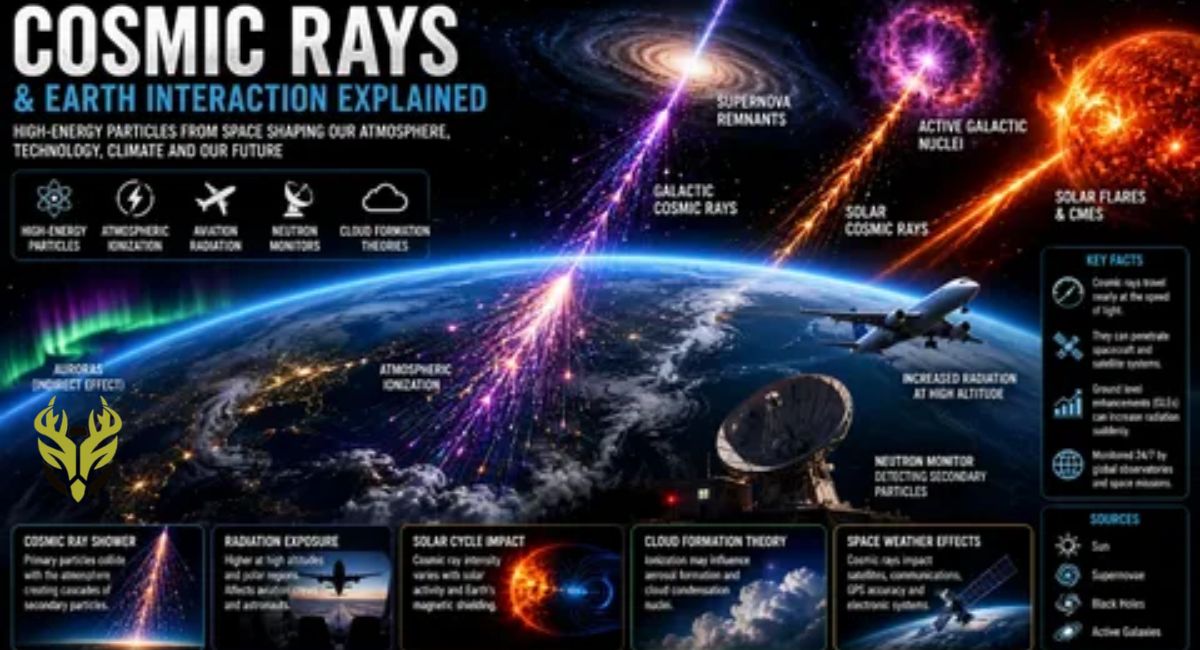
What Are Cosmic Rays?
Cosmic rays are high-energy charged particles that travel through space at extremely high speeds, often close to the speed of light. They constantly strike Earth’s atmosphere from every direction. Despite their name, cosmic rays are not rays of light. The term “ray” was used before scientists understood their true nature. Today, we know that cosmic rays are mostly atomic particles, not electromagnetic waves. When cosmic rays collide with molecules in Earth’s atmosphere, they produce showers of secondary particles that can reach the ground.
Are Cosmic Rays Made of Gases?
The answer is no.
Cosmic rays are not made of gases. They are made of charged subatomic particles and atomic nuclei.
However, many cosmic rays originate from stars that are made primarily of hot gases such as hydrogen and helium. The gases inside stars provide the material from which these energetic particles are accelerated.
what Are Cosmic Rays Made Of?
Cosmic rays contain several different types of particles.
| Particle | Approximate Percentage |
| Protons (Hydrogen nuclei) | About 90% |
| Alpha particles (Helium nuclei) | About 9% |
| Heavier atomic nuclei | About 1% |
| Electrons | Small amount |
| Positrons | Trace amount |
Most cosmic rays are simply hydrogen nuclei traveling through space at tremendous speeds.
How Are Cosmic Rays Created?
Cosmic rays are produced in some of the most energetic environments in the universe. They are created when charged particles are accelerated by powerful explosions, shock waves, or magnetic fields.
-
Cosmic Rays from the Sun
The Sun produces solar cosmic rays, also called solar energetic particles (SEPs).
Inside the Sun, hydrogen atoms fuse into helium through nuclear fusion:
41H→4He+Energy
This fusion releases enormous amounts of energy.
During solar flares and coronal mass ejections (CMEs), strong magnetic fields accelerate protons, electrons, and helium nuclei to very high speeds. These particles escape the Sun and travel through the Solar System.
Solar cosmic rays usually have lower energies than cosmic rays originating outside the Solar System.
-
Supernova Explosions.
One of the most important sources of cosmic rays is the explosion of massive stars. When a giant star reaches the end of its life, it explodes as a supernova. The expanding shock wave accelerates nearby charged particles to extremely high energies, sending them across the galaxy.
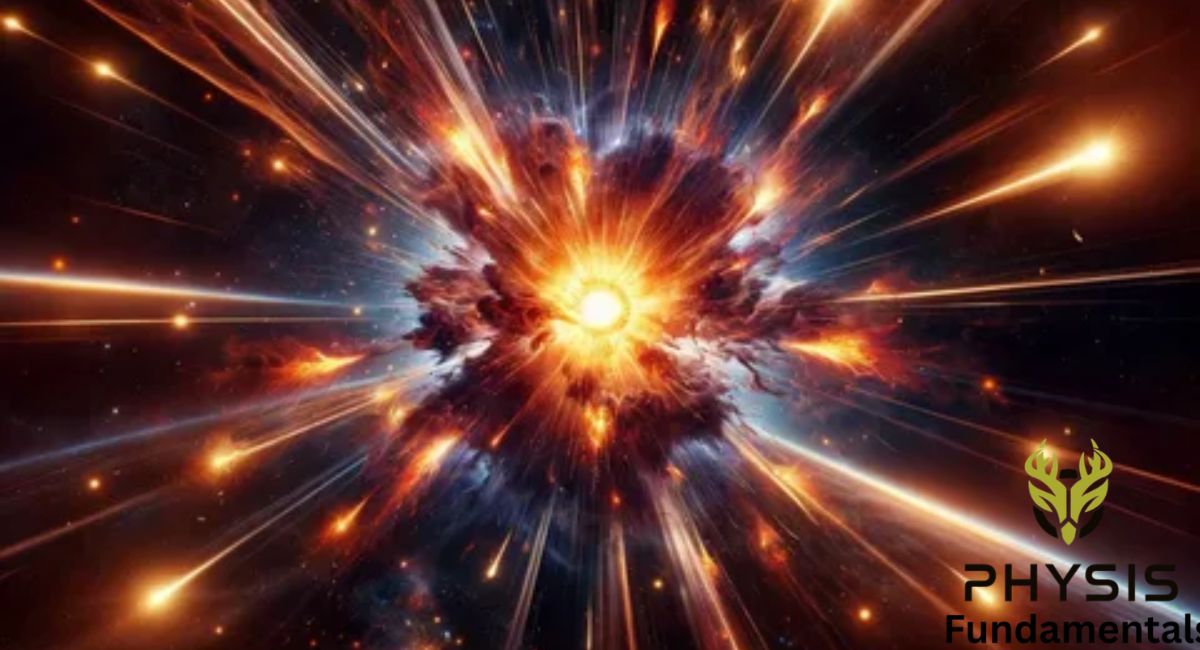
Many of the cosmic rays detected on Earth are believed to have been accelerated by ancient supernova remnants.
-
Neutron Stars and Pulsars
Neutron stars possess extremely strong magnetic fields and rotate rapidly. Their intense magnetic environments can accelerate charged particles to very high speeds, contributing to the population of cosmic rays.
-
Black Holes and Active Galaxies
Some galaxies contain supermassive black holes at their centers. As matter falls toward these black holes, enormous amounts of energy are released. Jets of particles launched from these regions can accelerate cosmic rays to energies far beyond those produced in our Solar System.
Types of Cosmic Rays.
Solar Cosmic Rays
These originate from the Sun during solar flares and coronal mass ejections.
Characteristics
- Lower energy
- Reach Earth within minutes to hours
- Affect astronauts and satellites
Galactic Cosmic Rays
These originate outside the Solar System, mainly from supernova remnants in the Milky Way.
Characteristics
- Much higher energy
- Travel for thousands or millions of years
- Continuously bombard Earth
Extragalactic Cosmic Rays
These come from distant galaxies and some of the most energetic objects in the universe.
Characteristics
- Extremely high energy
- Very rare
- Their exact origins are still being actively researched
What Happens When Cosmic Rays Reach Earth?
When a cosmic ray enters Earth’s atmosphere, it collides with atoms of nitrogen and oxygen.
This collision creates a particle shower, producing many secondary particles such as:
- Muons
- Electrons
- Positrons
- Neutrons
- Gamma rays
Many of these secondary particles reach Earth’s surface and can be detected by scientific instruments.
How Does Earth Protect Us from Cosmic Rays?
Earth has two major protective shields.
Earth’s Magnetic Field
The magnetic field deflects many charged cosmic rays, especially those with lower energies.
Earth’s Atmosphere
The atmosphere absorbs most of the energy carried by incoming cosmic rays before they reach the ground. This greatly reduces the radiation dose experienced by people at the surface.
Effects of Cosmic Rays.
Positive Effects
Cosmic rays help scientists study high-energy processes in the universe. They also contribute to the natural production of certain isotopes, such as carbon-14, which is widely used in radiocarbon dating.
Harmful Effects
High-energy cosmic rays can:
- Damage spacecraft electronics
- Increase radiation exposure for astronauts
- Pose a greater radiation risk for people on high-altitude flights than at sea level
- Damage DNA at sufficiently high exposures
Why Are Cosmic Rays Important?
Cosmic rays are valuable tools for understanding the universe.
Scientists use them to:
- Study supernova explosions
- Investigate black holes
- Explore the behavior of galaxies
- Understand magnetic fields in space
- Improve spacecraft radiation shielding
- Learn about conditions in the early universe
What Are Sunspots?
Sunspots are temporary dark regions on the Sun’s visible surface (the photosphere) where extremely strong magnetic fields reduce the flow of heat from the Sun’s interior.
Because less heat reaches these regions, they become cooler than the surrounding surface. Even though they are cooler, sunspots are still extremely hot compared with anything on Earth.
The surrounding photosphere has a temperature of about 5,500°C (9,932°F), while the center of a sunspot is typically about 3,500–4,500°C (6,300–8,100°F).
They appear dark only because they are cooler than the brighter surrounding surface.
Are Sunspots Made of Gases?
Yes, but not in the way many people think.
Sunspots are not made of different gases than the rest of the Sun. They are made of the same hot plasma, which consists mainly of ionized hydrogen and helium.
How Are Sunspots Formed?
Sunspots form because of the Sun’s complex and constantly changing magnetic field.
Step 1: Nuclear Fusion Produces Energy
Deep inside the Sun, hydrogen nuclei combine to form helium through nuclear fusion.
41H→4He+Energy
This process releases enormous amounts of heat and light.
Step 2: Hot Plasma Rises
The energy generated in the Sun’s core moves outward through the radiative and convective zones.
In the convective zone, hot plasma rises toward the surface while cooler plasma sinks, much like boiling water in a pot.
Step 3: Magnetic Fields Become Twisted
The Sun does not rotate as a solid object. Its equator rotates faster than its poles, causing magnetic field lines to stretch, twist, and become tangled.
As these magnetic fields become stronger, they rise through the Sun’s surface.
Step 4: Magnetic Fields Block Heat Flow
Where strong magnetic fields emerge, they suppress the normal upward flow of hot plasma.
Because less heat reaches these regions, they become cooler than the surrounding photosphere.
These cooler regions appear as sunspots.
Why Do Sunspots Look Dark?
Sunspots are not actually black.
They appear dark only because they are cooler than the surrounding surface of the Sun.
If a sunspot could be seen by itself against the night sky, it would appear brighter than a full Moon because it is still thousands of degrees Celsius hot.
Structure of a Sunspot
A mature sunspot has two main parts.
Umbra
The umbra is the dark central region of the sunspot.
Characteristics:
- Coolest part
- Strongest magnetic field
- Darkest appearance
Penumbra
The penumbra surrounds the umbra.
Characteristics:
- Slightly warmer than the umbra
- Contains filament-like structures
- Magnetic fields spread outward
How Large Are Sunspots?
Sunspots vary greatly in size.
Some are only a few hundred kilometers across, while others are much larger than Earth.
Large sunspots can exceed 50,000 kilometers in diameter.
Eventually, magnetic fields weaken and the sunspots disappear.
The Sunspot Cycle
Sunspots do not appear randomly.
Their numbers rise and fall in a regular pattern known as the 11-year solar cycle.
Solar Minimum
During solar minimum:
- Very few sunspots appear.
- The Sun is relatively quiet.
- Fewer solar flares occur.
Solar Maximum
During solar maximum:
- Hundreds of sunspots may appear.
- Solar flares become more frequent.
- Coronal mass ejections increase.
- Space weather becomes more active.
Why Are Sunspots Important?
Although they are cooler regions, sunspots are associated with some of the Sun’s most energetic events.
Solar Flares
Many solar flares originate near sunspots where magnetic fields suddenly reconnect and release enormous amounts of energy.
Coronal Mass Ejections (CMEs)
Sunspots are often linked with coronal mass ejections, which eject billions of tons of plasma into space.
Space Weather
Strong sunspot activity can influence space weather, affecting:
- Satellites
- GPS navigation
- Radio communication
- Power grids
- Astronaut safety
Effects of Sunspots on Earth
Sunspots do not significantly change Earth’s day-to-day weather. However, because they are linked to increased solar activity, they can influence the space environment around Earth.
During periods of high sunspot activity:
- Auroras (Northern and Southern Lights) become more frequent and more intense.
- Radio communications can experience temporary disruptions.
- GPS accuracy may be reduced during major solar storms.
- Satellites may experience increased drag due to changes in Earth’s upper atmosphere.
Scientists continue to study how long-term variations in solar activity may influence Earth’s climate, but current evidence shows that recent global warming is primarily driven by increased greenhouse gases rather than changes in sunspot activity.
How Do Scientists Observe Sunspots?
Because looking directly at the Sun can permanently damage the eyes, scientists observe sunspots using specialized instruments such as:
- Solar telescopes with protective filters
- Space-based observatories
- Solar satellites
- Spectrographs
- Magnetographs
These tools allow researchers to monitor the Sun safely and continuously.
FAQs
What is the space environment?
The space environment is everything beyond Earth’s atmosphere—vacuum, radiation, magnetic fields, and charged particles. It includes microgravity, extreme temperatures, and the solar wind, all of which affect satellites, spacecraft, and astronauts differently than conditions on Earth.
What is the Sun made of?
The Sun consists mostly of hydrogen (about 74%) and helium (about 24%), existing as super-heated plasma rather than ordinary gas. Trace elements like oxygen, carbon, and iron round out the rest of its composition.
How does the Sun produce energy?
Inside the Sun’s core, nuclear fusion fuses hydrogen nuclei into helium, converting roughly 4 million tons of mass into pure energy every second. This process, described by Einstein’s E=mc², is the ultimate source of sunlight and heat.
Why does the space environment matter for Earth’s climate?
Solar radiation drives evaporation, wind, ocean currents, and the seasons, so nearly every climate process traces back to the Sun. Earth’s atmosphere and magnetic field then filter out the more harmful parts of that same radiation.
Are sunspots and solar flares dangerous?
Sunspots themselves aren’t harmful, but they’re often linked to solar flares and coronal mass ejections that can disrupt GPS, radio signals, and power grids. These events are more of an infrastructure concern than a direct danger to people on the ground.
What will eventually happen to the Sun?
In about 5 billion years, the Sun will exhaust its hydrogen fuel, expand into a red giant, and possibly engulf Mercury and Venus. It will then shed its outer layers and settle into a slowly cooling white dwarf.
Conclusion
Space might look empty from a distance, but it’s anything but quiet—it’s full of radiation, plasma, and charged particles constantly interacting with Earth. At the center of it all sits the Sun, a G-type star whose nuclear fusion has powered our planet’s climate, weather, and every food chain for over 4.6 billion years.
From sunspots to solar wind, the Sun’s influence stretches far beyond simple daylight. It shapes our seasons, protects us through Earth’s magnetic shield, and even determines the electromagnetic spectrum we rely on for GPS, Wi-Fi, and medical imaging. Understanding the space environment isn’t just academic—it’s the key to safer satellites, healthier astronauts, and a clearer picture of the star that makes life on Earth possible in the first place.


3 Comments