
Solid State Physics: Crystals, Solids & Deformation Explained.
Introduction to solid state physics.
Look around you for a moment. The phone in your hand, the metal spoon in your kitchen, the glass in your window, the computer you use, and even the chair you sit on are all made of solid materials. They may look completely still and ordinary, but deep inside them, atoms and electrons are constantly interacting and behaving according to the laws of physics. Solid state physics is the branch of physics that helps us understand what is happening inside these materials and why different solids have such different properties.
At first, solid state physics may seem like a subject filled with complicated crystal structures, energy bands, electrons, and mathematical equations. However, its central idea is quite simple: if we understand how atoms are arranged and how electrons behave inside a solid, we can understand why that material behaves the way it does. For example, copper conducts electricity very well, rubber resists electric current, glass is transparent, and silicon can be used to make computer chips. Solid state physics explains these differences by looking at what happens at the microscopic level. A useful way to imagine a solid is to think about a large group of people standing close together. Everyone has a particular position, but they can still move slightly around that position. If one person moves, nearby people may also respond. Atoms in a solid behave in a somewhat similar way. They are held together by interactions with neighboring atoms and can vibrate around their usual positions. In a crystal, these atoms can form highly organized repeating patterns called crystal lattices.
The subject becomes even more interesting when we look at electrons. When individual atoms come together to form a solid, their electrons interact with one another and with the surrounding atoms. Instead of having only the isolated energy levels of individual atoms, the solid develops groups of closely spaced energy states called energy bands. These bands help explain why some materials conduct electricity easily, why others act as insulators, and why materials such as silicon behave as semiconductors. This understanding has transformed everyday life. Modern computers, smartphones, LEDs, solar cells, sensors, transistors, and many other technologies depend on our ability to control the properties of solid materials. In other words, solid state physics takes something that seems ordinary, a piece of metal, a crystal, or a semiconductor—and reveals the remarkable microscopic world hidden inside it.
At its heart, solid state physics is about connecting the tiny world of atoms and electrons with the large world of materials that we can see, touch, and use. Once you understand that connection, topics such as crystal structures, lattice vibrations, phonons, band theory, semiconductors, magnetism, and superconductivity become much easier to understand. The beauty of solid state physics is that you do not have to look far to find examples of it. Everyday materials are natural laboratories of physics. A phone screen, a piece of copper wire, a silicon chip, and a magnet may look very different, but their behavior can all be traced back to the microscopic arrangement and interaction of particles inside them.
What Is Solid State Physics?
Solid state physics is the branch of physics that studies the physical properties of solids and the microscopic behavior of their atoms, electrons, and other particles. It connects what happens at the atomic level with what we observe in everyday materials.
The word “solid” is important because solids have atoms or molecules that are generally held relatively close together. They do not simply fly around like particles in a gas. Their particles interact strongly with one another, producing properties such as shape, hardness, electrical conductivity, thermal conductivity, magnetism, and elasticity.
Classification of Solids.
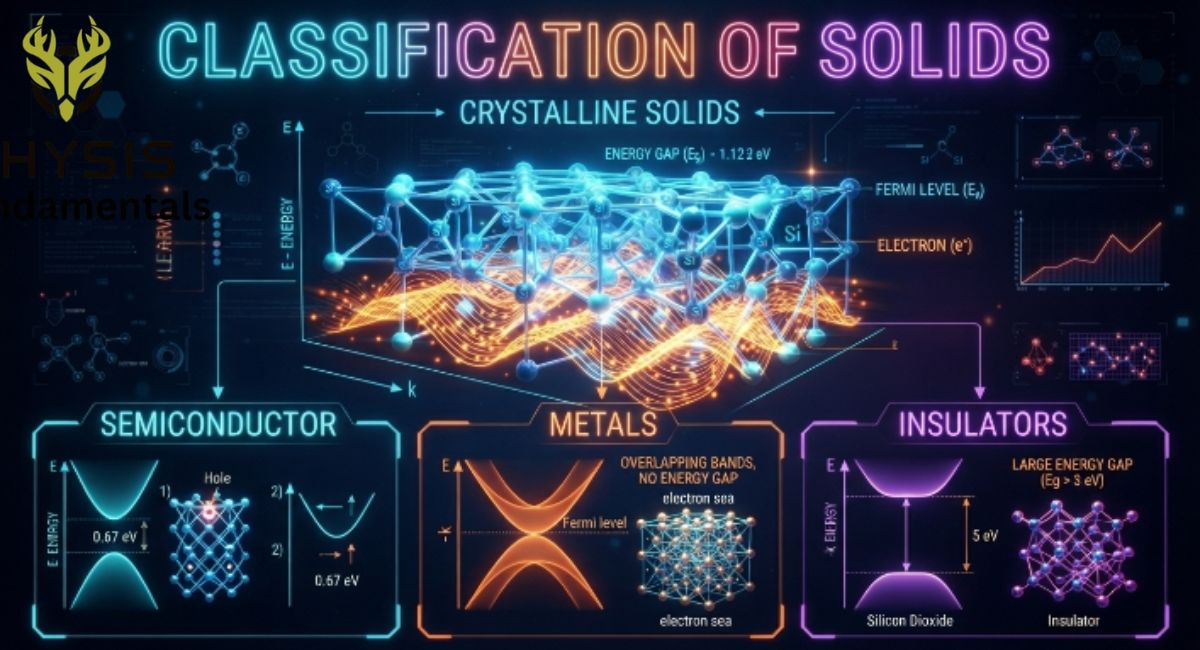
When we hear the word solid, we usually imagine something hard and fixed, such as a stone, a metal spoon, or a piece of wood. But in solid state physics, not all solids are organized in the same way. Their atoms, ions, or molecules can be arranged differently, and this microscopic arrangement strongly affects their properties. The most useful classification of solids is based on how their particles are arranged. According to this classification, solids are mainly divided into crystalline solids and amorphous solids.
-
Crystalline Solids.
A crystalline solid is a solid in which atoms, ions, or molecules are arranged in a regular and repeating pattern over a long distance. Think of a neatly tiled floor. Each tile follows the same pattern, and the arrangement continues from one side to the other. Atoms in a crystal can behave similarly, forming an organized three-dimensional structure called a crystal lattice.
Examples include table salt, diamond, quartz, copper, aluminum, and many other metals and minerals.
Crystalline solids generally have a definite melting point because their particles are arranged in an organized structure. They can also show anisotropy, meaning some physical properties may have different values in different directions.
Examples of Crystalline Solids.
Crystalline solids can be further classified according to the type of bonding that holds their particles together.
-
Ionic Solids.
In ionic solids, positively and negatively charged ions are held together by strong electrostatic attraction. A familiar example is sodium chloride (NaCl). Sodium ions and chloride ions arrange themselves in a regular crystal structure. Ionic solids are generally hard and brittle. They usually do not conduct electricity in their solid state because their ions cannot move freely, but they can conduct electricity when melted or dissolved in water.
Covalent or Network Solids.
In covalent solids, atoms are connected through strong covalent bonds that extend throughout a large structure. Diamond is a famous example. Each carbon atom is strongly bonded to neighboring carbon atoms, producing an extremely rigid structure.
This strong bonding explains why diamonds are very hard.
Metallic Solids.
Metallic solids consist of metal atoms arranged in an organized structure. Their outer electrons can move relatively freely throughout the material. This helps explain why metals such as copper, aluminum, silver, and iron are good electrical and thermal conductors.
Their mobile electrons also contribute to properties such as metallic luster and electrical conductivity.
Molecular Solids.
In molecular solids, molecules are held together by relatively weaker intermolecular forces.
Examples include ice, solid carbon dioxide, and iodine.
Because the forces between molecules are generally weaker than the strong bonds found in ionic or covalent network solids, many molecular solids have relatively low melting points.
Amorphous Solids.
An amorphous solid does not have a long-range, repeating arrangement of particles like a crystalline solid.
Imagine a box filled with marbles. Instead of carefully arranging every marble into perfect rows, you simply pour them into the box. The particles are still close together, but there is no large-scale repeating pattern. This gives you a useful mental picture of an amorphous structure.
Common examples include glass, rubber, plastics, and many types of polymers.
Amorphous solids generally do not have one sharp melting point. Instead, they can soften gradually over a range of temperatures.
For example, glass may look perfectly solid and rigid at room temperature, but when heated sufficiently, it gradually becomes softer rather than suddenly changing from solid to liquid at one precise temperature.
Polymeric Solids.
Polymeric solids are solid materials made from very long molecules called polymers. The word polymer comes from two ideas: “poly” means many and “mer” means unit. In simple terms, a polymer is like a very long chain made by joining many small repeating molecules together.
A useful way to imagine a polymer is to think of a long necklace made from hundreds or thousands of small beads. Each bead represents a repeating molecular unit, while the complete necklace represents the polymer chain. In a real polymer, these chains can become tangled, folded, stretched, or arranged partly in an ordered manner.
Examples of Polymeric Solids.
Common polymeric solids include plastic, rubber, nylon, polyethylene, polypropylene, PVC, polystyrene, and many synthetic fibers. Natural materials such as cellulose, natural rubber, and proteins are also polymeric materials.
Structure of Polymeric Solids.
Unlike a simple crystal such as sodium chloride, a polymeric solid contains very long molecular chains. These chains can interact with one another through different types of forces.
Some polymers have chains that are mostly disordered, while others contain regions where the chains become more regularly arranged. Therefore, many polymeric solids are partly crystalline and partly amorphous. . Some strands may lie in roughly parallel groups, while other strands are tangled randomly. This gives a useful picture of how polymer chains can be arranged inside a real polymeric material.
The arrangement of these chains strongly affects the material’s strength, flexibility, hardness, melting behavior, and elasticity.
Polymeric Solids in Everyday Life.
You encounter polymeric solids almost everywhere. Plastic bottles, food containers, phone cases, clothing fibers, automobile parts, electrical insulation, packaging materials, and tires all rely on polymers.
Difference between Crystalline solid, Amorphous solid and Polymeric solid.
Solids can be classified according to how their particles are arranged and how those particles behave inside the material. The three useful categories are crystalline, amorphous, and polymeric solids.
| Type | Short Cut | Particle Arrangement | Simple Explanation | Main Properties | Examples |
| Crystalline Solid | Ordered | Regular and repeating | Atoms or molecules are arranged in a neat, repeating pattern, like tiles on a floor. | Long-range order, definite structure, usually sharp melting point | Salt, diamond, copper, quartz |
| Amorphous Solid | Random | Irregular arrangement | Particles are close together but do not form a regular repeating pattern, like randomly arranged stones. | No long-range order, softens gradually, often isotropic | Glass, rubber, some plastics |
| Polymeric Solid | Long Chains | Long molecular chains, often tangled or partly ordered | Made from very long molecules formed by joining many small repeating units. | Lightweight, flexible, strong, may contain crystalline and amorphous regions | Nylon, PVC, polyethylene, rubber |
What Is a Crystal Lattice?
A crystal lattice is a regular, three-dimensional arrangement of points that represents the repeating positions of particles in a crystalline solid.
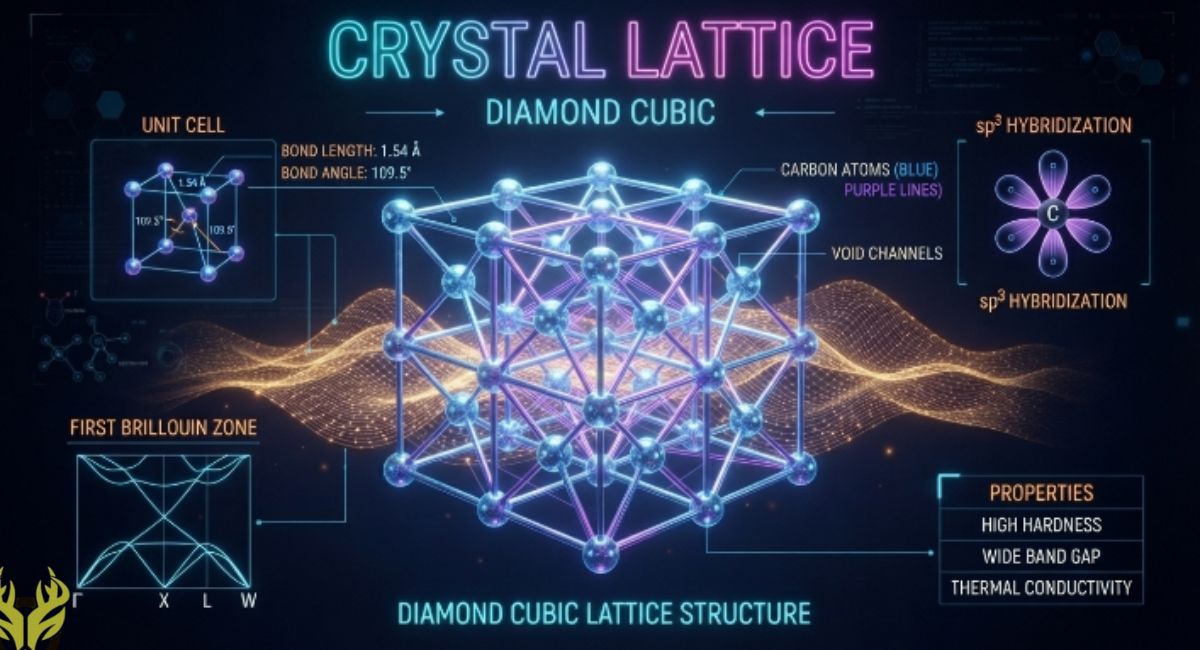
For example, in a crystal of sodium chloride, sodium ions and chloride ions are arranged in a highly organized pattern. The exact arrangement repeats throughout the crystal.
What Is a Unit Cell?
A unit cell is the smallest repeating portion of a crystal lattice that can reproduce the entire crystal structure when repeated in three dimensions.
Crystal Lattice vs. Unit Cell.
The difference becomes much easier when you think about a brick wall.
The complete arrangement of bricks represents the crystal lattice, while one repeating section of the brick pattern represents the unit cell.
| Crystal Lattice | Unit Cell |
| Describes the complete repeating arrangement | Represents the smallest repeating portion |
| Extends throughout the crystal | Can be repeated to build the crystal |
| Made of regularly arranged lattice points | Defined by its dimensions and angles |
| Gives the overall structural pattern | Acts as the basic building block |
| Example: 3D crystal arrangement | Example: cubic unit cell |
Parameters of a Unit Cell.
A unit cell is described using six parameters, known as lattice parameters. These include three lengths and three angles.
The three lengths are:
a, b, and c
The three angles are:
α, β, and γ
They describe the size and shape of the unit cell.
In a simple cubic crystal, for example, the three sides have equal lengths:
a=b=c
and the angles are all right angles:
α=β=γ=90∘
These parameters allow scientists to describe a crystal mathematically without having to draw every atom individually.
Types of Unit Cells.
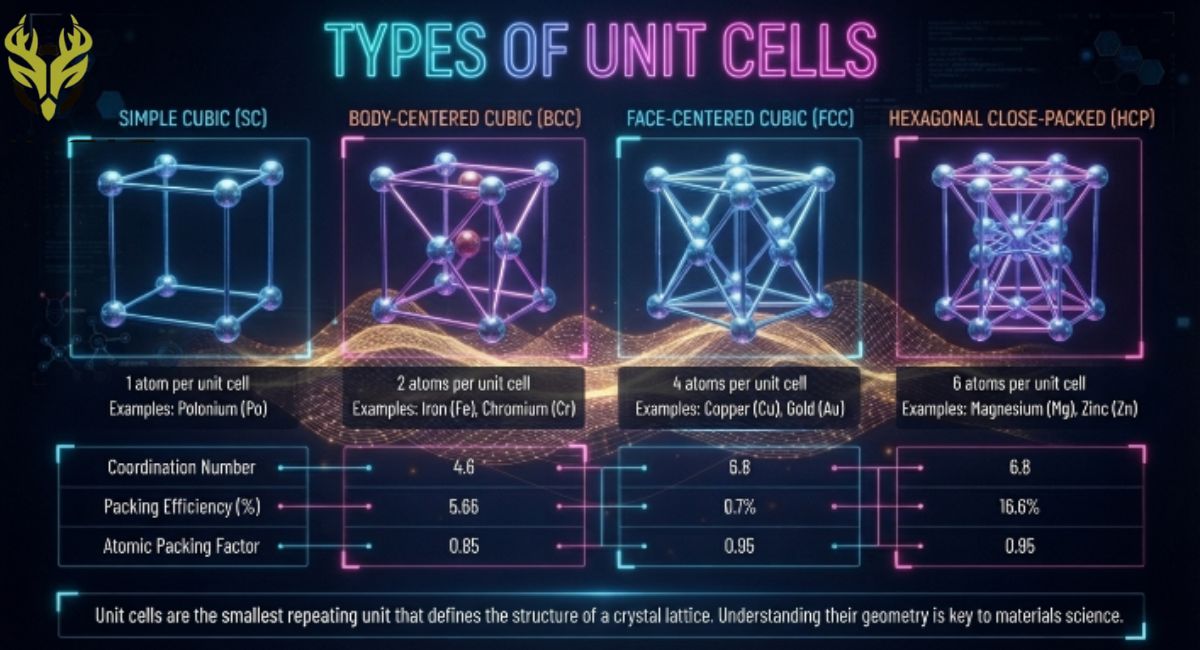
Unit cells can have different arrangements of particles. In cubic crystals, three important types are simple cubic, body-centered cubic (BCC), and face-centered cubic (FCC).
Simple Cubic Unit Cell
In a simple cubic unit cell, particles are located at the eight corners of the cube.
Although eight corners appear to contain eight particles, each corner particle is shared by eight neighboring unit cells. Therefore, each corner contributes only:
1/8
to one unit cell.
The total number of particles per simple cubic unit cell is therefore:
8×1/8=1
Body-Centered Cubic Unit Cell.
A body-centered cubic (BCC) unit cell has particles at the eight corners and one additional particle at the center of the cube.
The eight corner particles contribute one particle in total, while the body-centered particle belongs completely to the unit cell.
Therefore:
8×1/8+1=2
So a BCC unit cell contains 2 particles.
Iron and tungsten are examples of elements that can have BCC structures under appropriate conditions.
Face-Centered Cubic Unit Cell.
A face-centered cubic (FCC) unit cell has particles at the eight corners and at the center of each of its six faces.
Each corner contributes:
1/8
and each face-centered particle is shared between two unit cells, so each contributes:
1/2
Therefore:
8×1/8+6×1/2=4
An FCC unit cell contains 4 particles.
Copper, aluminum, silver, and gold are examples of metals with FCC crystal structures.
Why Are Crystal Lattice and Unit Cell Important?
The crystal lattice and unit cell are not just drawings used in textbooks. They help physicists understand why materials have different physical properties.
The arrangement of atoms influences a material’s density, strength, electrical conductivity, thermal behavior, melting behavior, and response to mechanical forces.
For example, two materials may contain atoms of similar types but have different arrangements. Their different crystal structures can lead to very different physical properties.
This is why crystal structure is one of the foundations of solid state physics and materials science.
What Are Bravais Lattices?
A Bravais lattice is a distinct three-dimensional lattice arrangement in which every lattice point has an equivalent environment.
There are 14 Bravais lattices distributed among seven crystal systems. These structures provide a systematic way to classify possible periodic crystal arrangements.
The seven crystal systems are commonly identified as cubic, tetragonal, orthorhombic, monoclinic, triclinic, hexagonal, and trigonal.
This classification may seem abstract at first, but its purpose is practical. Instead of describing every crystal independently, physicists can organize crystal structures into recognizable families.
Crystal Lattice and Unit Cell: The Simple Picture.
The easiest way to remember the relationship is:
Crystal lattice = the complete repeating pattern.
Unit cell = the small repeating block used to build that pattern.
Imagine a huge tiled floor. The entire tiled floor represents the crystal lattice, while one tile or repeating tile pattern represents the unit cell.
Once you understand this simple idea, topics such as Bravais lattices, crystal structures, Miller indices, X-ray diffraction, coordination number, and atomic packing factor become much easier to understand.
Deformation of Solids.
Imagine holding a rubber band and gently pulling it. It becomes longer. Now imagine pressing a sponge; it becomes shorter and changes shape. If you stop applying the force, the rubber band or sponge may return to its original shape. But if you bend a metal wire too far, it may stay bent. These everyday experiences are simple examples of deformation of solids.
In physics, deformation means a change in the shape, size, or volume of a solid when an external force is applied to it. Solids may look rigid, but their particles can move slightly from their original positions when a force acts on them.
What Is Deformation?
Deformation of a solid is the change produced in the dimensions or shape of a body because of an applied force.
For example, when you pull a spring, its length increases. When you compress it, its length decreases. When you bend a ruler, its shape changes.The amount of deformation depends on several factors, including the applied force, material of the solid, original dimensions, and temperature.
A simple way to understand it is:
Force changes the shape or size of a solid → this change is called deformation.
Why Do Solids Deform.
At the microscopic level, a solid is made of atoms or molecules held together by attractive forces. When no external force is applied, these particles remain around their equilibrium positions.
When you apply a force, the particles are pushed or pulled slightly away from their original positions. The bonds between neighboring particles resist this change.. If you pull the solid, these imaginary springs stretch. If you compress it, they become shorter. The material’s response to this change determines whether it behaves elastically or permanently deforms.
Types of Deformation.
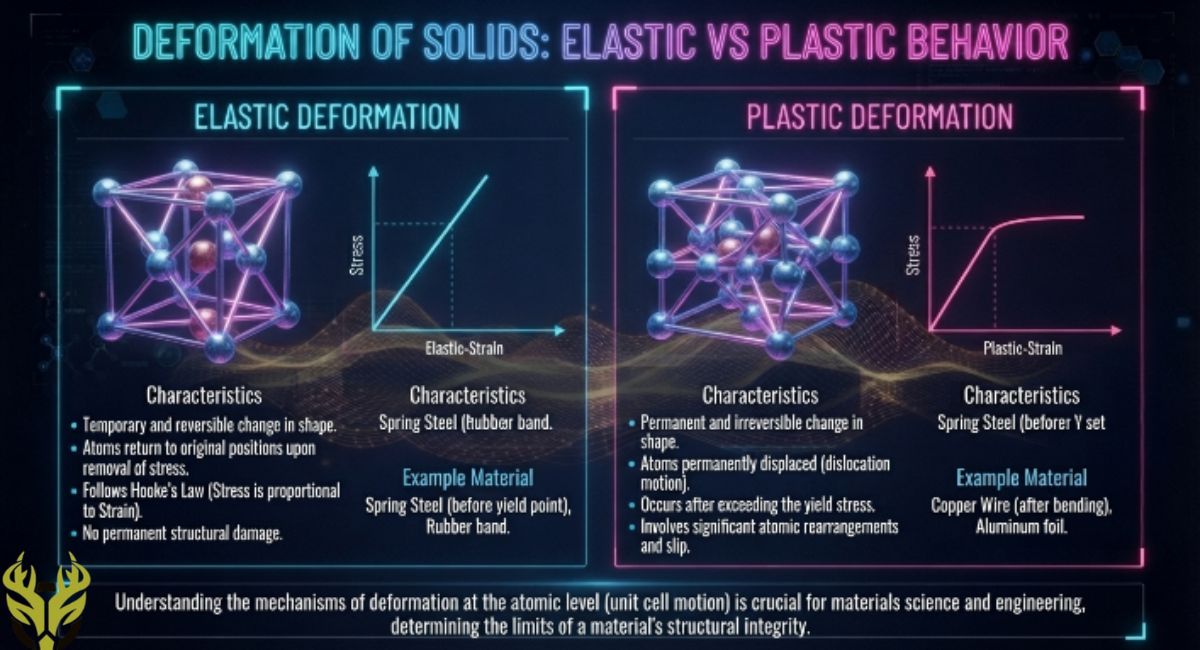
The main types of deformation are elastic deformation and plastic deformation.
Elastic Deformation.
Elastic deformation is a temporary deformation. When the external force is removed, the material returns to its original shape and size, provided the elastic limit has not been exceeded.
A stretched spring is a good example. Pull it gently, and it becomes longer. Release it, and it returns approximately to its original length.
Other examples include a slightly stretched rubber band and a metal wire stretched within its elastic limit.
Plastic Deformation.
Plastic deformation is a permanent deformation. If the applied force becomes large enough, the material does not return completely to its original shape after the force is removed.
For example, if you bend a metal paper clip slightly, it may return close to its original shape. But if you bend it strongly, it remains bent.
This happens when the applied stress exceeds the material’s elastic limit.
Elastic deformation is temporary; plastic deformation is permanent.
Types of Deformation According to Applied Force.
Deformation can also be classified according to the way the force acts on the solid.
| Type | What happens? | Simple example |
| Tensile deformation | Object is stretched | Pulling a wire |
| Compressive deformation | Object is squeezed | Compressing a spring |
| Shear deformation | Layers slide relative to each other | Pushing the top of a book sideways |
| Bulk deformation | Volume changes | Compressing a material from all sides |
| Bending deformation | Object curves or bends | Bending a ruler |
| Torsional deformation | Object twists | Twisting a shaft |
Tensile Deformation.
When forces pull a solid away from each other, the solid experiences tension and may become longer.
For example, imagine pulling both ends of a metal wire. The wire experiences tensile deformation.
L = L – L0
where L0 is the original length and
L is the final length.
Compressive Deformation.
When forces push toward each other, the solid experiences compression.
A spring being squeezed is an easy example. Its length decreases when compressive force is applied.
Shear Deformation.
Shear deformation occurs when a force acts parallel to a surface, causing different layers of the material to move sideways relative to one another. Imagine pushing the top of a stack of books while keeping the bottom book fixed. The stack becomes slanted. This is a simple model of shear deformation.
Bulk Deformation.
Bulk deformation occurs when forces act on a solid from several directions and change its volume.
For example, a material placed under very high pressure from all directions can become slightly smaller in volume.
Torsional Deformation.
Torsional deformation occurs when a solid is twisted by an applied torque.
A metal shaft in a motor is a practical example. When torque is applied, the shaft twists slightly.
Stress and Deformation.
To describe deformation quantitatively, physicists use stress and strain.
What Is Stress?
Stress describes the applied force per unit area.
σ = F / A
σ = stress
F = applied force
A = cross-sectional area
1 Pa = 1 N/m2
Stress tells us how strongly a material is being loaded.
What Is Strain?
Strain describes the relative amount of deformation produced in a material.
For tensile or compressive deformation:
ε = ΔL⁄L0
where ΔL is the change in length and L0 is the original length.
Strain has no unit because it is a ratio of two lengths.
Hooke’s Law.
For many materials, when the deformation is small, stress is directly proportional to strain.
This relationship is expressed by Hooke’s law:
σ ∝ ε
σ = Eε
where E is called Young’s modulus.
Therefore,
E = σ⁄ε
Young’s modulus measures how strongly a material resists stretching or compression. A material with a large Young’s modulus is difficult to deform. A material with a small Young’s modulus deforms more easily.
For example, steel has a much larger Young’s modulus than rubber, so steel is much harder to stretch by the same amount of stress.
Elastic Limit.
The elastic limit is the maximum stress or deformation that a material can experience while still returning to its original shape when the force is removed.
- If you stay below this limit, the deformation is mainly elastic.
- If you go beyond it, permanent deformation may begin.
This is why you should not assume that every stretched object will return to its original shape. A material can only recover its original shape within a certain range.
Yield Point.
When a material is stretched beyond a certain point, it may begin to undergo significant plastic deformation. The point at which noticeable permanent deformation begins is associated with the yield point or yield strength.
After yielding, removing the force does not bring the material completely back to its original dimensions.
This is particularly important when designing bridges, buildings, aircraft components, machine parts, and other structures.
Ultimate Tensile Strength.
If a material is continuously stretched, the stress may eventually reach a maximum value known as the ultimate tensile strength. It represents the maximum tensile stress the material can withstand before significant failure develops.
After this stage, the material may become weaker locally and eventually break.
Fracture.
If the applied load continues to increase, a material may eventually fracture, meaning it breaks into separate pieces.
The behavior before fracture depends strongly on the material.
- A ductile material, such as many metals, can undergo considerable plastic deformation before breaking.
- A brittle material, such as glass, can fracture with relatively little plastic deformation.
Stress-Strain Curve.
The relationship between stress and strain is commonly shown using a stress-strain curve.
For a typical ductile material, the curve can be understood in stages:
Elastic region → Yield point → Plastic region → Ultimate strength → Fracture
- In the elastic region, the material returns to its original shape when the load is removed.
- At the yield point, permanent deformation begins.
- In the plastic region, the material remains permanently deformed after the load is removed.
The material eventually reaches its ultimate tensile strength, and continued deformation can lead to fracture.
Deformation in Everyday Life.
Deformation happens around you more often than you might realize. A rubber band stretches, a spring compresses, a metal spoon bends, a car tire changes shape under load, and a bridge experiences slight deformation when vehicles pass over it.
Engineers carefully study these changes because even a small deformation can become important in large structures. A bridge does not need to remain perfectly motionless to be safe. It is designed to deform by small, predictable amounts while remaining within safe limits.
Conclusion
Solid state physics turns ordinary objects — a spoon, a phone screen, a rubber band — into windows onto atomic behavior. By studying crystal lattices, unit cells, and how electrons arrange themselves, this field explains why copper conducts and glass doesn’t.The same framework explains deformation: why a spring snaps back but a bent paperclip stays bent. Whether a material is crystalline, amorphous, or polymeric, its microscopic structure decides its real-world behavior — from your car tire to the bridge you drive over.
FAQs
Q. What is solid state physics?
Solid state physics is the branch of physics that studies how atoms, electrons, and other particles behave inside solid materials, connecting microscopic structure to properties like conductivity, hardness, and elasticity.
Q. What is the difference between crystalline and amorphous solids?
Crystalline solids have a regular, repeating atomic arrangement and a definite melting point, while amorphous solids lack long-range order and soften gradually instead of melting sharply. Glass and rubber are common amorphous examples.
Q. What is a unit cell in solid state physics?
A unit cell is the smallest repeating block of a crystal lattice. Repeating it in three dimensions reconstructs the entire crystal structure, whether simple cubic, body-centered cubic, or face-centered cubic.
Q. What’s the difference between elastic and plastic deformation?
Elastic deformation is temporary — the material returns to its original shape once the force is removed. Plastic deformation is permanent, occurring when stress exceeds the material’s elastic limit.
Q. Why do metals conduct electricity better than insulators?
In metals, outer electrons move freely through the structure, a property tied directly to energy band behavior in solid state physics. Insulators lack this free electron movement, so current can’t flow easily.
Q. What are Bravais lattices?
Bravais lattices are the 14 distinct three-dimensional lattice arrangements, grouped into seven crystal systems, that classify every possible periodic crystal structure in solid state physics.